A mysterious glow at the center of the Milky Way may hold a long-awaited clue in the hunt for dark matter. By digging into gamma-ray data from NASA’s Fermi Gamma-ray Space Telescope, Professor Tomonori Totani from the University of Tokyo spotted an emission pattern that lines up with what physicists would expect from the annihilation of weakly interacting massive particles, or WIMPs. These elusive particles have long topped the list of dark matter candidates, and this signal, detailed in the Journal of Cosmology and Astroparticle Physics, could be one of the clearest hints yet of their existence .
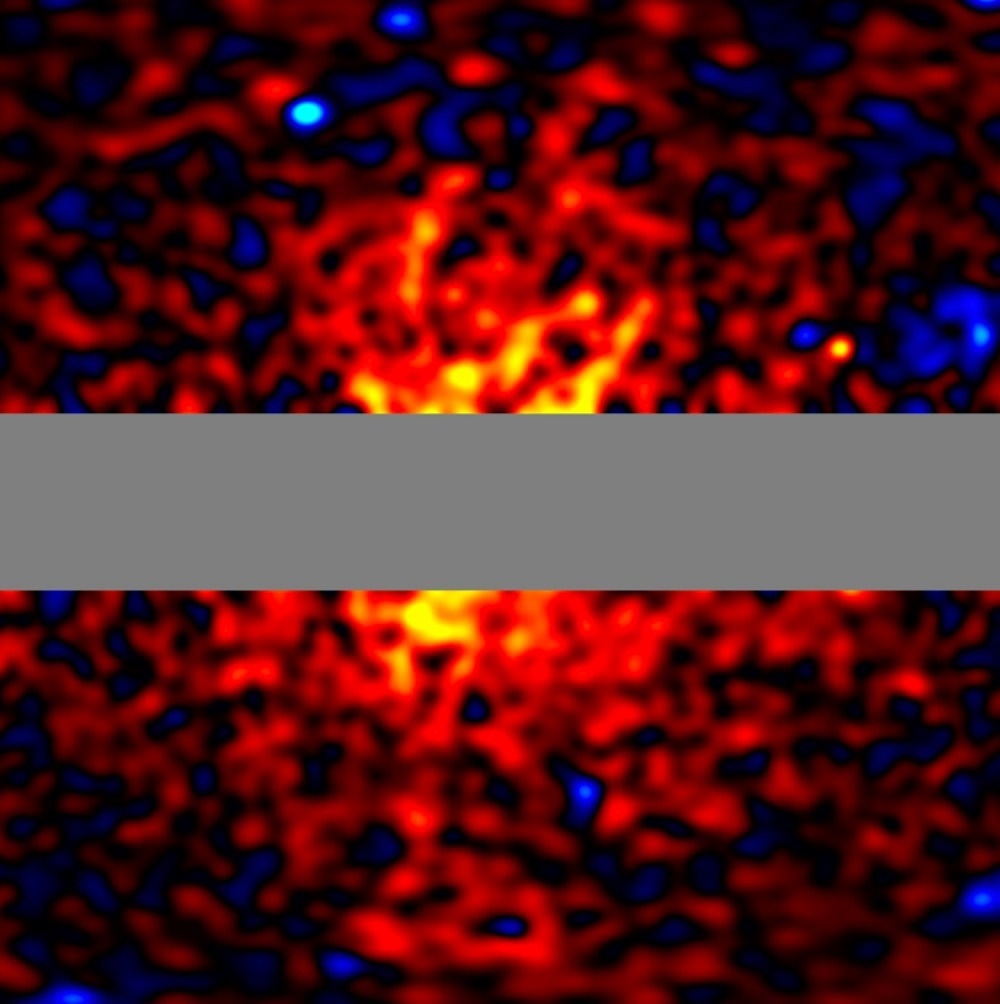 Gamma-ray image of the Milky Way halo. Gamma-ray intensity map excluding components other than the halo, spanning approximately 100 degrees in the direction of the Galactic center. The horizontal gray bar in the central region corresponds to the Galactic plane area, which was excluded from the analysis to avoid strong astrophysical radiation. Image Credit: Tomonori Totani, The University of Tokyo
In the 1930s, astronomer Fritz Zwicky noted that galaxies moved at speeds inconsistent with their visible mass. He proposed the existence of dark matter, an unseen substance providing the necessary gravitational force to bind them. Almost a century later, NASA's Fermi Gamma-ray Space Telescope potentially offered direct evidence of dark matter, enabling its initial visualization.
Since its initial proposal, dark matter has remained mysterious. Previously, scientists could only indirectly detect dark matter via its gravitational effects on visible matter, such as maintaining galactic cohesion. Direct observation has been impossible because dark matter particles do not interact with the electromagnetic force; they neither absorb, reflect, nor emit light.
Many researchers theorize that dark matter consists of weakly interacting massive particles (WIMPs). These WIMPs are heavier than protons and interact minimally with matter. Theoretical models predict that WIMP collisions result in annihilation, releasing particles such as gamma-ray photons.
Astronomical observations have long targeted dark matter-dense regions, like the Milky Way's center, searching for these gamma rays.
We detected gamma rays with a photon energy of 20 gigaelectronvolts (or 20 billion electronvolts, an extremely large amount of energy) extending in a halolike structure toward the center of the Milky Way galaxy. The gamma-ray emission component closely matches the shape expected from the dark matter halo.
Tomonori Totani, Professor, Department of Astronomy, University of Tokyo
The detected gamma-ray energy spectrum aligns with the predicted emission resulting from the annihilation of WIMPs, possessing a mass around 500 times the proton mass. Furthermore, the estimated WIMP annihilation rate, derived from the observed gamma-ray intensity, is consistent with theoretical expectations.
Totani suggests that these specific gamma-ray observations are unlikely to be the result of typical astronomical occurrences or gamma-ray production mechanisms. Consequently, Totani interprets this data as compelling evidence for gamma-ray emission originating from dark matter, a long-standing objective in the field.
If this is correct, to the extent of my knowledge, it would mark the first time humanity has ‘seen’ dark matter. And it turns out that dark matter is a new particle not included in the current standard model of particle physics. This signifies a major development in astronomy and physics.
Tomonori Totani, Professor, Department of Astronomy, University of Tokyo
Totani believes his gamma-ray measurements identify dark matter particles, but independent verification by other researchers is necessary. Even if confirmed, further evidence will be required to prove the halolike radiation arises from dark matter annihilation, not other astronomical phenomena.
Supporting evidence would come from detecting WIMP collisions in other high dark matter concentration locations. For instance, observing the same energy gamma-ray emissions from dwarf galaxies within the Milky Way halo would strengthen Totani’s analysis.
This may be achieved once more data is accumulated, and if so, it would provide even stronger evidence that the gamma rays originate from dark matter.
Tomonori Totani, Professor, Department of Astronomy, University of Tokyo
Journal Reference:
Totani, T. (2025). 20 GeV halo-like excess of the Galactic diffuse emission and implications for dark matter annihilation. Journal of Cosmology and Astroparticle Physics. DOI:10.1088/1475-7516/2025/11/080. https://iopscience.iop.org/article/10.1088/1475-7516/2025/11/080.