In the pursuit of powerful and stable quantum computers, researchers at Chalmers University of Technology, Sweden, have developed the theory for an entirely new quantum system – based on the novel concept of ‘giant superatoms’. This breakthrough enables quantum information to be protected, controlled, and distributed in new ways and could be a key step towards building quantum computers at scale.
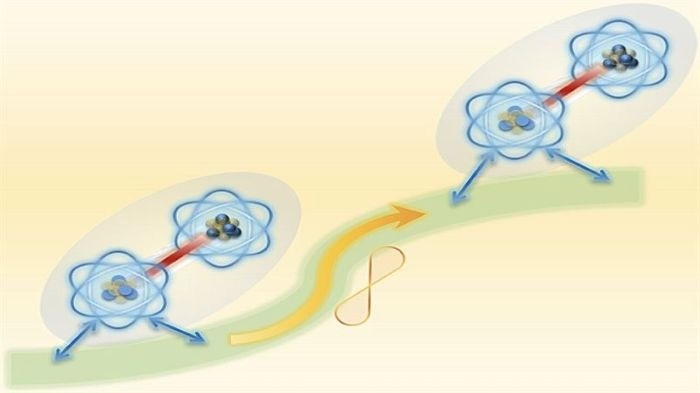 Researchers at Chalmers have developed a theoretical model which they can use to program and control directional transfer of an entangled quantum state between two distant artificial ‘giant superatoms’. Each of these comprises two atoms that share a common quantum state. The atoms have multiple, spatially separated coupling points to a light or sound wave and can thus interact with their surroundings at several locations simultaneously. Image Credit: Lei Du, Chalmers University of Technology
It is anticipated that quantum computers will revolutionize technologies in areas such as drug development and encryption by tackling problems far beyond the capabilities of today’s computers. However, the practical realization of quantum computers has been slowed by a fundamental challenge known as decoherence – the tendency of quantum bits, or qubits, to lose information when interacting with their environment. Even tiny disturbances from electromagnetic noise can destroy the delicate quantum effects required for reliable computation.
“Quantum systems are extraordinarily powerful but also extremely fragile. The key to making them useful is learning how to control their interaction with the surrounding environment,” says Lei Du, postdoctoral researcher in applied quantum technology at Chalmers.
Lei Du is the lead author of a scientific paper presenting the theoretical model of an entirely new quantum system developed by a Chalmers research team. Their system is based on the novel concept of giant superatoms and brings together several key properties. It suppresses decoherence and is stable, whilst simultaneously comprising multiple, tightly interconnected “atoms” that act collectively.
Giant superatoms combine two different quantum-mechanical constructs: giant atoms and superatoms. These have been explored separately in recent years but have not previously been combined. They behave like atoms but are not natural atoms. Rather, they are artificial structures that physicists have learned to engineer (see fact box below).
Giant Atoms with a Quantum Echo
The concept of giant atoms was coined by researchers at Chalmers just over a decade ago and has since become a standard term in the field. A giant atom is most often designed as a qubit (which is the smallest unit of quantum information). The atom has multiple, spatially separated coupling points to a light or sound wave, allowing it to interact with its surroundings at several locations simultaneously. This enables the giant atom to protect quantum information.
“Waves that leave one connection point can travel through the environment and return to affect the atom at another point – similar to hearing an echo of your own voice before you’ve finished speaking. This self-interaction leads to highly beneficial quantum effects, reduces decoherence and gives the system a form of memory of past interactions,” explains Anton Frisk Kockum, Associate Professor of Applied Quantum Physics at Chalmers and co-author of the study.
Enabling Entanglement to be Distributed Over Long Distances
While giant atoms have already advanced our understanding of quantum physics, their ability to exploit another key quantum phenomenon – entanglement – has so far been limited. Entanglement allows multiple qubits to share a single quantum state and operate as a single, unified system. This is a prerequisite for building powerful, large-scale quantum computers.
The researchers have addressed this problem by combining giant atoms with the superatom concept. A superatom is a structure comprising several natural atoms that share a common quantum state and behave collectively as a single, larger atom.
It is anticipated that this combination will now make it easier to create the advanced quantum states that are crucial for future quantum communication, quantum networks and highly sensitive sensors.
“A giant superatom may be envisaged as multiple giant atoms working together as a single entity, exhibiting a non-local interaction between light and matter. This enables quantum information from multiple qubits to be stored and controlled within one unit, without the need for increasingly complex surrounding circuitry,” explains Lei Du.
“Giant superatoms open the door to entirely new capabilities, giving us a powerful new toolbox. They allow us to control quantum information and create entanglement in ways that were previously extremely difficult, or even impossible,” says Janine Splettstoesser, Professor of Applied Quantum Physics at Chalmers and co-author of the study.
A Key Step Toward Scalable Quantum Computers
The results open up new opportunities to build scalable and reliable quantum systems, with the researchers now planning to move from theory to fabrication of the quantum system. Their concept could also be combined with other types of quantum systems; as a building block for connecting multiple systems, for example.
“There is currently strong interest in hybrid approaches, in which different quantum systems work together, because each has its own strengths,” says Anton Frisk Kockum. “Our research shows that smart design can reduce the need for increasingly complex hardware and giant superatoms are bringing us one step closer to practically applicable quantum technology.”