A recent study led by the Center for Astrobiology (CAB) and CSIC-INTA, using modeling developed at the University of Oxford, reports a high abundance of small organic molecules in the heavily obscured nucleus of a nearby galaxy, based on observations from the James Webb Space Telescope (JWST). The work was published in Nature Astronomy and examines how complex organic material and carbon may be processed in extreme, dust-enshrouded galactic environments.
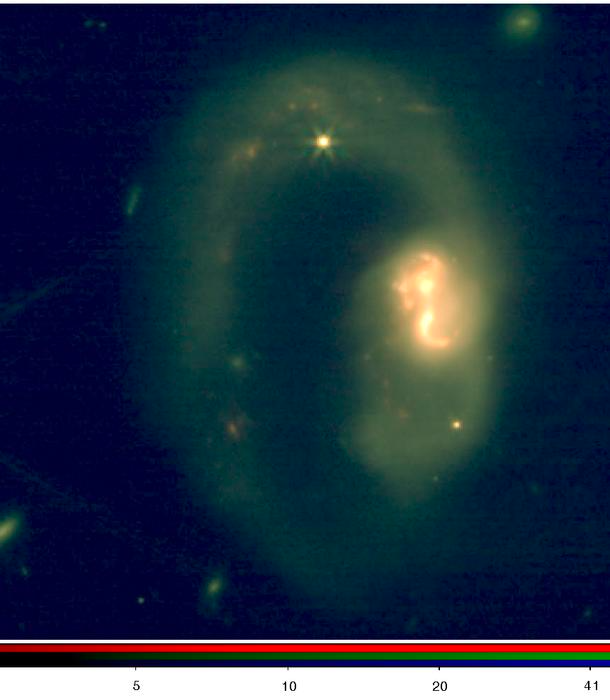 JWST/NIRCam false-color image of IRAS 07251–0248 (filters: 2.0 μm, 2.77 μm, 3.56 μm). Data: JWST GO 3368 (P.I. L. Armus), via MAST/STScI.
. Image Credit: Data came from Mikulski Archive for Space Telescopes, Space Telescope Science Institute, Association of Universities for Research in Astronomy, Inc., NASA.
The research focuses on IRAS 07251–0248, an ultra-luminous infrared galaxy whose nucleus is hidden by large amounts of gas and dust. This material absorbs much of the radiation from the central supermassive black hole, making the region difficult to study at optical wavelengths. Infrared observations can penetrate the dust and provide access to the chemistry in the buried nucleus.
State-of-the-Art Instruments
The team used JWST spectroscopy across 3–28 μm, combining data from NIRSpec and MIRI. These measurements allow the identification of gas-phase molecular signatures as well as features associated with ices and dust grains. Using these data, the researchers estimated the abundance and temperature of multiple chemical species in the nucleus.
The spectra show a diverse set of small organic molecules, including benzene (C6H6), methane (CH4), acetylene (C2H2), diacetylene (C4H2), and triacetylene (C6H2), as well as the methyl radical (CH3), reported here as a first detection beyond the Milky Way. The study also reports solid-phase material, including carbonaceous grains and water ice.
We found an unexpected chemical complexity, with abundances far higher than predicted by current theoretical models. This indicates that there must be a continuous source of carbon in these galactic nuclei fuelling this rich chemical network.
Dr. Ismael García Bernete, Study Lead Author and Researcher, Oxford University
García Bernete is now a researcher at CAB.
These molecules may serve as essential building blocks for intricate organic chemistry, which is significant for processes pertinent to life.
Although small organic molecules are not found in living cells, they could play a vital role in prebiotic chemistry, representing an important step towards the formation of amino acids and nucleotides.
Dimitra Rigopoulou, Study Co-Author and Professor, Department of Physics, University of Oxford
Factories of Organic Molecules in the Universe
Using PAH models developed by the Oxford group, the authors argue that the observed chemistry is not explained by high temperatures or turbulent gas motions alone. Instead, they suggest that cosmic rays in these environments can fragment PAHs and carbon-rich dust grains, releasing small organic molecules into the gas phase. The paper reports a correlation between hydrocarbon abundance and cosmic-ray ionization in similar galaxies, which the authors present as support for this interpretation.
Overall, the results suggest that heavily obscured galactic nuclei could be important sites for producing small organic molecules and for processing carbon-bearing dust.
Sources:
Journal Reference:
García-Bernete, I., et al. (2026) Abundant hydrocarbons in a buried galactic nucleus with signs of carbonaceous grain and polycyclic aromatic hydrocarbon processing. Nature Astronomy. DOI: 10.1038/s41550-025-02750-0. https://www.nature.com/articles/s41550-025-02750-0
University of Oxford