Stanford physicists have engineered a sophisticated optical cavity capable of harvesting single photons from individual atoms. These atoms act as 'qubits', the quantum counterpart to classical binary bits. For the first time, this architecture enables the simultaneous processing of all qubits within the system, a critical milestone for scalable quantum computing. The study was published in Nature.
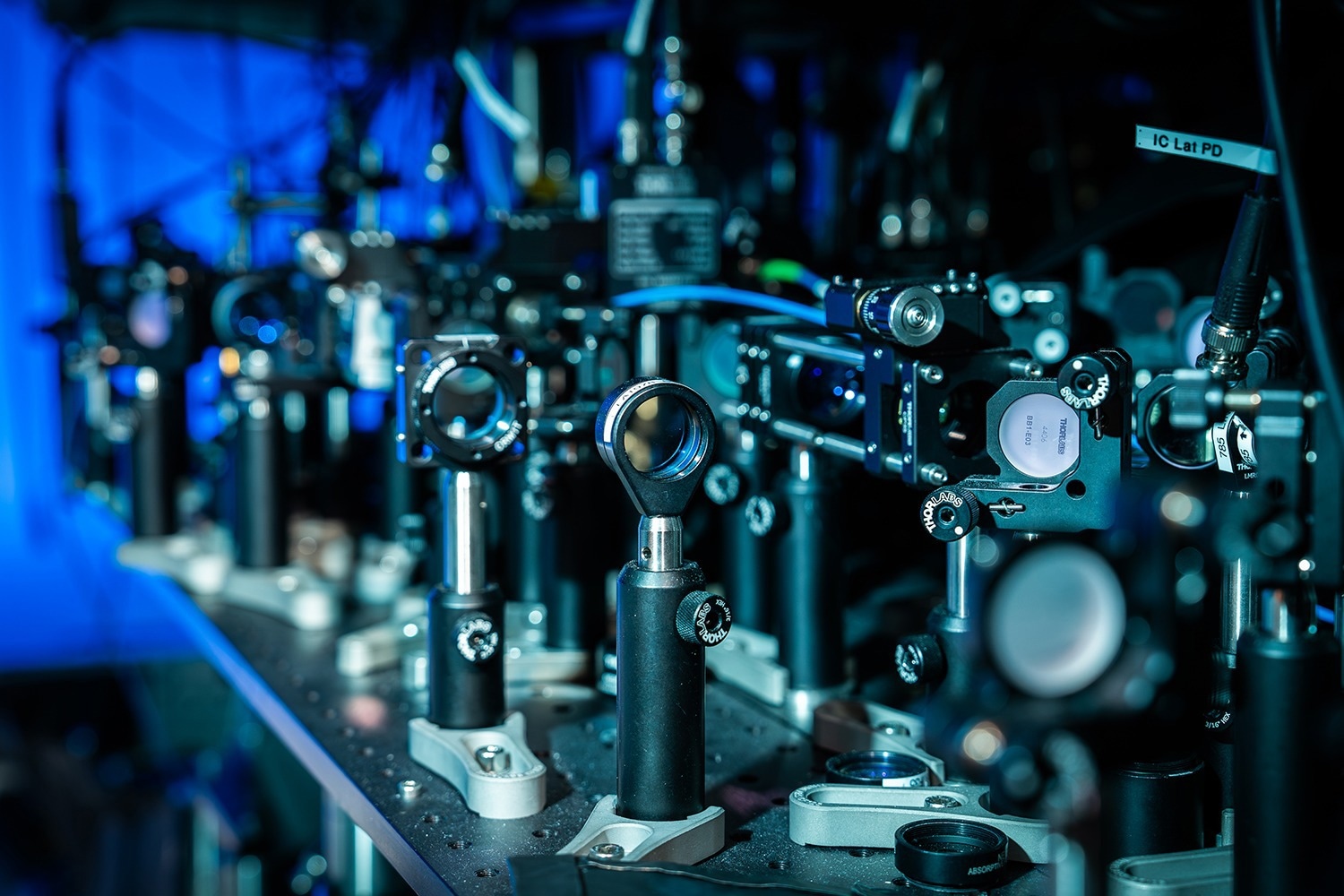 Various optics, including lenses and mirrors, as well as other test equipment which are used for directing and measuring the light collected from atoms in the cavity array microscope. Image Credit: LiPo Ching for Stanford University
A breakthrough in the long-running effort to develop quantum computers offers new hope: researchers are now closer to machines that could slash the time needed for certain complex calculations, from thousands of years down to just a few hours.
The researchers describe an array of 40 cavities, each containing a single atom qubit, as well as a prototype with more than 500 cavities. Their findings point toward a potential path for building a scalable network of quantum computers with millions of qubits.
If we want to make a quantum computer, we need to be able to read information out of the quantum bits very quickly. Until now, there has not been a practical way to do that at scale because atoms just don’t emit light fast enough, and on top of that, they spew it out in all directions. An optical cavity can efficiently guide emitted light toward a particular direction, and now we’ve found a way to equip each atom in a quantum computer within its own individual cavity.
Jon Simon, Study Senior Author and the Joan Reinhart Professor, School of Humanities and Sciences, Stanford University
An optical cavity is created when two or more reflective surfaces cause light to bounce back and forth repeatedly, much like someone standing between a series of funhouse mirrors, seeing endless reflections stretching into the distance. Unlike those mirrors, however, these cavities are much smaller and use repeated reflections of a laser beam to gather more detailed visual information from atoms.
For decades, researchers have been conducting experiments with optical cavities, aiming to achieve sufficient light reflections to interact with the minuscule, almost transparent atoms.
The research team, under the direction of Simon's lab, adopted an alternative method by incorporating microlenses within each cavity to concentrate the light more precisely on an individual atom. This results in a reduced number of light bounces while still proving to be more efficient in extracting quantum information from the atom.
We have developed a new type of cavity architecture; it’s not just two mirrors anymore. We hope this will enable us to build dramatically faster, distributed quantum computers that can talk to each other with much faster data rates.
Adam Shaw, Study First Author, Postdoctoral Scholar and Science Fellow, Stanford University
Beyond the Binary
In contrast to traditional computers that use a sequence of zeros and ones to signify bits of information, quantum computers depend on the quantum states of minute particles. These qubits can exist as zero, one, or a superposition of both simultaneously. This characteristic enables a quantum computer to perform specific, intricate calculations significantly faster than the conventional binary framework.
“A classical computer has to churn through possibilities one by one, looking for the correct answer. But a quantum computer acts like noise-canceling headphones that compare combinations of answers, amplifying the right ones while muffling the wrong ones,” said Simon.
The researchers project that a quantum computer will need millions of qubits to surpass classical supercomputers. Achieving this quantity will likely require the interconnection of multiple quantum computers, according to Simon. The progress made in this study, which utilizes cavities to establish a parallel interface, creates a highly effective platform for scaling to these extensive sizes.
The team showcased a 40-cavity array containing atoms, along with a proof-of-concept array exceeding 500, with aspirations toward tens of thousands. Looking forward, they envision quantum data centers where each quantum computer is equipped with a network interface made up of a cavity array, facilitating large-scale integration into quantum supercomputers.
Accomplishing this objective will involve addressing significant engineering challenges; however, the researchers assert that the potential exists, along with the vast possibilities of quantum computing. This could lead to significant breakthroughs in materials design and chemical synthesis, including applications in drug discovery, as well as advancements in code breaking.
More generally, the light-collection capabilities of the cavity arrays present considerable promise for biosensing and microscopy, which could propel medical and biological research forward. Quantum networks might even enhance our understanding of space by enabling optical telescopes with improved resolution, allowing for direct observation of exoplanets.
As we understand more about how to manipulate light at a single particle level, I think it will transform our ability to see the world.
Adam Shaw, Study First Author, Postdoctoral Scholar and Science Fellow, Stanford University
This study was funded by the National Science Foundation, the Air Force Office of Scientific Research, the Army Research Office, the Hertz Foundation, and the U.S. Department of Defense.
Sources:
Journal Reference:
Simon, J., et al. (2026) A cavity-array microscope for parallel single-atom interfacing. Nature. DOI: 10.1038/s41586-025-10035-9. https://www.nature.com/articles/s41586-025-10035-9.
Stanford University