Increasingly, the mid-infrared (MIR) spectrum is becoming recognized as one of the most valuable spectral windows for sensing applications.
This recognition stems from its selectivity, specificity, and ability to deliver high-precision, high-resolution data suitable for qualitative and quantitative analysis.
This increase in the use and importance of MIR-based gas sensing technologies spans most industries, from healthcare to energy. These technologies enable the accurate identification and quantification of gases that exhibit strong, distinct absorption features, known as a molecular ‘fingerprint’, in this region. Some examples include carbon dioxide (CO2), methane (CH4), and hydrogen sulfide (H2S).
These capabilities are proving ever more essential as industries are required to respond to increasingly stringent environmental regulations, safety requirements, and sustainability goals.
Quantum cascade lasers (QCLs) designed especially for the MIR range are attracting significant interest due to their wavelength selectivity, narrow emission bands, and capacity to reduce interference from complex gas mixtures.
These features make QCLs particularly valuable for gas sensing and environmental monitoring. This article examines QCLs, evaluating the advantages, challenges, and potential applications of the technology.1
Advantages of the MIR Range
Many gases that require industrial monitoring absorb light most strongly at approximately 2.5 to 25 μm, which is the MIR region. This absorption is linked to the fundamental vibrational modes of chemical bonds, producing spectral features that are unique, sharp, and easily distinguishable from one another.
For instance, CH4 demonstrates strong absorption at 3.3 μm, while CO2 shows strong absorption at approximately 4.2 μm. Nitrogen oxides are regulated in maritime and industrial emissions, and these also fall in the UV to MIR range. Highly toxic H2S can also be detected in the MIR region via a QCL device, although this can be technically challenging to monitor.
The benefits of the MIR range outweigh those of near-infrared (NIR) technologies, which are widely used in more mature telecoms-derived devices.1 NIR technologies suffer from weaker absorption and overlapping bands, so it is often more difficult to distinguish between species with this characterization technique.
NIR detectors tend to be more sensitive overall, but MIR offers greater specificity and cleaner separation of gas signatures, even when used in complex environments. MIR sensing, especially with QCLs, represents a major step forward in gas monitoring due to its high selectivity and its capacity to reduce interference from other gases, even in challenging environments.
The Rise of Quantum Cascade Lasers
QCLs were initially developed in the 1990s, and this was a significant advance in MIR light sources.2 Standard semiconductor lasers use interband transitions, but QCLs leverage intersubband (intraband) transitions in specifically engineered quantum well stacks.
This design gives QCLs exceptional flexibility, and allows their emission wavelength to be engineered across the majority of the MIR spectrum via layer thickness adjustments.
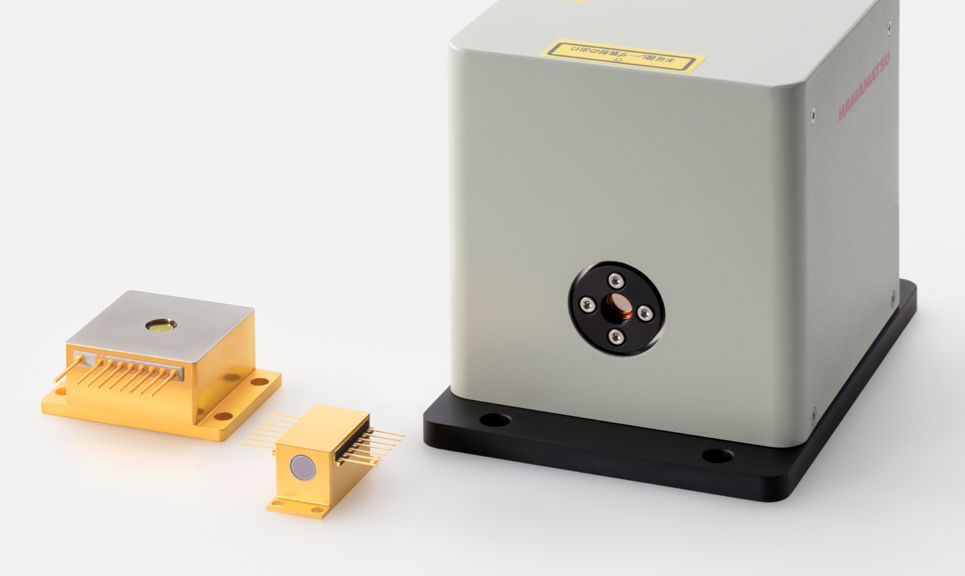
Hamamatsu's Quantum cascade lasers (QCL). Image Credit: Hamamatsu Photonics Europe
QCLs offer a wide range of advantages, including:
- Narrow linewidths and tunability suitable for the precise targeting of specific gas absorption peaks.
- High spectral brightness with sensitivity down to ppm or even ppb.
- A compact, chip-scale design, though current power and cooling requirements mean that QCLs are generally employed in analytical, laboratory, and process control systems as opposed to in fully portable devices.
QCLs saw initial use in the defense and security sectors, later expanding to include applications in climate strategy, process control, healthcare, and industrial monitoring.1,3,4
Challenges and Barriers to Adoption
Despite their success, some challenges must still be overcome in QCLs.5,6
Complex, Expensive Manufacturing
The relatively low production yields of QCLs leads to high unit prices versus alternative emitters. Unit prices are expected to lower as demand grows and volumes increase.
Low Wall-Plug Efficiency
Much of QCLs’ input energy becomes heat, with thermoelectric cooling and stable power supplies typically required. This results in increases in both unit size and unit cost.
Integration Complexity
Careful engineering and training are necessary to operate QCLs properly. Precise control electronics are also required due to the potential for small temperature shifts to alter the emission wavelength.
Limited Portability
QCLs are less suited to handheld or battery-powered devices due to their cooling and power needs. LEDs and simpler emitters dominate in this area.
Competing Technologies
Simpler, less expensive light sources, such as tungsten lamps or blackbody emitters, are less precise but easier to integrate, and are often chosen over QCLs.
Adoption Hurdles
Despite their considerable technical advantages, uptake of QCLs is slower in some sectors due to the need for durability, cost sensitivity, and the lack of mass-production economies of scale.
Common Applications of QCLs
QCLs are experiencing increasingly widespread use in multiple sectors.
Public Health and Safety
QCLs and other MIR sources are often used in hospital settings, with these devices now delivering critical feedback on patient safety via capnography, the monitoring of exhaled CO2 during anesthesia.7
QCLs are also used to help ensure the health and safety of staff in oil, gas, and other industrial settings. QCL sensors have the capacity to detect hazardous gases such as H2S and CH4 with ppb to ppm sensitivity.8
New technologies have seen gas sensing combined with wireless optical communication, allowing the remote monitoring of gas leaks in high-risk areas.9
Climate Strategy
QCLs are already seeing regular application in continuous emissions monitoring systems (CEMS) in industrial settings, with hybrid QCL/tunable diode laser (TDL) analyzers able to deliver the rapid, reliable detection of gases such as CH4 and CO2, even in hot, challenging environments.10
Sensor networks are increasingly used around oil and gas facilities to detect fugitive CH4 leaks. This approach has been encouraged by the EU Methane Regulation (Regulation (EU) 2024/1787), which requires comprehensive leak detection, repair, and emissions reporting across gas, oil, coal, and import chains.11,12
Drones equipped with compact QCL-based spectrometers are now able to detect CH4 leaks at ppb sensitivity,13 while portable QCL-quartz enhanced photoacoustic spectroscopy (QCL-QEPAS) sensors have successfully demonstrated detection limits of ~13 ppb for CH4.14
Environmental and Smart Infrastructure
MIR sensing is ideally suited to urban air quality monitoring due to its capacity to detect a range of gases subject to binding limits under the EU Ambient Air Quality Directive.15 Stricter thresholds for these gases are also planned for 2030.
Researchers based at the Vienna University of Technology, TU Wien, have successfully used a QCL-based sensor to perform ambient air monitoring and quantification of five gases that affect air quality: nitrogen oxide, nitrogen dioxide, carbon monoxide, nitrous oxide, and sulfur dioxide.16
In Boston, scientists conducted a field trial of a mobile QCL dual-comb spectrometer, exploring its potential for the remote detection and quantification of airborne chemical plumes in dense urban environments.17
Building standards and voluntary certifications are increasingly driving the integration of MIR sensors throughout the construction sector, particularly in smart buildings where CO2 monitoring helps to optimize energy efficiency and ventilation.
MIR technology also has applications in agriculture, enabling the monitoring of CH4 and ammonia (NH3) emissions to track environmental impact and animal welfare.18
Industrial Process Control
QCLs are ideally suited for use in process environments like the real-time monitoring of chemical reactions, where ppm-level accuracy is critical.
These instruments also show excellent potential for in situ reaction monitoring in the pharmaceutical industry, where they are currently being tested for use in process analytical technology applications that necessitate real-time process monitoring and control.
These applications are using QCLs to help ensure regulatory compliance, quality assurance, and optimized yields, while simultaneously improving operational efficiency and safety.7

Hamamatsu's CW Quantum cascade lasers L1200X series. Image Credit: Hamamatsu Photonics Europe
QCLs’ Bright Future
The future of QCLs is exciting, with promising avenues continuing to open up. For example, there is a growing need for integrated solutions that see QCLs coupled directly into fibers or embedded into photonic integrated circuits. This development would reduce optical component costs and simplify optical alignment, opening new possibilities for scalable, robust modules.
Dual-comb QCL spectroscopy is also paving the way for compact systems offering high-resolution, broadband measurements. These systems could potentially replace bulky Fourier transform infrared spectrometers for field use.
Cost-effective MIR light emitting diodes (LEDs) and detectors also have valuable applications in agriculture, urban environments, and industrial fence-line monitoring, where hybrid networks using a combination of high-precision QCL nodes and distributed low-cost sensors are expected to become common.
Climate and safety regulations are also driving the acceleration of QCL adoption by generating demand for precise and reliable sensing solutions.
Summary
QCLs show excellent promise as potential mainstream enablers of industrial safety, healthcare, and climate action due to their tunability, improved wavelength selectivity, and beam quality.
QCLs are expected to increasingly complement LEDs and advanced detectors, making a deeper impact across global markets as part of innovative sensing solutions, particularly as regulatory momentum, integration capabilities, and manufacturing advances become more aligned.
Hamamatsu boasts a comprehensive product portfolio, including QCLs, LEDs, indium gallium arsenide photodiodes, indium arsenide antimonide detectors, and associated electronics. The company is uniquely positioned to support the widespread adoption of this transformative technology, with solutions for scalable LED-based networks and high-performance QCL applications.
References and Further Reading
- Hamamatsu Photonics. (2015). Beyond Gas Sensing Panel Discussion | Hamamatsu Photonics. (online) Available at: https://www.hamamatsu.com/eu/en/resources/webinars/infrared-products/beyond-gas-sensing-panel-discussion.html.
- Faist, J., et al. (1994). Quantum Cascade Laser. Science, 264(5158), pp.553–556. DOI: 10.1126/science.264.5158.553. https://www.science.org/doi/10.1126/science.264.5158.553.
- Grasso, R.J. (2016). Defence and security applications of quantum cascade lasers. Proceedings of SPIE, the International Society for Optical Engineering/Proceedings of SPIE. DOI: 10.1117/12.2238963. https://www.spiedigitallibrary.org/conference-proceedings-of-spie/9933/1/Defence-and-security-applications-of-quantum-cascade-lasers/10.1117/12.2238963.short.
- Ron, M. (2023). Journal of Lasers, Optics & Photonics Applications of Quantum Cascade Lasers in Spectroscopy and Sensing. (online) DOI: 10.37421/2469-410X.2023.10.97. https://www.hilarispublisher.com/open-access/applications-of-quantum-cascade-lasers-in-spectroscopy-and-sensing-102161.html.
- Saandeep Sreerambatla (2022). Quantum Cascade Lasers. Zenodo (CERN European Organization for Nuclear Research). DOI: 10.5281/zenodo.13325205. https://zenodo.org/records/13325205.
- Kulakowski, J. and Benoît d'Humières (2022). Cascade laser technologies: challenges for a broad adoption. 17, pp.35–35. DOI: 10.1117/12.2617419. https://www.spiedigitallibrary.org/conference-proceedings-of-spie/11982/2617419/Cascade-laser-technologies-challenges-for-a-broad-adoption/10.1117/12.2617419.short.
- Hamamatsu Photonics. (2025). The Role of Quantum Cascade Lasers in Advanced Process Monitoring | Hamamatsu Photonics. (online) Available at: https://www.hamamatsu.com/eu/en/news/featured-products_and_technologies/2025/the-role-of-quantum-cascade-lasers-in-advanced-process-monitoring.html .
- Moser, H., et al. (2025). ATEX-Certified, FPGA-Based Three-Channel Quantum Cascade Laser Sensor for Sulfur Species Detection in Petrochemical Process Streams. Sensors, 25(3), p.635. DOI: 10.3390/s25030635. https://www.mdpi.com/1424-8220/25/3/635.
- Elkhazraji, A., sait, mohammed and Farooq, A. (2025). Integrated Optical Gas Sensing and Wireless Communication in the Mid-Infrared. Applied Optics. DOI: 10.1364/ao.559367. https://opg.optica.org/ao/abstract.cfm?uri=ao-64-16-D114.
- Emerson Electric Co. (2024). Continuously Monitor Emissions in Real-Time and Gain Detailed Insight into your Gas Measurement Operations with Quantum Cascade Laser Analyzers, Application Note. report. (online) Available at: https://www.emerson.com/documents/automation/application-note-continuously-monitor-emissions-in-real-time-quantum-cascade-laser-analyzers-rosemount-en-72998.pdf.
- European Union. (2024). Regulation - EU - 2024/1787 - EN - EUR-Lex. (online) Available at: https://eurlex.europa.eu/eli/reg/2024/1787/oj/eng.
- Clifford Chance. (2025). EU methane regulation: reducing emissions in the energy sector. (online) Available at: https://www.cliffordchance.com/content/dam/cliffordchance/briefings/2025/01/2025-EU-Methane-Regulation.pdf.
- Béla Tuzson., et al. (2020). A compact QCL spectrometer for mobile, high-precision methane sensing aboard drones. Atmospheric Measurement Techniques, 13(9), pp.4715–4726. DOI: 10.5194/amt-13-4715-2020. https://amt.copernicus.org/articles/13/4715/2020/.
- Jahjah, M., et al. (2014). A compact QCL based methane and nitrous oxide sensor for environmental and medical applications. The Analyst, 139(9), p.2065. DOI: 10.1039/c3an01452e. https://pubs.rsc.org/en/content/articlelanding/2014/an/c3an01452e.
- EUR-Lex. EUR-Lex - 32008L0050 - EN - EUR-Lex. (online) Available at: https://eur-lex.europa.eu/eli/dir/2008/50/oj/eng.
- Genner, A., et al. (2020). A Quantum Cascade Laser-Based Multi-Gas Sensor for Ambient Air Monitoring. Sensors, 20(7), p.1850. DOI: 10.3390/s20071850. https://www.mdpi.com/1424-8220/20/7/1850.
- Westberg, J., et al. (2023). Urban open-air chemical sensing using a mobile quantum cascade laser dual-comb spectrometer. APL Photonics, 8(12). DOI: 10.1063/5.0163308. https://pubs.aip.org/aip/app/article/8/12/120803/2929599/Urban-open-air-chemical-sensing-using-a-mobile.
- Giansergio Menduni, et al. (2022). Measurement of methane, nitrous oxide and ammonia in atmosphere with a compact quartz-enhanced photoacoustic sensor. Sensors and Actuators B Chemical, 375, pp.132953–132953. DOI: 10.1016/j.snb.2022.132953. https://www.sciencedirect.com/science/article/pii/S0925400522015969?via%3Dihub.
Acknowledgments
Produced from materials originally authored by Hamamatsu Photonics Europe GmbH.

This information has been sourced, reviewed and adapted from materials provided by Hamamatsu Photonics Europe.
For more information on this source, please visit Hamamatsu Photonics Europe.