Hamamatsu Photonics continuously works on solutions to reduce phase noise in its liquid crystal on silicon spatial light modulators, which are crucial for applications such as quantum computing, quantum key distribution, and high-precision manufacturing.1
Hamamatsu's latest range of LCOS-SLMs includes a low-noise mode that limits phase ripples to less than 4 mrad (peak-to-peak), which is two orders of magnitude lower than some of the LCOS-SLMs on the market today.
Origin of Jitter in LCOS-SLMs
In LCOS-SLMs, phase retardation is regulated by the orientation of liquid crystal (LC) molecules, which is determined by the drive voltage delivered to the electrodes in that pixel.2
Hamamatsu LCOS-SLMs are driven by an AC voltage whose magnitude at a pixel is proportional to the desired phase retardation.3 The drive voltage frequency is higher than the response time of the LC molecules to the driving electric field.
As a result, the LC molecules twitch briefly during each cycle of the AC drive voltage, but their average orientation remains constant. However, the twitching of LC molecules causes minor shifts or oscillations in the beam pattern, which are undesirable in some applications.4
In contrast, some manufacturers utilize pulse-width modulation (PWM) to power LC molecules.5
In PWM, the magnitude and frequency of the drive voltage stay constant, while the duty cycle varies depending on the desired phase retardation. This mechanism causes LC molecules to twitch, resulting in jitters in the beam pattern.4
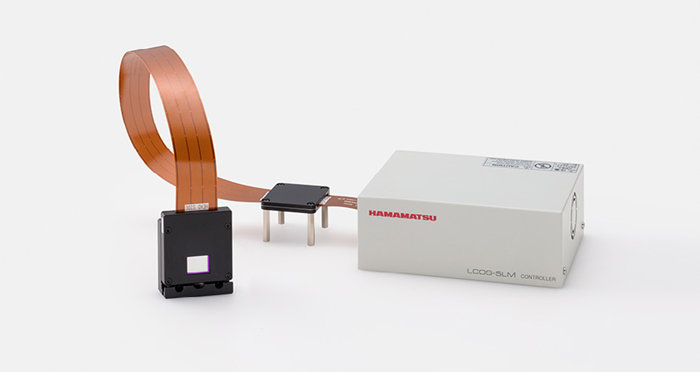
Hamamatsu Photonics' X15213 Series LCOS-SLM. Image Credit: Hamamatsu Photonics Europe
Significance of Jitter in Certain Beam Shaping Applications
High Precision
Laser material processing applications, such as marking and high-precision manufacturing, can benefit from LCOS-SLM-based beam-shaping technologies that increase throughput. However, jitter in the beam pattern can sometimes adversely affect output quality.
Quantum Computing and Quantum Key Distribution
In atom trap-based quantum computing, LCOSSLMs are used to generate laser spot arrays that serve as potential wells for trapping atoms. Jitter can influence the potential wells' steepness and positioning precision.
This can lead to unstable atom traps, erroneous quantum state readouts, and limited scalability for the quantum computer. Similarly, in quantum key distribution (QKD), LCOSSLMs are used to encode quantum keys as beam patterns, which are subsequently sent over optical networks.
Phase noise directly impacts the integrity of quantum keys, the distance they can be transferred, and their susceptibility to interception by other parties.
Certain QKD techniques employ interference between keys and jitter, which can impair the reading of interference patterns. Finally, phase noise increases the burden on error-correction techniques, reducing overall efficiency.
Low Noise Mode of LCOS-SLMs From Hamamatsu
Hamamatsu's LCOS-SLMs are well-known for their low-phase noise caused by LC molecules twitching. Even at the highest drive voltage, peak-to-peak phase noise is as low as 8 mrad (Figure).
Hamamatsu engineers developed a low-noise mode to further reduce phase noise. As a result, the variation in phase retardation is reduced by 60% (see figure below), and the peak-to-peak value of phase fluctuations is just a few mrad, which is extraordinarily low for LCOS-SLMs.
The low-noise mode of Hamamatsu's LCOS-SLMs efficiently tackles these issues while needing no changes to the product integration. However, there is one disadvantage to the low-noise mode: LC molecules respond relatively slowly.
In applications where beam-shaping accuracy and stability are more important than fast refresh rates, Hamamatsu's LCOS-SLMs' revolutionary low-phase-noise feature is an appealing option.
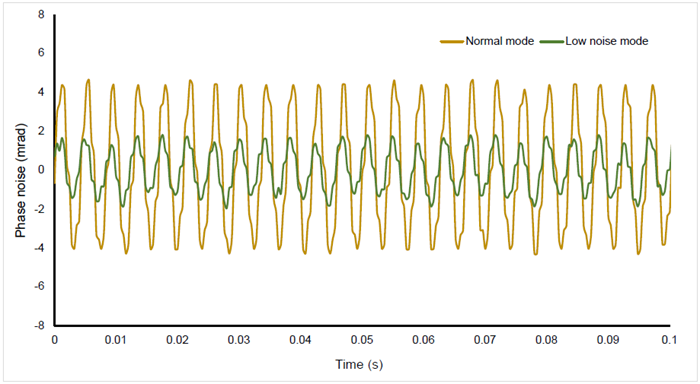
Figure. Peak-to-peak phase noise due to fluctuations of LC molecules in normal and low noise modes of Hamamatsu’s LCOS-SLMs. Image Credit: Hamamatsu Photonics Europe
The quest for stability in optical applications is more than just a technological problem. Precision and accuracy are critical to industry success.
The low-noise mode in LCOS-SLMs is designed to help engineers achieve accuracy, hence accelerating the development of applications such as high-precision manufacturing, quantum computing, and communications. In our intricately connected world, every detail is critical to a future defined by precision and reliability.
References
- Hamamatsu Photonics (2026). What is LCOS-SLM? Technology | Hamamatsu Photonics. Available at: https://lcos-slm.hamamatsu.com/eu/en/learn/about_lcos-slm.html.
- Hamamatsu Photonics (2026). What is LCOS-SLM? Principle and structure | Hamamatsu Photonics. Available at: https://lcos-slm.hamamatsu.com/eu/en/learn/about_lcos-slm/principle.html.
- Hamamatsu Photonics. LCOS-SLM Spatial Light Modulators Applications and Features. Hamamatsu Photonics. Available at: https://lcos-slm.hamamatsu.com/content/dam/hamamatsu-photonics/sites/documents/99_SALES_LIBRARY/lpd/application_note_LCOS_E.pdf.
- Hamamatsu Photonics (2026). Spatial Light Control Technology, Concept movie. Available at: https://youtu.be/nf7Zry8R7gQ?t=91.
- Collings, N., et al. (2011). The Applications and Technology of Phase-Only Liquid Crystal on Silicon Devices. Journal of Display Technology, 7(3), pp.112–119. DOI: 10.1109/jdt.2010.2049337. https://holoeye.com/papers-references/the-applications-and-technology-of-phase-only-liquid-crystal-on-silicon-devices/.

This information has been sourced, reviewed and adapted from materials provided by Hamamatsu Photonics Europe.
For more information on this source, please visit Hamamatsu Photonics Europe.