Astronomers may have solved one of the biggest mysteries uncovered by NASA’s James Webb Space Telescope (JWST), using sophisticated simulations to show that enigmatic objects known as “Little Red Dots” (LRDs) are likely the birthplaces of the first supermassive black holes.
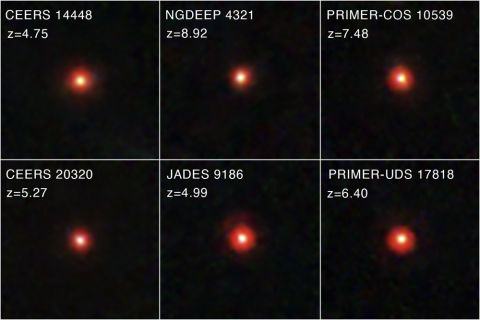 Little Red Dots images from the James Webb Space Telescope. Image Credit: NASA, ESA, CSA, STScI, Dale Kocevski (Colby College)
The discovery sheds new light on how some of the Universe’s largest black holes formed less than a billion years after the Big Bang.
Since JWST began peering deeper into the cosmos than ever before, astronomers have been puzzled by hundreds of compact, bright objects known as Little Red Dots. These mysterious sources appear as tiny red specks in the early Universe and are unlike anything predicted by existing theories.
Lead author Dr Daniel Whalen, from the University of Portsmouth’s Institute of Cosmology and Gravitation, said: "LRDs have been one of the most surprising discoveries made by the James Webb Space Telescope. They are compact, only a few hundred light-years across, but are as bright as much larger galaxies, and their unusual V-shaped spectra have defied the usual astrophysical explanations. Their lack of detectable X-ray and radio emissions have left astronomers struggling to explain what they are."
Using advanced cosmological simulations, the team discovered that LRDs are most likely primeval galaxies hosting massive black holes due to the collapse of supermassive primordial stars. Crucially, the black holes remain wrapped inside the enormous discs of gas that created them, hiding much of their activity from view.
The simulations suggest these objects contain black holes with masses around 10 million times that of the sun. Dense gas surrounding the black hole traps high-energy X-rays, while allowing some ultraviolet, visible and infrared light to escape. This naturally recreates the unusual light signatures seen by JWST.
At the same time, a large neighboring cluster of stars in the small galaxy produces the blue portion of the spectrum, helping to explain another long-standing feature of Little Red Dots.
The simulations also show that these systems contain dense clusters of around 100 million stars packed into a region only around 500 light-years across, matching what astronomers observe in real LRDs.
Previous theories suggested the objects could be compact collections of stars, heavily obscured black holes, supermassive stars, or even hypothetical, exotic objects such as “black hole stars”. However, none could fully explain their formation, abundance, lifespan, and unusual spectral signatures.
The new model successfully reproduces the properties of a wide variety of Little Red Dots observed by JWST, including some of the most distant and extreme examples ever discovered.
Dr Whalen added: "What makes this discovery so exciting is that we may be witnessing the birth of the first supermassive black holes. For decades, simulations have predicted that these objects should exist, and now the James Webb Space Telescope may finally be allowing us to see them."
The paper is published in The Astrophysical Journal Letters.