AZoQuantum speaks with Francis Doumet, CEO and Co-founder of Metaspectral, about how the company’s Clarity AI platform converts hyperspectral satellite imagery into actionable intelligence. He discusses Metaspectral’s partnership with Planet and explains how combining AI with hyperspectral data can reveal material composition, biochemical changes, and environmental risks that conventional satellite imagery cannot detect. These capabilities are creating new opportunities across agriculture, mining, environmental monitoring, and planetary intelligence.
Can you introduce yourself and your vision behind Metaspectral?
I'm Francis Doumet, CEO and Co-founder of Metaspectral. Our vision is to enable organizations to understand the world at the material level, beyond what we see with the visible spectrum, using hyperspectral data. This means more actionable, better-informed intelligence, at much greater speed, across a range of industries.
Keep the PDF of this interview here
What does the Planet partnership enable that satellite imagery alone couldn't?
Planet's Tanager satellites capture high-resolution hyperspectral imagery, which offers data of enormous scientific and practical value. Hyperspectral imagery consists of hundreds of spectral bands that go far beyond what conventional color imagery provides and are otherwise impossible to visually analyze or fully interpret with the naked eye or traditional cameras.
This is why we created Metaspectral's Clarity AI platform, which automatically interprets hyperspectral data, transforming highly complex spectral measurements into clear, decision-ready insights in seconds, to enable the identification and detection not only of the composition of materials, but also subtle changes to them, while fully and transparently explaining the evidence behind every finding.
This means that organizations can now use Tanager satellite data to gain a robust understanding of what is happening on the ground, rather than just guessing based on what can be seen visually. Some use cases include quantifying soil moisture, detecting early signs of crop disease, identifying mineral deposits, and more. This partnership between Planet and Metaspectral bridges the gap between the hyperspectral data collected and the information needed to make more informed and strategic decisions.
"Train and optimize a model" by Metaspectral's Clarity AI
How does Metaspectral Clarity turn Tanager hyperspectral data into decision-ready insights?
Tanager captures hundreds of spectral measurements per pixel, creating an incredibly rich but highly complex dataset. Metaspectral Clarity transforms it, enabling even those without specialized training in this analysis to use raw hyperspectral data instantly to identify materials, quantify their abundance, detect anomalies, and reveal subtle biochemical and chemical changes that would otherwise remain hidden.
We achieve this with Metaspectral Clarity’s patented deep learning processes that handle spectral unmixing, material classification, target detection, regression, and change detection all within the platform. For these findings, the platform also provides the supporting explanations, including spectral evidence, confidence metrics, and natural-language summaries, enabling both experts and non-experts to understand and trust the results.
We are making it possible for businesses, governments, and other organizations to access and use these tremendously powerful datasets without requiring teams of remote sensing specialists to manually interpret hyperspectral imagery.
Instead, users can ask questions in plain language, just as so many of us are used to interacting with AI chatbots today, and they receive not only their answers but also the full reasoning used to determine them, with explainable, step-by-step logic in seconds. The result is a seamless path from raw spectral measurements to the intelligence to make better operational decisions faster. We are seeing growing demand for this across agriculture, environmental monitoring, mining, defense, and more.
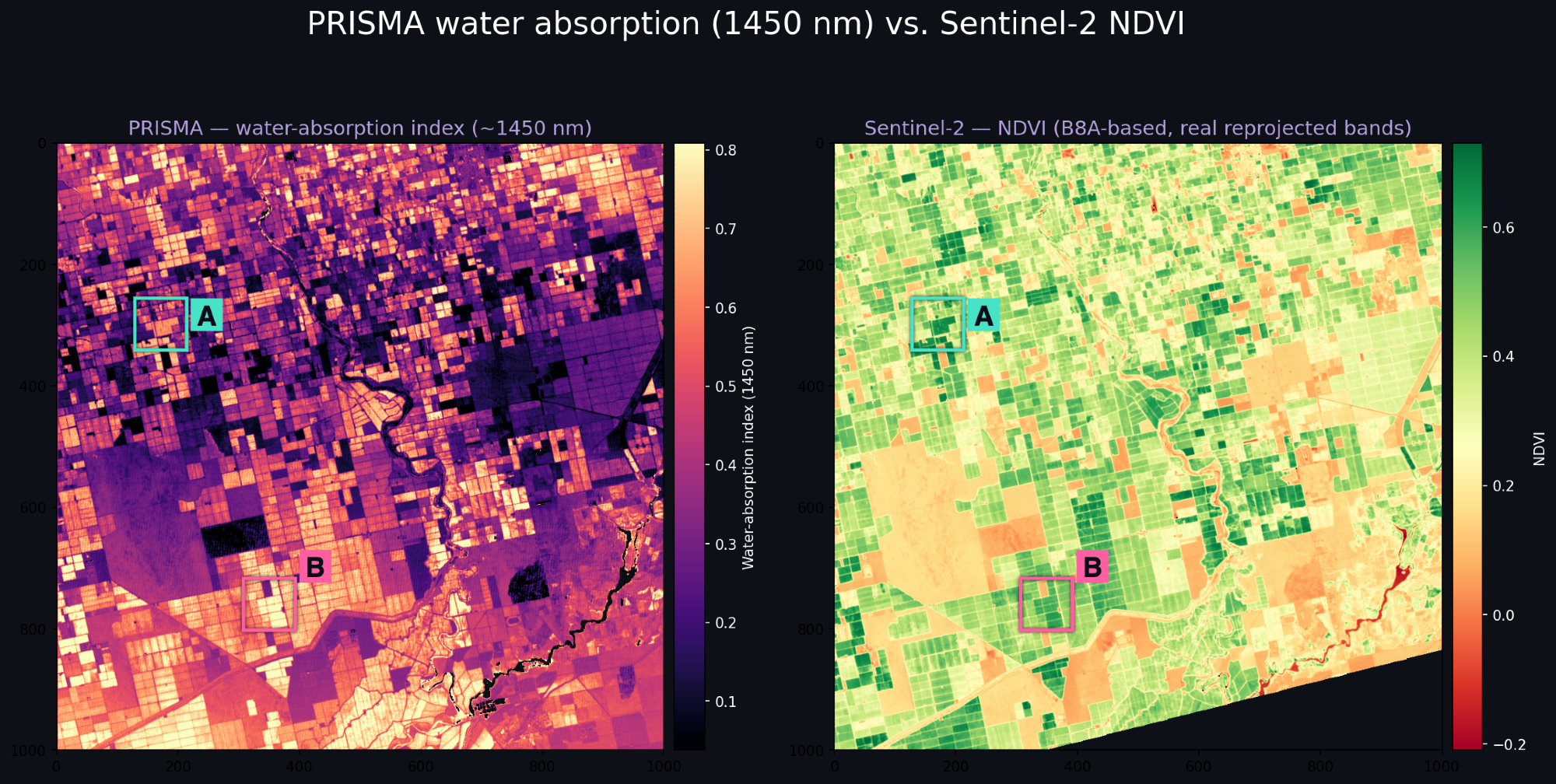
Image Credit: Metaspectral
Where does hyperspectral data outperform multispectral imagery in agriculture, forestry, and environmental monitoring?
Multispectral imagery is excellent for measuring broad indicators such as vegetation greenness, but hyperspectral imagery reveals the underlying chemistry of the observed characteristics. By capturing hundreds of contiguous spectral bands, it can detect subtle biochemical and material signatures that multispectral sensors either average together or miss entirely.
In agriculture, this means detecting water stress, nutrient deficiencies, crop maturity, and early disease weeks before they become visible. It can also distinguish healthy green vegetation from dry or senescent vegetation, identify crop residue versus bare soil, and separate mixed pixels into their constituent materials.
In forestry, hyperspectral data enables earlier detection of vegetation stress, species composition, forest health, drought impacts, insect infestations, and wildfire risk by identifying subtle biochemical changes in vegetation before visible symptoms emerge. For environmental monitoring, hyperspectral imagery also enables applications that are difficult or impossible to perform reliably with conventional multispectral imagery, including detecting and quantifying greenhouse gas emissions such as methane using their unique spectral absorption features.
How does Clarity's patented subpixel deep learning reveal material and biochemical signals in complex scenes?
Clarity uses patented deep neural networks to perform spectral unmixing, the process of separating multiple material signatures blended within a single pixel. Rather than treating each pixel as a single object, our AI effectively untangles the mixed spectral signals to estimate the presence and abundance of individual materials, even when they occupy only a small fraction of a pixel. This enables Clarity to detect materials, biochemical signatures, or concealed targets significantly smaller than the sensor's spatial resolution. In other words, instead of being limited by pixel size, Clarity extracts information at the material level, revealing signals that would otherwise remain hidden in conventional pixel-based analysis.
How does Clarity ensure findings are explainable, reviewable, and backed by spectral evidence?
Every finding is accompanied by the underlying spectral evidence, confidence metrics, and a transparent explanation of why the AI reached its conclusion, enabling users to independently review and validate the results.
Beyond the AI's outputs, Clarity also provides supporting references where appropriate, including relevant academic white papers, peer-reviewed publications, conference proceedings, and technical documentation. This gives users additional scientific context and traceability, helping them understand not only what was detected, but why the underlying spectral signatures are associated with a particular material, biochemical property, or target.
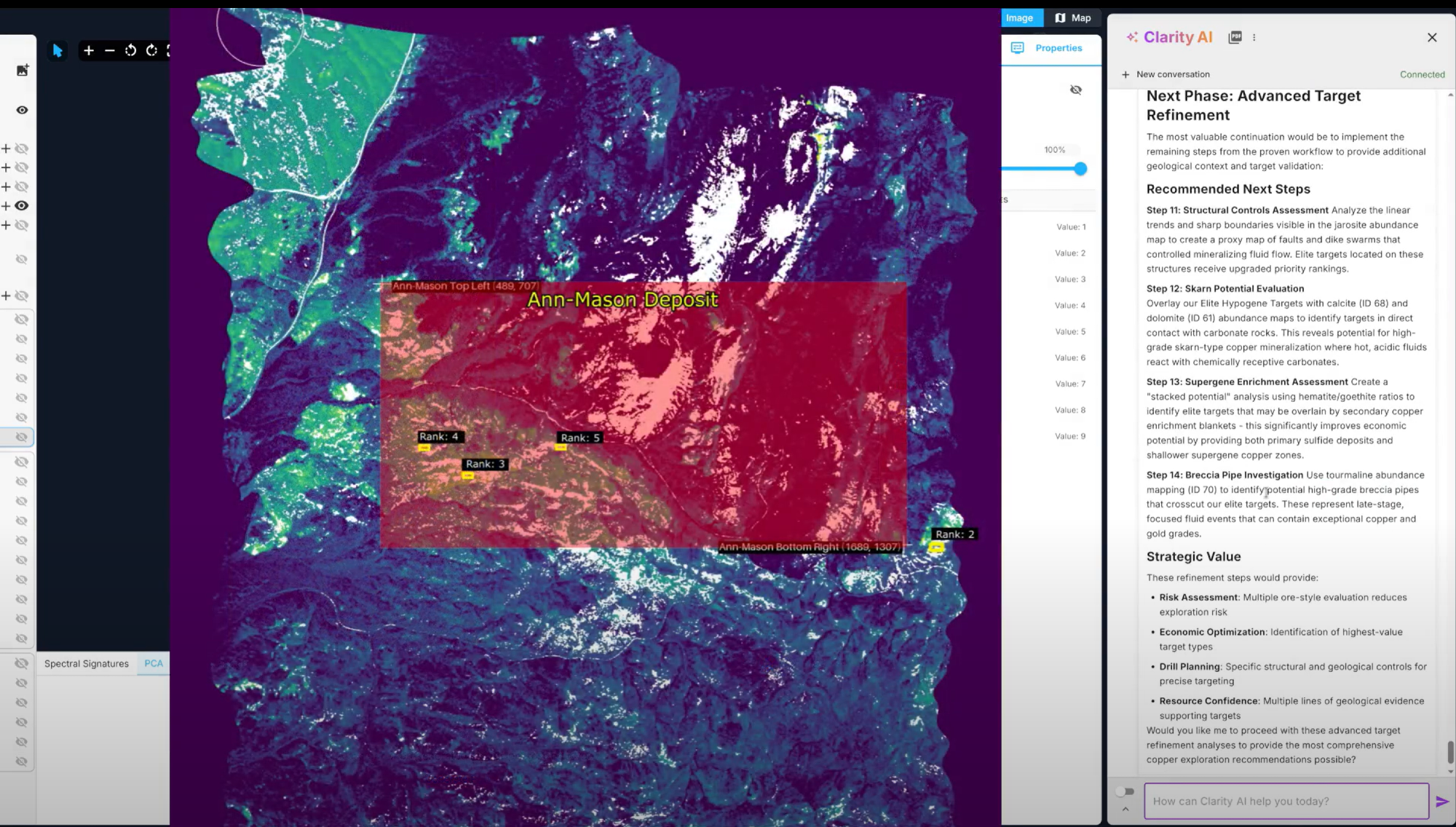
Image Credit: Metaspectral
How does Clarity communicate uncertainty and distinguish between confirmed findings, early indicators, and signals requiring field validation?
Clarity assigns confidence levels to its findings, clearly distinguishing between high-confidence detections, emerging indicators that warrant monitoring, and observations that should be validated with additional data or field inspections.
What early warnings can Tanager and Clarity provide, such as crop stress, soil changes, or environmental risks, before they're visible?
The biggest advantage of hyperspectral imaging is its ability to detect biochemical changes before they become visible. Rather than waiting for plants to change color or show obvious symptoms, by using hyperspectral imagery captured from Tanager satellites, Clarity can identify early shifts in canopy water content, chlorophyll, cellulose, nutrient levels, and plant physiology, essentially providing warnings of drought stress, disease, pest infestation, nutrient deficiencies, and crop maturation days to weeks before they are apparent in conventional imagery.
In forestry, this means identifying early indicators of declining forest health, drought stress, insect infestations, and elevated wildfire risk before widespread dieback or discoloration occurs. In environmental monitoring, it can provide early detection of methane leaks, the spread of invasive species, and oil spills, helping to mitigate disaster risks sooner.
How could this partnership advance Planetary Intelligence and change how organizations monitor and respond to Earth's conditions?
Planetary Intelligence is only as powerful as the information it can extract from the planet. Today's systems are capable of gathering tremendous amounts of information, but without the ability to interpret it more precisely, they largely just tell us what the Earth looks like, and appearances can be deceiving. Clarity adds the missing dimension: what the Earth is made of.
We are providing the spectral intelligence layer for planetary Intelligence that determines the chemical and molecular composition of what we're looking at, along with its condition, to help us understand changes taking place beyond what can otherwise be seen in the world around us. Without that layer, Planetary Intelligence is operating with only part of the picture. It's like trying to understand the world with one eye closed: you can see shapes and patterns, but you miss the material information that explains why they're changing. By combining Planet's global hyperspectral coverage with Metaspectral Clarity AI, organizations gain continuous, explainable insights into the Earth's chemistry. We are unlocking the ability to detect emerging risks earlier, leading to better-informed decisions and a fundamentally new way to monitor and understand our planet.
We also explore how NASA monitors Antarctic ice from space here
About the Speaker
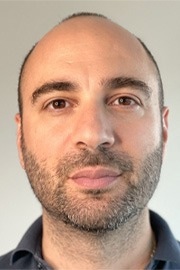
Francis is CEO & Co-Founder of Metaspectral, building the material intelligence layer for Physical AI systems operating in the industrial, environmental, and defense domains. Francis also co-founded Catapult Design, a non-profit design consultancy providing engineering support to organizations in need of socially empowering technologies, which was awarded a National Design Award from the Cooper Hewitt, Smithsonian Design Museum in 2020. Francis holds 11 patents, a Master's in Engineering from Stanford University, and an MBA from the Wharton School of Business.
Disclaimer: The views expressed here are those of the interviewee and do not necessarily represent the views of AZoM.com Limited (T/A) AZoNetwork, the owner and operator of this website. This disclaimer forms part of the Terms and Conditions of use of this website.