Researchers at Johannes Gutenberg University Mainz (JGU) have created an innovative quantum sensing technology capable of detecting biomagnetic signals, including those generated by cardiac activity. The study was published in the journal Science Advances.
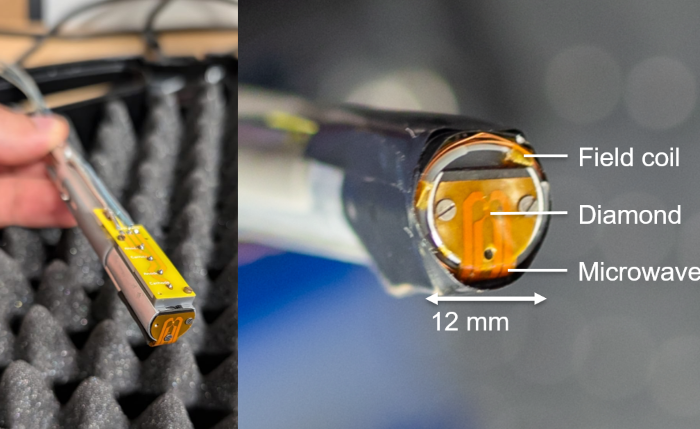 Diamond sensor in the lab (left) and close-up of the head with dimensions. Image Credit: Dr. Arne Wickenbrock
The DIAQNOS (DIAmond-based Quantum Sensing for NeurOSurgery) flagship initiative, supported by the German Federal Ministry of Research, Technology, and Space and led by Dr. Arne Wickenbrock in Mainz, has demonstrated how quantum technology can support advances in medical practice. To that end, the team led by Prof. Dr. Dmitry Budker (PRISMA++ Cluster of Excellence and Helmholtz Institute Mainz) used nitrogen-vacancy (NV) centers in diamond.
Muhib Omar, a doctoral researcher in Budker's laboratory and the publication's principal author, engineered this advanced quantum sensor as part of his doctoral studies. Because of its small size and ability to operate at ambient temperature, this NV-based sensor offers significant opportunities to improve the detection of magnetic signals from cardiac and neural tissue. This technology may enable timely identification of disorders such as myocarditis and epilepsy.
NV centers form when a lattice vacancy in diamond sits immediately adjacent to a nitrogen atom that has substituted for a carbon atom in the diamond structure. Through examination of the energy level transitions within these centers, scientists are able to precisely quantify diverse physical phenomena, including magnetic fields, electric fields, temperature variations, and mechanical stress.
These results are the product of over ten years of development work. We work closely with neurosurgeons to ensure that our technologies do not remain confined to the laboratory but find clear practical applications. Our primary goal is to develop highly sensitive sensors that function outside the laboratory and can fulfill important societal needs.
Dr. Arne Wickenbrock, Director, German Federal Ministry of Research, Technology, and Space, Johannes Gutenberg University Mainz
DIAQNOS researchers used three independently developed systems, built by project partners at Johannes Gutenberg University Mainz (JGU), the Universities of Stuttgart and Freiburg, and Q.ANT GmbH, to measure cardiac magnetic fields
Through this investigation, they showed that German quantum technologies can advance toward clinical applications and identified the specific enhancements needed for successful implementation. The portable, endoscopic, fiber-based NV-diamond magnetometer developed at Johannes Gutenberg University Mainz (JGU) operates without a magnetic bias field, unlike other systems that use bias fields to suppress environmental magnetic interference.
Developing a New Way of Detecting Heart Signals
Two principal methodologies currently exist for assessing cardiac function: electrocardiography (ECG) and magnetocardiography (MCG). ECG operates by employing electrode patches positioned on the patient's skin to quantify the electrical signals generated by the heart, whereas MCG functions through the detection of magnetic field emissions.
Although ECG is widely used in clinical practice, it is sensitive to differences in tissue conductivity across the body. In some situations, including severe burn injuries, electrodes also cannot be applied directly to the skin.
MCG does not require skin contact and is largely insensitive to differences in tissue conductivity. However, it depends on extremely sensitive magnetometers and has traditionally relied on expensive, complex systems such as superconducting quantum interference devices (SQUIDs) and optically pumped magnetometers (OPMs).
The system developed by the JGU research team, which makes use of NV centers found in diamonds, presents a viable option with considerable benefits compared to current MCG techniques. A key distinction is the sensor's compactness: a truncated diamond pyramid that has a volume of less than 0.5 cubic millimeters, which facilitates portability.
In contrast to SQUID- or OPM-based systems, NV magnetometers can operate at room temperature. This makes them ideal for direct application on a patient’s skin and enables their use at any chosen site. As a result, it could enable more accurate mapping of biomagnetic signals, including three-dimensional reconstruction of the heart’s electrical conduction network and monitoring of fetal heart activity.
NV magnetometers are characterized by fast initialization, excellent biocompatibility, and stable operation over a wide temperature range. This makes them particularly attractive for biomedical applications.
Dr. Arne Wickenbrock, Director, German Federal Ministry of Research, Technology, and Space, Johannes Gutenberg University Mainz (JGU)
The Potential is High but Technical Challenges Remain
The research demonstrates the potential of NV diamond magnetometers, a performance differential persists relative to SQUIDs and OPMs, which continue to provide superior sensitivity and improved signal-to-noise ratios. However, as technological advancement continues, opportunities for applications extending beyond the clinical domain are emerging: the distinctive integration of an expansive dynamic range, effective noise reduction, and adaptable geometry positions NV magnetometers as viable instruments for diverse innovative biomedical applications.
Because they are so small, these detectors can be paired with enhancement components designed to reach ECG-equivalent performance. One example is a flux concentrator: a structure that gathers magnetic flux into the diamond, strengthening the field seen by the NV centers and improving detection.
With NV sensors, this kind of approach can deliver signal gains of more than 100×. Developing and testing flux concentrators that work effectively at room temperature is a core research focus for Muhib Omar.
Adapting magnetic structures to optimally concentrate the magnetic field lines from a source within the diamond is the path to bringing these quantum technologies into practical use.
Muhib Omar, Study Principal Author and Doctoral Researcher, Johannes Gutenberg University Mainz (JGU)
Another promising area is surgical oncology, where a gradiometer setup measures the magnetic-field difference between two spatially separated sensors. This approach can also support intraoperative nerve monitoring in unshielded operating rooms.
Because gradiometers are sensitive to local field gradients, they may also help separate maternal and fetal cardiac signals noninvasively for prenatal assessment. Looking further ahead, NV-based gradiometers could enable portable magnetoencephalography (MEG) systems that operate at room temperature, opening new options for neurological assessment and, potentially, advanced brain-computer interfaces (BCIs).
Journal Reference:
Omar, M., et al. (2026) Human cardiac measurements with diamond magnetometers. Science Advances. DOI:10.1126/sciadv.aeg5281. https://www.science.org/doi/10.1126/sciadv.aeg5281