From micro-electro-mechanical systems (MEMS) foundries to quantum laboratories, the ability to accurately record resonances at microwave and radio frequencies is essential. But should researchers choose a microwave lock-in amplifier (MLA) or a vector network analyzer (VNA)?
In a joint webinar, Rohde & Schwarz and Zurich Instruments collaborated to precisely answer this question. By contrasting these two tools side by side, the session showed how each piece of equipment is suited to particular applications and how using them in tandem can provide a greater understanding of complicated devices.
Analyzing the Building Blocks of RF Systems
VNAs continue to be the gold standard for the measurement of radio frequency (RF) components over the complete frequency spectrum. When measuring antennas, amplifiers, or filters, VNAs uncover the entire S-parameter matrix, demonstrating how signals are lost, transmitted, or reflected.
- In filter design, VNAs plot the stopband and passband, revealing both rejection and gain.
- For amplifier production, VNAs facilitate power sweeps to mark phase shifts and identify points of compression.
- In antenna investigations, VNAs measure impedance matching, providing fast signal transfer.
VNAs offer the expansive, clear view that researchers require at the design and measurement stage due to these benefits (Figure 1).
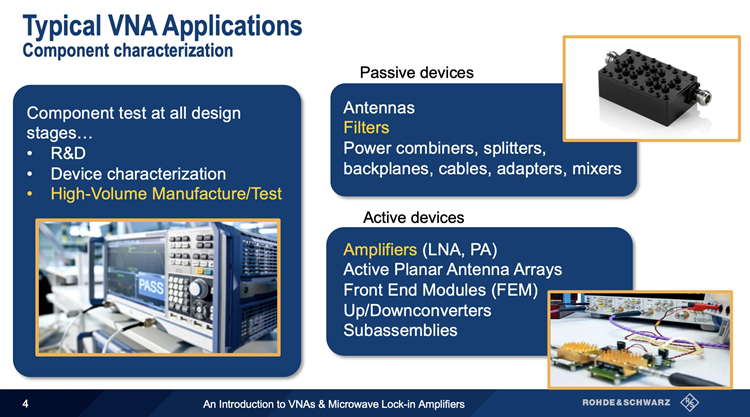
Figure 1. Slide from the webinar showing typical VNA applications that cover all design stages, from research and development, through device characterization to high-volume manufacturing test. Image Credit: Zurich Instruments AG
Measuring Resonances in Real Time
Lock-in amplifiers take an alternative route. Rather than sweeping widely, they shine when recording a single resonance with unparalleled accuracy. MLAs stabilize and manage operating points that would otherwise drift when the signal becomes lost in the noise by demodulating weak periodic signals from noisy environments.
- In surface acoustic wave (SAW) sensors, MLAs record variations in frequency produced by changes in the environment like temperature or pressure, offering highly accurate detection.
- They uncover faint sidebands in cavity optomechanics that encode data about photon–phonon interactions, essential for quantum science.
- In quantum sensing and qubit readout, their capability to perform many feedback loops and demodulators at the same time offers noise-resilient, accurate studies.
Contemporary RF-capable MLAs provide further capabilities, including pulse measurements, sideband quantification, tracking of multiple frequencies, and proportional-integral-derivative (PID) controllers, making them flexible for a varied range of dynamic studies (Figure 2).

Figure 2. Slide from the webinar showing the additional features and functionality that microwave lock-in amplifiers bring to specific applications. Image Credit: Zurich Instruments AG
The Advantages of Each Tool
In a straightforward example of resonator measurement:
- A VNA can sweep over frequencies to locate the resonance peak and analyze the entire transmission spectrum.
- Once the peak is identified, an MLA can focus on it, measure very small detuning changes in real time, and give feedback to make the system secure, even when disturbed.
This combined process enables researchers not only to measure but also to manage resonances, connecting the gap between dynamic studies and static measurements.
Conclusion
Rohde & Schwarz and Zurich Instruments joined forces in this webinar to give researchers a rare opportunity to examine both points of view in one session, enabling the engineering and scientific communities to solve advanced RF measurement obstacles, from the quantum laboratory to the design floor.
Whether a researcher is producing a MEMS sensor, designing a filter, or stabilizing a quantum cavity, it is crucial to understand when to use an MLA or a VNA. VNAs offer the clear, complete picture while MLAs provide high accuracy in real time.
The shared knowledge from the two companies underscores a key takeaway: the most innovative laboratories don’t select one solution over the other; they use them together.
Acknowledgments
Produced from materials originally authored by Tim Ashworth from Zurich Instruments.

This information has been sourced, reviewed, and adapted from materials provided by Zurich Instruments AG.
For more information on this source, please visit Zurich Instruments AG.