In a study published in Monthly Notices of the Royal Astronomical Society (MNRAS), scientists from MIT, Harvard, and other institutions describe Lumina, a large-scale, high-resolution simulation that traces the evolution of the universe from the dark ages through the following 2 billion years.
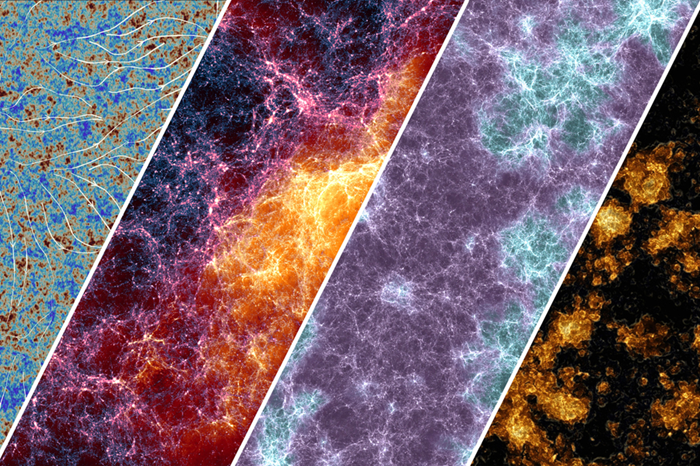
A composite image of Lumina’s scales of simulation, depicting (from left to right) the streaming velocities of subatomic particles and dark matter at the beginning of the simulation; gas structures during helium reionization, color-coded by how fast the gas is moving; helium reionization where blue indicates regions that are ionized by supermassive black holes; and hydrogen reionization, where bright regions show bubbles where radiation from galaxies has ionized hydrogen, while the dark regions are still neutral. Image Credit: Lumina Collaboration
After the Big Bang, the universe emerged as an extremely hot, dense mixture of electrons and subatomic particles. This primordial ionized plasma, smaller than an atom at the start, expanded quickly and cooled. As it cooled, particles slowed enough to capture electrons, creating electrically neutral hydrogen.
As more neutral hydrogen accumulated, it created a barrier that prevented light and other radiation from passing through easily. About 380,000 years after the Big Bang, this marked the beginning of the cosmic “dark age.”
A new computer simulation is helping researchers understand how the earliest galaxies, stars, and other structures may have formed during that time and how they could ultimately re-energize and illuminate the universe.
Two Pivotal Transformations
Lumina simulates a vast region of the early universe, spanning 500 megaparsecs, about 1.6 billion light-years across. Within this volume, it models how dark matter, gas, stars, and radiation (including photons) evolve over massive cosmic distances, while also zooming in to capture fine details within individual forming galaxies.
Over the 2 billion years Lumina models, it follows two major transitions in cosmic evolution: hydrogen reionization and helium reionization.
Hydrogen re-ionization occurs when the first stars and galaxies generate enough ultraviolet radiation to interact with neutral hydrogen. Ultraviolet light strips electrons from hydrogen atoms, returning the gas to an ionized state. This effectively stops neutral hydrogen from absorbing incoming photons, allowing light to pass through more freely. Lumina depicts this “lifting of the veil” caused by neutral hydrogen in unprecedented detail.
Lumina also simulates helium re-ionization, a related process in which even higher-energy radiation breaks apart neutral helium, once again removing electrons and restoring ionization.
By running these detailed calculations, the researchers find that hydrogen re-ionization was most likely powered by radiation from early galaxies and stars. Helium re-ionization, however, appears to have been driven by far more energetic radiation from early supermassive black holes during their active, material-accreting phases. Together, Lumina is among the first simulations to capture both hydrogen and helium re-ionization in a single framework.
Lumina does everything from small-scale star and galaxy formation to large-scale re-ionization of hydrogen and helium, in a volume that is 100 times larger than previous best simulations.
Mark Vogelsberger, Study Author and Professor, Physics, Massachusetts Institute of Technology (MIT)
Vogelsberger and colleagues are releasing Lumina to the broader scientific community so researchers can directly compare its high-resolution simulation results, showing the growth of early cosmic structures, with observations from new and upcoming telescopes. They may then begin to assemble the methods that influenced the formation of the first galaxies, stars, and cosmic structures.
The MIT co-authors are Xuejian (Jacob) Shen and Teodora-Elena Bluichi. Other authors include Oliver Zier (the paper’s first author, formerly a postdoc in the Vogelsberger Lab), Rongrong Liu, Sonja Koehler, and Lars Hernquist from the Harvard and Smithsonian Center for Astrophysics; Aaron Smith of the University of Texas at Dallas; Rahul Kannan of York University; and Volker Springel and Rüdiger Pakmor of the Max Planck Institute for Astrophysics in Germany.
Cosmic Computation
Lumina’s name comes from the Latin word for “lights.” At its core is IllustrisTNG, a simulation created previously by researchers at MIT and other institutions, including members of the Lumina team. IllustrisTNG models how dark matter, gas, and related physical processes interact to form galaxies, beginning shortly after the Big Bang and continuing to the present day.
The team upgraded IllustrisTNG’s code so the simulation could produce galaxy formation with comparable detail, but over a much larger region of the universe to create Lumina. They also paired the enhanced galaxy modeling with radiation transport, allowing the code to represent how ultraviolet and other forms of radiation interact on cosmic scales, capturing key events such as hydrogen reionization.
The result is a simulation that resolves extremely subtle structures across vast distances. In total, Lumina follows roughly half a trillion individual components, including dark matter particles and gas cells, providing about 30 times higher resolution than IllustrisTNG. It then evolves this detailed system forward in time across a region about 500 megaparsecs wide, roughly 100 times the volume of earlier simulations.
Simulating every element across both very small and very large scales for the full 2 billion years of cosmic history requires immense computational resources. The team ran the simulation on Frontier, one of the world's most powerful supercomputers, located at Oak Ridge National Laboratory in Tennessee.
At peak scale, the calculation brings together the equivalent of more than 100,000 CPU cores and around 15,000 GPUs. Making all of those processors communicate efficiently while continuously evolving trillions of interacting pieces of information is itself an extraordinary feat of computer engineering.
Xuejian (Jacob) Shen, Study Co-Author, Massachusetts Institute of Technology
Full Zoom
Lumina starts its runs about 45 million years after the Big Bang, during the dark ages, when neutral hydrogen made up most of the universe’s gas. To begin, the team chooses initial conditions that reflect what physicists expect such an early dark period to contain.
From there, the simulation evolves forward, calculating how gas and dark matter interact across its enormous region, tracking motion and forces through hundreds of billions of elements. At the same time, it models where and how radiation, such as ultraviolet light from young stars, is produced and how it interacts with the surrounding medium.
On the project website, the researchers also provide videos that illustrate the simulation at different scales and over different epochs. These include a zoom-in that narrows from the full, wide cosmic patch to an individual, disk-shaped galaxy, as well as a time-lapse of the entire simulated volume over the next 2 billion years, showing how hydrogen becomes re-ionized across time and space.
On the one hand, it’s evolving dark matter as well as the gas in the universe, and on the other, it’s also tracking how radiation travels. We see dark matter and gas start to clump in these over-densities. And when we zoom in, we can see gas is falling into these dark matter haloes. Zooming in more, we see this is where the first galaxies form. And the first stars form in those first galaxies. Those stars then create radiation. The simulation then tracks that radiation, and we can zoom way out to see how that radiation travels out from stars, through the universe, until at some point it ionizes some neutral hydrogen.
Oliver Zier, Study First Author, Massachusetts Institute of Technology
“Other simulations cannot zoom in as far as this. The difference between the smallest and largest scales that we simulate is larger than in any other simulation,” noted Vogelsberger.
The team intends to use Lumina to study and map the early universe’s large-scale structure. The simulation could also be used to forecast the gravitational-wave signals that the first galaxies and black holes might generate. As these predictions improve, the results from Lumina will increasingly be testable against observations from next-generation telescopes and instruments.
“One of Lumina's major advantages is its sheer size. It produces enormous populations of simulated galaxies, finally allowing us to make comparisons with the very large galaxy samples that upcoming surveys will observe,” said Shen.
The study was supported in part by NASA and the National Science Foundation, and it used computing resources from the Oak Ridge Leadership Computing Facility at Oak Ridge National Laboratory. That facility is supported by the Advanced Scientific Computing Research programs in the U.S. Department of Energy’s Office of Science.
Fly through of massive halo in the Lumina simulation.
A fly-through of a massive halo at redshift z = 3, moving from the large-scale cosmic environment into the dense inner regions of the halo where individual galaxies become visible toward the end of the sequence. The video shows the distribution of dark matter density, gas density, gas temperature, gas metallicity, and stellar light across the system. Video Credit: Lumina Collaboration
Journal Reference:
Zier, O., et al. (2026) Introducing the lumina project: large-volume radiation-hydrodynamic simulations of the epochs of hydrogen and helium reionization. Monthly Notices of the Royal Astronomical Society. DOI:10.1093/mnras/stag1469. https://academic.oup.com/mnras/article/552/4/stag1469/8971942.