NVIDIA announced a record-breaking quantum computing simulation on JUPITER, Europe’s first exascale supercomputer. The breakthrough enables researchers to thoroughly study and validate magic state cultivation, an advanced fault-tolerant quantum computing technique that cuts required qubits by 90% compared to earlier methods.
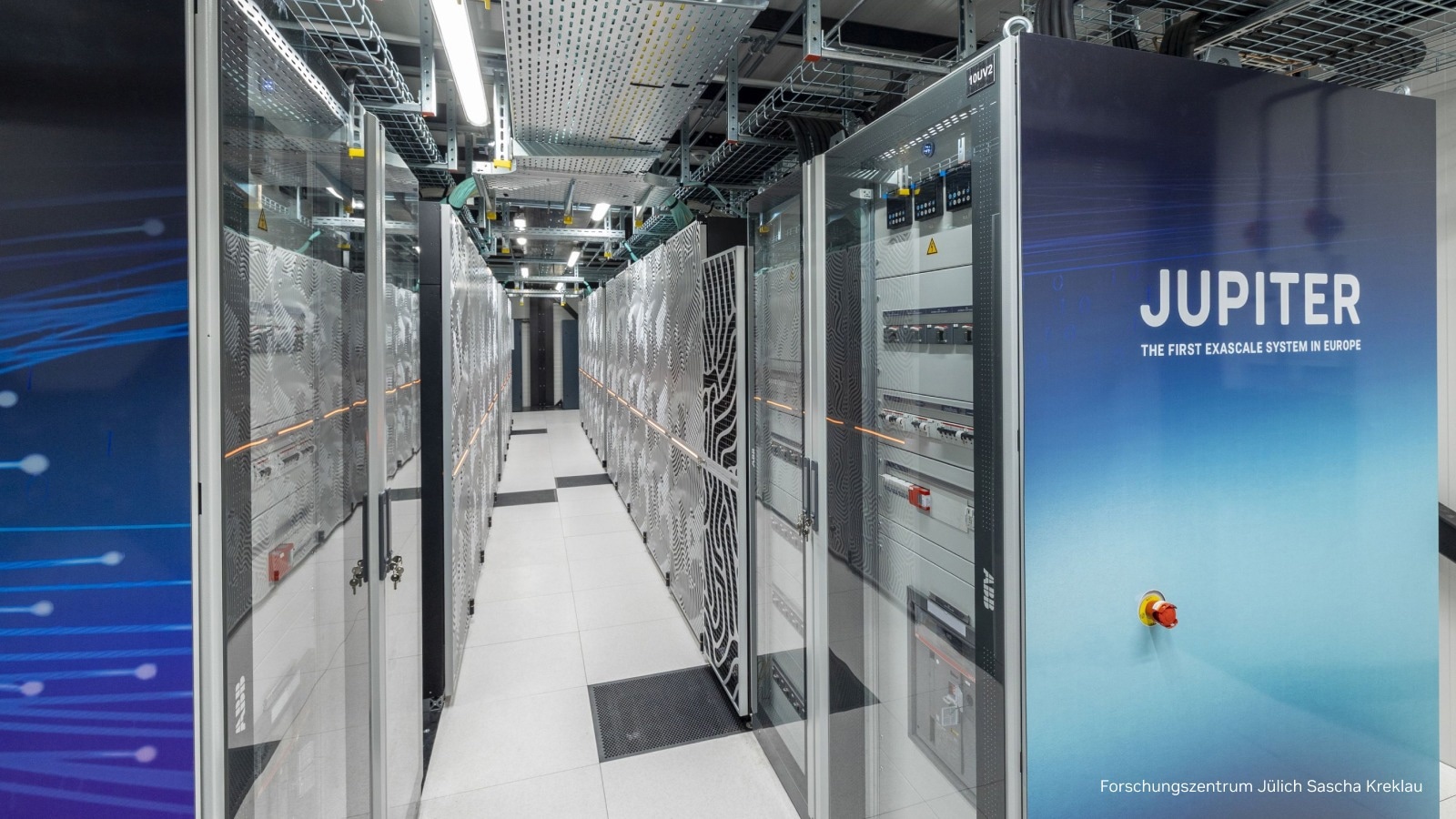 Image Credit: Forschungszentrum Jülich Sascha Kreklau
This 104-qubit run marks the largest detailed simulation of a fault-tolerant quantum processor to date, demonstrating how realistic quantum hardware executes fault-tolerant computing at unprecedented scale powered by NVIDIA GH200 superchips at the Jülich Supercomputing Centre.
This degree of accuracy equips researchers with the insight required to evaluate future designs before construction, cutting down on physical trial and error while speeding up the development of practical quantum applications in materials science, finance, and drug discovery.
Useful quantum computing will require fantastically complex, fault-tolerant systems - and understanding how they behave at scale is essential to building them. Our results from Jülich show how quantum processors and GPU supercomputers can work together to tackle research that would otherwise be out of reach - accelerating the discovery of transformative quantum applications.
Jensen Huang, Founder and CEO, NVIDIA
“Europe’s investment in JUPITER gives researchers the ability to investigate questions that were previously beyond reach,” said Kristel Michielsen, Director of the Jülich Supercomputing Centre at the Forschungszentrum Jülich facility. “Working with NVIDIA, we’re bringing that capability to quantum computing - helping scientists make better-informed decisions about the designs most likely to deliver useful applications.”
Reducing the Resources Needed for Useful Quantum Computing
Control interactions inevitably introduce error-causing noise because qubits operate at physical limits. Fault-tolerant quantum computing manages this noise by consuming "magic states", specially configured qubit arrangements, throughout the computation.
Optimizing their production significantly lowers the barrier to building practical quantum computers, as fault-tolerant systems depend on the continuous generation of magic states.
By modeling this process with realistic noise, NVIDIA researchers validated an advanced magic-state cultivation method, giving scientists tools to build and evaluate future improvements.
While prior breakthrough research at Jülich simulated 50 qubits in ideal, noiseless conditions, this milestone tests magic-state cultivation against realistic hardware noise, clarifying how errors impact overall performance.
From Research Development to Exascale Simulation
Simulating magic-state cultivation allows researchers to refine designs before physical quantum hardware is constructed. However, because memory demands scale exponentially with qubit count, large-scale simulations quickly exceed the capabilities of standard computing systems.
Researchers used an NVIDIA GB200 NVL72 system at the NVIDIA Accelerated Quantum Research Center (NVAQC) as a launchpad, scaling tests from four GPUs up to hundreds before transitioning to 8,192 GPUs on JUPITER.
This platform accelerated method development and testing, enabled result comparisons with JUPITER, and revealed how accuracy scales with added compute. The team reduced a week-long simulation process to days, preparing it to efficiently harness JUPITER’s exascale capacity.
Ultimately, the project highlights the rising importance and complexity of simulation as quantum systems grow. It also shows how accelerated computing hubs like NVAQC let researchers validate techniques locally before running their heaviest workloads on supercomputers.
To maximize efficiency and scale, the simulations relied on NVIDIA cuQuantum software, alongside the NVIDIA CUDA-Q™ platform’s fault-tolerant logical layer to structure the magic-state circuit.