Within solid materials, various modes of excitation can influence one another. Using an innovative experimental method at the X-ray free-electron laser SwissFEL, a team at Paul Scherrer Institute PSI has successfully revealed the interactions among electronic, magnetic, and lattice excitations. This insight is essential for understanding how spin excitations might be manipulated for upcoming information technology applications. Their findings were featured in the publication Nature Communications.
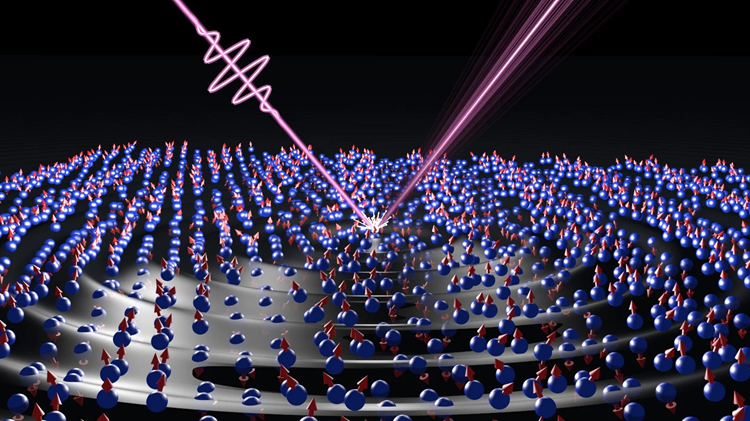 A study revealed that magnons are surprisingly long-lived, an important insight for designing future spintronic materials. In the image, an ultrashort laser pulse triggers collective excitations in an antiferromagnetic material, forming a wave. A new X-ray technique at SwissFEL let researchers track how these collective excitations, such as magnons, evolve. Image Credit: Paul Scherrer Institute PSI/Hiroki Ueda
Silicon-based computer technology is approaching its physical boundaries, as components cannot be infinitely miniaturized nor clock speeds endlessly increased. Meanwhile, the expansion of massive AI data centers is driving a surge in global electricity demand. Scientists worldwide are seeking novel materials that can replace or supplement silicon while drastically lowering energy consumption.
From Electrons to Spin Waves
Future computer technology could become faster and far more energy-efficient by controlling rapid spin flips in electrons that remain fixed in a solid. In principle, that could support ultrafast logic components, including transistor-like devices, without driving charge through a material, reducing the power loss and heat generation that limit today’s chips.
In these systems, information can be carried by spin waves (magnons), sometimes compared to a “Mexican wave” in a stadium: the pattern and energy propagate, even though the individuals stay put. This idea sits within spintronics (from “spin” and “electronics”), where devices exploit collective magnetic excitations by manipulating electron spins at the atomic scale and their response to magnetic fields.
We have now investigated the dynamics of these excitations and, in doing so, have been able to reveal in unprecedented detail all important aspects that happen in the material with a microscopic view.
Hiroki Ueda, Project Lead, Paul Scherrer Institute
Researchers could probe many aspects of how spin waves behave in a material. Until recently, though, building a coherent picture was difficult because each analytical technique could capture only a slice of the underlying microscopic processes at any one time.
We are particularly interested in the interrelationship between the various excitations in the material.
Hiroki Ueda, Project Lead, Paul Scherrer Institute
Alongside magnons, atomic vibrations within the crystal lattice, called phonons, play a vital role. Both magnons and phonons are classified as "quasiparticles": while not actual particles like atoms, electrons, or photons, quantum mechanics allows them to exhibit distinct energy and momentum as individual entities, behaving much like real particles.
Magnons Live Long in the Quantum World
To make these phenomena observable, the researchers first generated magnons by hitting the material sample with a short, high-intensity optical laser pulse.
“We chose copper oxide because it is a well-known magnetic material with strong interactions between magnetism and the lattice,” said publication first-author Arnau Romaguera of the PSI Center for Photon Science.
The laser pulse initially energized electrons in the material, which then caused the previously disordered spins to flip sequentially, producing magnons. This process occurred instantaneously, transpiring within femtoseconds (one quadrillionth of a second).
The optically excited magnons then dispersed through interactions with one another, establishing a state of incoherent wave propagation throughout the material, resembling turbulent waters, over picoseconds (one-trillionth of a second). After an additional three orders of magnitude in time, within the nanosecond range (one-billionth of a second), the magnons interacted with the atoms in the crystal lattice and transferred their energy into phonons, quantized lattice oscillations.
The noteworthy aspect of these findings is that magnons have an exceptionally long lifetime before converting into phonons. From a human perspective, all these temporal intervals remain extraordinarily brief.
In the quantum world, however, they span many orders of magnitude. Romaguera says, “Considering the strong coupling between magnetism and the lattice of copper oxide, we were surprised how long it then takes the generated magnons to pass their energy to the lattice.” The comparatively long lifetime of the magnons could thereby allow enough time to perform and control logical operations.
The magnons and phonons exhibit very different relationships between their momentum and energy values. This modulates the efficiency in which magnons can transfer their energy to the lattice, leading to the long lifetime of the magnons and providing us with important insights into how to use specifically designed materials to adjust the lifetime of the magnons as desired.
Hiroki Ueda, Project Lead, Paul Scherrer Institute
Following the Dynamics from Femtoseconds to Nanoseconds
The main difficulty in these experiments was making all these disparate phenomena observable across such an extensive range of temporal scales.
“We used several X-ray techniques for this,” says Romaguera. “What they all have in common is that a highly brilliant X-ray pulse from a free-electron laser is directed at the sample shortly after the optical laser pulse that generates the magnons.”
Known as the pump-probe technique, this method gradually adjusts the delay between two pulses, allowing researchers to inspect the material at various moments post-excitation and piece together a frame-by-frame timeline of the microscopic activity.
The team premiered a new technique called "time-resolved resonant diffuse scattering” with two established X-ray methods. The team carried out these experiments at PSI's SwissFEL Furka endstation, with complementary measurements at the ESRF synchrotron in Grenoble, France. Finally, quantum kinetic simulations were used to model the observed energy flow and reinforce the experimental findings.
“Our measurements are largely consistent with the theoretical calculations,” explains Ueda.
This shows that the underlying theoretical principles hold up, even when tailored to specific material structures. Although still in the stage of foundational research, this work brings future spintronic electronics a significant step closer to real-world deployment.
Journal Reference:
Romaguera, A., et al. (2026) Hierarchical quasiparticle dynamics in antiferromagnets revealed by time- and momentum-resolved x-ray scattering. Nature Communications. DOI: 10.1038/s41467-026-77964-5. https://www.nature.com/articles/s41467-026-77964-5.