Quantum computing hiring is having its breakout year, according to new research from Coresignal, a leading provider of public AI-ready web data. Coresignal identified 4,518 quantum job postings from January through August 2026, nearly 58% more than all of 2025 (2,861).
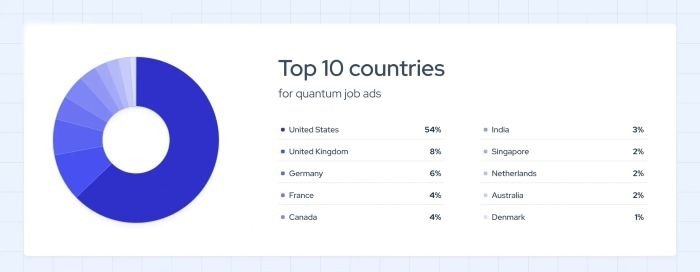 Image Credit: Coresignal
The analysis covers roughly 9,500 quantum roles posted by about 1,000 employers between 2023 and August 2026, including hardware and systems engineers building quantum processors, software developers writing quantum algorithms, research scientists, and specialists in quantum sensing and cryptography.
Key Findings
- Rapid Growth: Quantum postings in Coresignal’s dataset rose from 239 in 2024 to 2,861 in 2025 and 4,518 in the first eight months of 2026.
- Google Leads: Google posted 6.4% of quantum job ads, nearly 200 more ads than second-place IBM (4.4%). Amazon Web Services (3.0%), Infleqtion (2.7%), IonQ (2.4%), NVIDIA (2.3%), and Microsoft (2.3%) complete the top seven, followed by Booz Allen Hamilton (2.0%).
- Building the Bench: Mid-senior-level roles make up the vast majority of postings, followed by entry-level, internship and associate roles. Director and executive roles make up the smallest share.
- Software and hardware: Software development is the largest employer industry, ahead of IT services and IT consulting. Four of the top 10 industries are hardware, semiconductor, or computer and electronics manufacturing.
- U.S. Leads: The United States accounts for more than half of the postings. California, New York and Massachusetts are the top states, with hiring clustered in the Bay Area, Boston/Cambridge and the Washington, D.C.-Virginia-Maryland corridor. Goleta, California, is the city mentioned most often in quantum job ads. Outside the U.S., London and Paris lead.
“Quantum computing has been ‘a decade away’ for 30 years, but hiring data suggests the industry is now building in earnest,” said Karolis Didziulis, Product Director at Coresignal. “Most of these openings are for experienced engineers and developers, followed by early-career staff and interns, not executives. That’s what the field looks like when it’s expanding its bench.”
The hiring surge comes as investment and policy attention grow. McKinsey’s Quantum Technology Monitor 2026: A commercial tipping point reported $12.6 billion invested in quantum start-ups in 2025. At the House Committee on Science, Space, and Technology hearing on January 22, 2026, titled “Assessing U.S. Leadership in Quantum Science and Technology,” Dr. James Kushmerick, director of the Physical Measurement Laboratory at the National Institute of Standards and Technology (NIST), told U.S. lawmakers, “We are in a workforce shortage.”
Read the full Coresignal report at https://coresignal.com/blog/quantum-computing-hiring-2026/
Methodology
Coresignal analyzed more than 25,000 publicly available job ads mentioning “quantum” from its multi-source job dataset. Analysts narrowed these to more than 12,000 quantum-related postings, then to roughly 9,500 quantum development roles after removing nearly 2,900 templated “Quantum Physics Tutor” listings from a single tutoring platform. Postings date from 2023 through August 2026; postings without a date are excluded from the year-by-year counts. The data comes from English-language professional networks and job boards, so it omits many company career sites and national job boards, including most hiring in China, as well as roles whose ads do not mention quantum. A company’s absence from the rankings, such as Meta or Apple, does not mean it is not investing in quantum. All findings are based on aggregated job posting data and do not identify any individual.