A recent study published in Physical Review D looks at the physical laws that usually prevent black holes from splitting, and at the special circumstances under which a split could potentially occur.
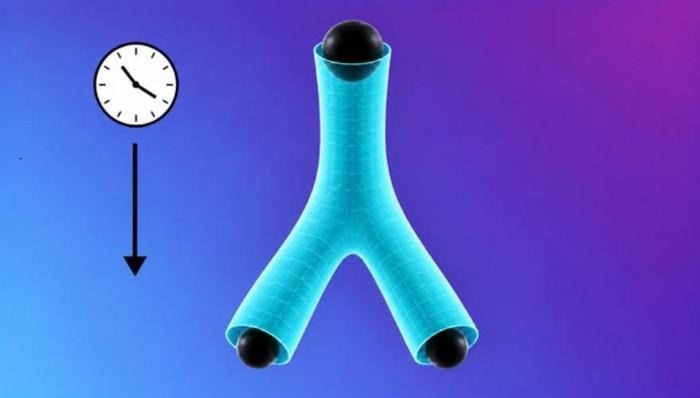 Image Credit: University of Southern Denmark
Two black holes can merge into a larger one during a collision, but could one black hole split into two?
Francesco Sannino, a co-author of the research and a physics professor at the University of Naples Federico II and the Quantum Field Theory Center at the University of Southern Denmark, decided to investigate.
The paper’s co-authors are Giacomo Cacciapaglia (a researcher at CNRS at the Laboratoire de Physique Théorique et Hautes Énergies, a joint CNRS–Sorbonne Université institute in Paris) and Manuel Del Piano and Vania Vellucci, both at the Quantum Field Theory Center.
Why Black Holes Resist Splitting
Black holes rarely split, and one major reason is thermodynamics.
A black hole has entropy, which, put simply, measures how many microscopic configurations a system can have while still presenting the same observable properties from the outside.
For a standard, non-spinning (non-rotating) black hole, splitting into two smaller black holes would reduce the total entropy, so the process is thermodynamically disfavored.
Extreme Spin Could Open a Narrow Window
The researchers’ calculations suggest rapidly rotating black holes could be an exception, allowing a split under specific conditions.
Any resulting black holes would also need to move apart. They cannot simply separate briefly and then collapse back together. Adding this requirement narrows the permitted “window” considerably. Francesco Sannino says it may only remain open for black holes spinning close to their maximum possible rate.
If a split did occur, the black hole’s outer boundary, or event horizon, would change shape over time into a trouser-like geometry, where one region divides into two distinct “legs.” This is what the authors mean by the study’s distinctive phrase: “pair-of-pants topologies.”
Extra Dimensions and More Exotic Splits
The authors also consider even less conventional scenarios. In theories with additional spatial dimensions, physicists have previously identified black-hole-like objects that can become unstable and break apart.
In some of these frameworks, a split could become thermodynamically allowed, particularly if one of the two resulting black holes is much smaller than the other. Even then, that does not mean fragmentation would necessarily happen.
We can’t yet assign a single probability for a black hole to split. It depends on how gravity works beyond Einstein’s theory, and we’re working to quantify that. We expect small primordial black holes to be more likely to split than much larger astrophysical black holes. And we might detect such a split indirectly: telescopes like Fermi-LAT could look for signals from tiny black-hole fragments that might form during mergers.
Francesco Sannino, Study Co-Author and Professor, Physics, University of Southern Denmark
Download the PDF of this page here
Journal Reference:
Cacciapaglia, G., et al. (2026) When black holes admit pair-of-pants topologies. Physical Review D. DOI:10.1103/cx69-t466. https://journals.aps.org/prd/abstract/10.1103/cx69-t466.