A “black hole star” can look like a compact stellar object from afar, but it is powered by accretion rather than nuclear fusion. In the leading model, a rapidly growing black hole is wrapped in a dense gas cocoon that absorbs and re-emits the radiation produced as material falls inward, making the system appear bright and star-like.
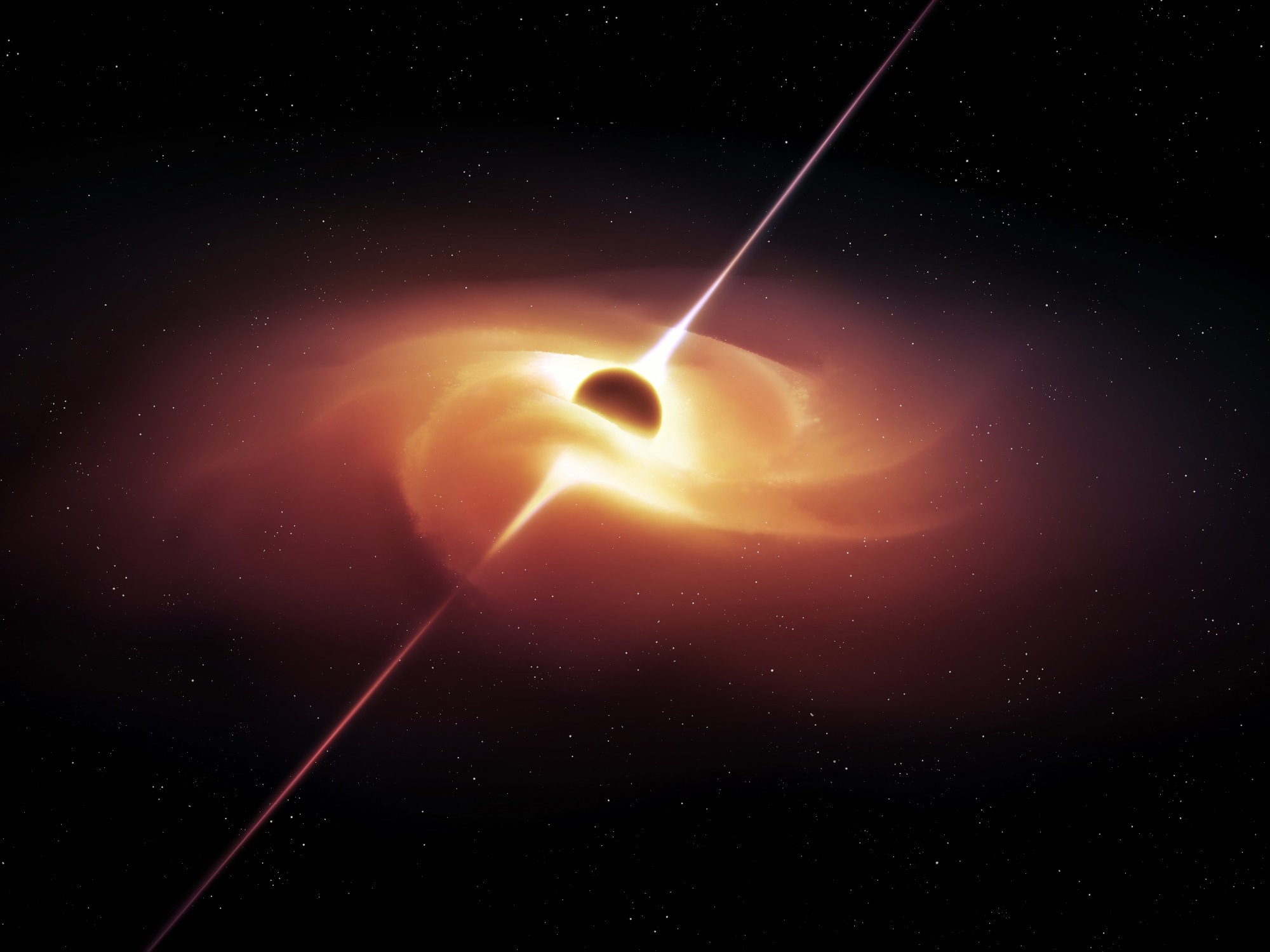
Image Credit: Nazarii_Neshcherenskyi/Shutterstock.com
Interest has risen with James Webb Space Telescope observations of the early Universe. Black hole stars have been suggested as an explanation for some “little red dots,” and the case was strengthened in June 2026 when a spectrum of GLIMPSE-17775 showed more than 40 features consistent with a fast-growing black hole buried in dense gas. This does not prove all little red dots fit the model, but it is among the strongest observational support so far.
If confirmed, these hidden, rapidly feeding black holes could help explain how massive seeds formed and grew into supermassive black holes surprisingly early in cosmic history.
Download the PDF of this article here
What are Black Hole Stars?
Black hole stars are thought to form when a black hole accretes matter rapidly while embedded in a massive, hydrostatic gas envelope.1 Unlike conventional stars, which are powered by nuclear fusion in their cores, black hole stars are powered by accretion onto the central black hole, which can generate far more luminosity than fusion.
They are also often confused with active galactic nuclei (AGN), but the two are not the same. AGN are bright galactic centers powered by supermassive black holes, typically with an accretion disk and large-scale outflows such as jets and winds.2 A black hole star, by contrast, is a compact object whose surrounding gas envelope both feeds the central black hole and absorbs and reprocesses much of the radiation, producing a star-like spectrum.3
How Could Black Hole Stars Form?
There are no confirmed theories regarding the formation of black hole stars. One of the postulates is that a large cloud of gas in the early universe may have directly collapsed into a concentrated black hole mass, forming the core, while the remaining gas comprising hydrogen and helium forms a cocoon completely enveloping the core. Experts have also suggested that these black-hole quasi stars may evolve into Little Red Dots (LRD), when the black hole has accreted around 10-15% of the total mass of the system.4
A natural formation process for black hole stars conceptualized in a recent study involves a direct collision between a stellar-mass black hole and a massive star. In the case of a less-energetic collision, the released energy isn’t sufficient to disrupt the star; rather, the drag due to gases decelerates the black hole sufficiently, so that it is retained within the stellar gaseous envelope, leading to the formation of a black hole star.5
Experts have also suggested that the massive progenitor stars in the early universe produced iron cores due to excessive fusion reactions, leading to gravitational collapse when the core reaches the Chandrasekhar limit. This triggered a supernova explosion, leading the dense core to collapse into a black hole. Under certain conditions, the core draws gaseous matter from nearby companions. A weak explosion leads to the stellar envelope of gases remaining bound to the black hole core, creating a persistent accretion disk.6
Experts are continuously utilizing data from telescopes and deep space missions to unravel the mysteries of the early universe and understand the origin and evolution of astronomical objects such as black hole stars.
Could Black Hole Stars Explain the Little Red Dots?
The James Webb Space Telescope (JWST) data has revealed a complex population of red, compact objects called the “Little Red Dots” (LRDs). These complex bodies show unusual behavior such as compact morphologies and distinctive “V-shaped” spectral energy disruptions (SEDs), making it possible only for the JWST to identify them due to its unmatched near-infrared (NIR) sensitivity.7
The properties of LRDs made it impossible to classify them, either as evolved galaxies or dusty compact galaxies. This is due to the absence of massive stellar populations straining Lambda cold dark matter (LCDM) predictions, and the absence of dust emissions.8
Previously, researchers hypothesized that point sources like LRDs exhibiting V-shaped SEDs could be AGNs. However, recent theoretical studies and observations have unearthed a new picture, where LRDs host accreting black holes surrounded by dense, ionized gas cocoons, called “black hole stars”. These exhibit star-like and black-hole-like features with broad permitted lines, steep Balmer-limit breaks, and Balmer absorption.
GLIMPSE-17775, A Black Hole Star Observed using JWST
A recent study analyzed JWST NIRSpec G395M observations of GLIMPSE-17775, a “little red dot” at z = 3.501. The spectrum contains more than 40 identified features, consistent with a dense, partially ionized gas cocoon heated by a strong ionizing source.
In the rest-frame UV (reff ≈ 1,000 pc), GLIMPSE-17775 shows an extended component and broad permitted emission lines. Exponential broad-line wings, Balmer and helium absorption, and signatures consistent with rapid, super-Eddington growth are presented as evidence for a compact accretor embedded in a dense envelope.
The O I λ8446–λ11290 line pair supports the presence of a Lyβ radiation field and a dense gas reservoir. Fourteen Fe II lines form a prominent “iron forest,” in line with Lyα fluorescence models. The observed line widths, together with high optical depths and large column densities, indicate that radiative transfer and gravitational motions are both shaping the spectrum within the surrounding cocoon, consistent with radiation-dominated gas expected in super-Eddington accretion flows.9
What Black Hole Stars Could Reveal About Supermassive Black Holes
The black hole stars that were formed about 600 years after the Big Bang were initially supplied with an extremely high rate of gas. The angular momentum didn’t allow the gas to disappear into the black hole and form a thick and dense structure around it. In short, the black hole stars are little red dots comprising a black hole wrapped in its own fuel.
In the early universe, an extraordinary supply of gases was available. Galaxies were growing rapidly, and dense gas in massive concentration was sucked into their centers. The strong radiation flow from nearby star-forming galaxies also played a crucial role in black holes gaining such extraordinary masses, also suppressing star formation in neighboring clouds.
These conditions pushed massive quantities of gaseous matter to accumulate before a rapid collapse occurred. This led to the first supermassive stars, which led to a stellar implosion developing massive black-hole seeds.
The simulations in recent studies reveal that supermassive black holes grew due to the abundance of gas reservoirs in the early universe, and the simulation process showed black hole star formation initiation with supermassive stars, reaching several hundred thousand solar masses. It was followed by a stellar collapse, leaving behind massive black hole seeds.10 In this way, black hole stars have laid the theoretical foundation for understanding the early supermassive black hole problems, with much more research needed to find a definite solution.
Larger Implications
The confirmation of the black hole star concept will cause astronomers to rethink several assumptions, especially about the early universe. The study of LRDs has shifted the astronomy world towards the direct collapse heavy seed model as mentioned above.11 As experts have begun to study LRDs, several claims of the past are being negated due to new observations and studies. The study of WISEA J123635.56+621424.2, nicknamed “Saguaro,” has provided proof denying a theory proposed in the past that LRDs form a unique class of galaxy. Recent studies prove that LRDs represent a phase in the life of supermassive black holes in which they are highly active.12
LRDs have opened up a new theoretical concept, where heavy seeds formed early in the universe, accreted for over a million years, and led to the assembly of surrounding galaxies and stellar mass. So, a novel concept that black holes were ahead of the galaxies has made us closer to answering one of the critical questions about the early universe.13
Testing the Black Hole Star Hypothesis
JWST data and the scientific equipment integrated with its platform are key for studying cosmic emissions. Frameworks like the Blue Jay survey, a Cycle 1 JWST program comprising the use of the NIRSpec micro-shutter assembly (MSA), are useful in studying the stellar and gas content of galaxies at cosmic noon.14
The study of X-ray and spectroscopic datasets for X-ray-selected AGNs over several thousand galaxies will be key for probing the dependence of AGN clustering on black hole masses, accretion rates, and luminosity with immaculate precision.15 The continuous observations and simulation modeling of larger samples will be key for determining the actual place of black hole stars as a common phase in black hole growth, or a subset of LRDs.
There is still a long way to completely understand the black hole stars, their formation, their role in the early universe, and their kinematics. The spectroscopic data from JWST and deeper space missions will prove to be key for unraveling the mysteries of the universe. However, while uncertainty surrounds black hole stars, it has certainly ushered us into a new conceptual era of understanding the early universe.
JWST isn't the only one hard at work - Check out what Nancy Grace Roman can teach us here
Further Reading
- Begelman, M.C., Rossi, E.M. and Armitage, P.J. (2008). Quasi-stars: accreting black holes inside massive envelopes. Monthly Notices of the Royal Astronomical Society, 387(4), pp.1649–1659. doi:10.1111/j.1365-2966.2008.13344.x.
- McCoy, M. and NASA (2025). What Are Active Galactic Nuclei? [online] NASA Science. Available at: https://science.nasa.gov/mission/webb/science-overview/science-explainers/what-are-active-galactic-nuclei/ [Accessed 20 Sept. 2026].
- European Research Council [ERC]. (2025). Earliest known black hole star found at cosmic dawn. [online] Available at: https://erc.europa.eu/news-events/news/earliest-known-black-hole-star-found-cosmic-dawn [Accessed 21 Sept. 2026].
- Gault, L. (2026). Starring in the Early Universe: Black Hole Stars and Little Red Dots. [online] AAS Nova. Available at: https://aasnova.org/2026/03/25/starring-in-the-early-universe-black-hole-stars-and-little-red-dots/ [Accessed 22 Sept. 2026].
- Shi, Y., Hu, Q., Xu, Z., Lin, D.N.C. and Murray, N. (2026). Formation of black hole stars via star--black hole collisions. Available at: https://doi.org/10.48550/arXiv.2608.27596
- Guide, A. (2026). 9 Black Hole Star Insights Every Astronomy Enthusiast Needs. [online] AWC Guide. Available at: https://awc.airforce.mil.ng/black-hole-star/ [Accessed 22 Sept. 2026].
- Barro, G., Pérez-González, P.G., Kocevski, D.D., McGrath, E.J., Leung, G.C.K., Cullen, F., Dunlop, J.S., Ellis, R.S., Finkelstein, S.L., Grogin, N.A., Illingworth, G., Kartaltepe, J.S., Koekemoer, A.M., Lucas, R.A., McLure, R.J. and Yang, G. (2026). A Comprehensive Photometric Selection of “Little Red Dots” in MIRI Fields: An Infrared-Bright Little Red Dot at z = 3.1386 with Warm Dust Emission. The Astrophysical Journal, 997(1), p.48. doi:10.3847/1538-4357/ae0704.
- Casey, C.M., Akins, H.B., Kokorev, V., McKinney, J., Cooper, O.R., Long, A.S., Franco, M. and Manning, S.M. (2024). Dust in Little Red Dots. The Astrophysical Journal Letters, 975(1), p.L4. doi:10.3847/2041-8213/ad7ba7.
- Kokorev, V., Chisholm, J., Naidu, R.P., Fujimoto, S., Atek, H., Brammer, G., Finkelstein, S.L., Akins, H.B., Berg, D.A., Furtak, L.J., Fei, Q., Hsiao, T.Y.-Y., Labbé, I., Matthee, J., Muñoz, J.B., Oesch, P.A., Pan, R., Rinaldi, P., Saldana-Lopez, A., Schaerer, D., Volonteri, M. and Zitrin, A. (2026). The Deepest GLIMPSE of a Dense Gas Cocoon Enshrouding a Little Red Dot. The Astrophysical Journal, 1004(2), p.153. doi:10.3847/1538-4357/ae4ed7.
- Lea, R. (2026). The James Webb Space Telescope’s mysterious Little Red Dots may be overfeeding black holes. [online] Space. Available at: https://www.space.com/astronomy/black-holes/the-james-webb-space-telescopes-mysterious-little-red-dots-may-be-overfeeding-black-holes [Accessed 23 Sept. 2026].
- ScienceDaily. (2026). JWST’s mysterious little red dots may be black holes growing at incredible speeds. [online] Available at: https://www.sciencedaily.com/releases/2026/09/260917003703.htm [Accessed 23 Sept. 2026].
- ScienceDaily. (2026). Webb’s mysterious little red dots may be hiding entire galaxies. [online] Available at: https://www.sciencedaily.com/releases/2026/08/260815064808.htm [Accessed 23 Sept. 2026].
- Farrar, O. (2026). Are ‘Little Red Dots’ Keys to Understanding the Early Universe? [online] Harvard Magazine. Available at: https://www.harvardmagazine.com/five-questions/harvard-little-red-dots-black-holes-stars-early-universe-cosmology [Accessed 23 Sept. 2026].
- Belli, S., Bugiani, L., Park, M., Mendel, J.T., Davies, R.L., Khoram, A.H., Johnson, B.D., Leja, J., Tacchella, S., Brown, V., Conroy, C., Emami, R., Li, Y., Liboni, C., Maheson, G., Mathews, E.P., Naidu, R.P., Nelson, E.J., Terrazas, B.A. and Weinberger, R. (2026). The Blue Jay survey: Deep JWST spectroscopy for a representative sample of galaxies at cosmic noon. Astronomy & Astrophysics, [online] 713, p.A237. doi:10.1051/0004-6361/202557679
- Mountrichas, G., Carrera, F.J., Shankar, F. and Georgakakis, A. (2026). Large-scale environments of star-forming active galactic nuclei: How black-hole mass, accretion rate, and luminosity connect to dark-matter halos. Astronomy & Astrophysics, [online] 708, p.A323. doi:10.1051/0004-6361/202659274.
Disclaimer: The views expressed here are those of the author expressed in their private capacity and do not necessarily represent the views of AZoM.com Limited T/A AZoNetwork the owner and operator of this website. This disclaimer forms part of the Terms and conditions of use of this website.