In a study from the University of Ottawa reports that an alternative cosmological model, where the Universe is 26.7 billion years old and does not require dark matter or dark energy, has so far passed several major tests. The study was published in the journal Universe.
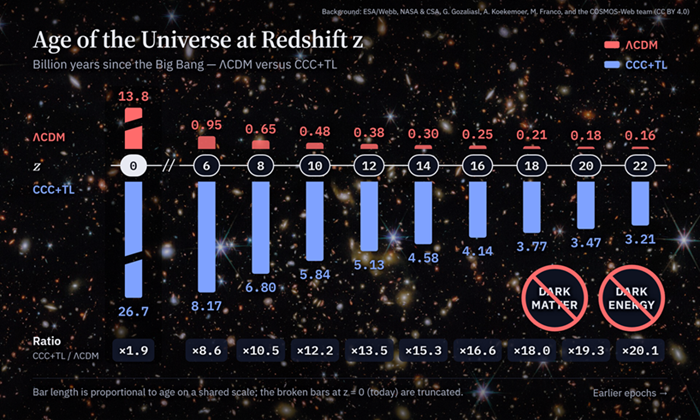 Age comparison against redshift in CCC+TL and CDM models. Image Credit: University of Ottawa
One Model, Many Observations
From 2025 to 2026, Rajendra Gupta, an Adjunct Professor in uOttawa’s Department of Physics, and postdoctoral researcher Dr. Nikolaos Samaras, tested the CCC+TL model against a wide range of key astronomical observations.
CCC+TL stands for “covarying coupling constants plus tired light.” In this model, what is normally attributed to dark matter and dark energy could instead result from fundamental constants that change over time, constants that determine how forces and particles interact.
Researchers have studied dark matter and dark energy for many years, yet neither has been observed directly. The conventional cosmological framework, referred to as ΛCDM, is also challenged by findings concerning unexpectedly developed galaxies from the early Universe.
Most emerging models explain only a limited set of observations. A new model must not conflict with the pillars of cosmology and astrophysics, and our findings meet that challenge, including the yet-to-be-published Cosmic Microwave Background challenge.
Rajendra Gupta, Adjunct Professor, Department of Physics, University of Ottawa
CCC+TL modifies the Einstein and Friedmann equations, which describe gravity and the expansion of the Universe. As a result, the researchers could not simply tweak the standard model or reuse existing software. Instead, for each experiment, they derived the CCC+TL-consistent equations and wrote custom code to implement them.
What the Tests Found
The model’s results matched several key observations. Its predictions for the amounts of hydrogen, helium, and other light elements formed soon after the Big Bang agreed with those of the standard model. It also matched results from cosmic chronometers, which use galaxy ages to estimate how quickly the Universe has expanded over time.
In a recent paper in Monthly Notices of the Royal Astronomical Society, the researchers applied the model to all 175 galaxies in the SPARC database. They reported that it could reproduce the observed rotation curves without invoking dark matter.
Separately, an analysis of time dilation in supernova observations also appears to support the model, although that work is still under review.
The team examined the Bullet Cluster as well. In this context, the additional gravitational influence that the model predicts follows the galaxies instead of the hot, X-ray-emitting gas. The researchers call this an initial proof of concept that requires further investigation.
“Observations attributed to dark matter and dark energy likely originate from covarying coupling constants,” added Professor Gupta, whose paper on the origin of dark matter and dark energy explores the idea.
More Time for Early Galaxies to Form
The model may also help explain why astronomers frequently discover substantial, mature galaxies so early in the universe's history.
In the conventional model, the Universe was estimated to be about 300 million years old during the period known as cosmic dawn. In contrast, under CCC+TL, it would be estimated to be around 4.6 billion years old at the same observed redshift.
This extra time gives galaxies more opportunity to grow and evolve. According to the researchers' calculations, early galaxies are roughly 12 times larger in both size and mass than predicted by the standard model, as indicated in Galaxies 13, 115.
Impossible early galaxies become predictable galaxies. We predict that galaxies exist well beyond the distances the James Webb Space Telescope has reached.
Rajendra Gupta, Adjunct Professor, Department of Physics, University of Ottawa
That prediction may be tested soon. The James Webb Space Telescope’s GLIMPSE program plans to study galaxies at redshifts that could exceed 50. In the standard model, there may not be enough time for substantial galaxies to form so early in cosmic history. CCC+TL, however, does not impose the same constraint.
A Model Worth Further Study
“The success should encourage astronomers to take the new model seriously. It is challenging to understand and apply, but we believe it extends the physics of the Universe beyond ΛCDM limits,” concluded Professor Gupta.
Journal Reference:
Gupta, R. P., et al. (2026) A Big Bang Nucleosynthesis Consistency Test of the CCC+TL Cosmology. Universe. DOI:10.3390/universe12070193. https://www.mdpi.com/2218-1997/12/7/193.