A research team from the University of Regensburg, Philipps-Universität Marburg, and Forschungszentrum Jülich has directly observed the ultrafast dynamics of transitions in graphene. The team describes this breakthrough in a new paper published in the prestigious international journal Nature
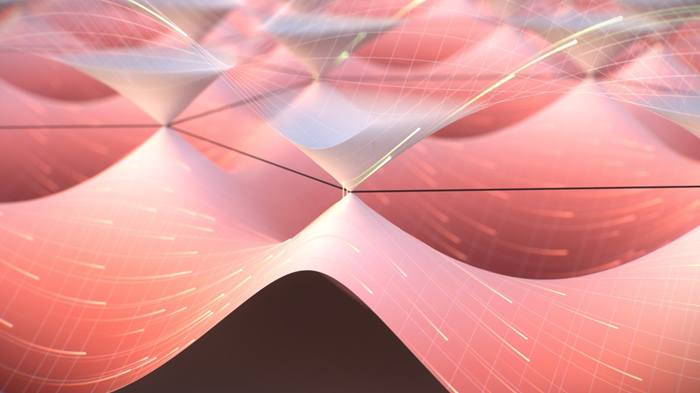 Panoramic view of the energy landscape (the band structure) of graphene. Under the influence of the extremely strong electric field of a light pulse, electrons are accelerated through the band structure (yellow stripes). If electrons in the lower band (the valence band) approach the upper band (the conduction band) fast enough, they can tunnel through the energy gap into the excited state via a Landau-Zener-Majorana transition. Image Credit: Brad Baxley (parttowhole.com)
Using a slow-motion electron camera, scientists in Regensburg, Marburg, and Jülich have shown how strong electric fields drive electrons through graphene, pushing them across energy gaps in a way that initially seems contradictory. The work was made possible by combining ultrafast laser methods with electron microscopy.
The effect can be pictured as an elevator display that jumps from “1,” “2,” or “3” straight to “20.” The elevator does not pass floors 4 through 19, but it still arrives at the twentieth. In quantum physics, this kind of “impossible” jump can occur: electrons can transition between energy states without occupying the intermediate states in between. These events are known as Landau–Zener–Majorana transitions, and researchers have long suspected they could become increasingly relevant as semiconductor electronics continue to speed up.
The researchers watched electrons being accelerated by the electric field of a light pulse and switching between energy bands as they travel. In semiconductors and similar materials, electrons can exist only within specific energy bands, separated by a band gap where states are not allowed. Under normal circumstances, electrons stay within their original bands. But during a Landau–Zener–Majorana transition, they seem to cross this “forbidden” region with surprising ease.
A Slow-Motion Camera for Electrons
The team created a new approach that combines laser technology with electron microscopy to capture these extremely rapid events.
If you want to know who has won a race, you have watch all participants. Likewise, we must observe as many electrons as possible at one time to catch those that undergo a quantum mechanical transition while moving.
Vincent Eggers, Study First Author, University of Regensburg
A device called a photoemission momentum microscope enables this. Unlike a traditional microscope that produces enlarged images, it doesn’t show pictures of the sample. Instead, it measures the electrons’ energies and motion, then uses that information to reconstruct a map of their distribution.
The main challenge was to merge electron spectroscopy with intense laser fields that oscillate extremely rapidly, so the electrons could be driven in a controlled way.
“Our team worked on this experiment for many years. Now, we can track electrons moving across the entire energy landscape of a solid in real time," stated Rupert Huber. Huber’s cooperation partner Ulrich Höfer, one of the pioneers of ultrafast electron spectroscopy, added enthusiastically: "Being able to observe such a fundamental quantum mechanical process during our first measurement campaign was a very special moment for us – it was also made possible by the samples we used."
The measurements were derived from custom-made, atomically thin layers of carbon of exceptional purity, created at Forschungszentrum Jülich.
These precision experiments require material that is nearly perfect at the atomic level. This ensures that impurities do not obscure the delicate quantum dynamics of the electrons. Another important factor for the study was the use of “rotated” graphene, a specialty from Jülich, which allows the quantum dynamics to emerge particularly clearly.
Stefan Tautz, Forschungszentrum Jülich
The slow-motion images revealed an unexpected result: under intense light fields, electrons can cross the band gap with a tunneling probability of up to 100%. What makes Landau–Zener–Majorana transitions especially striking is that they can still occur with a high probability even when the relevant energy states are clearly separated.
The key factor is the velocity of electrons near the band gap. In this context, these dynamic transitions are fundamentally different from traditional quantum mechanical tunneling across a spatial energy barrier.
A Panoramic View of the Quantum World
This innovative approach can be used to explore not only basic quantum mechanical transitions but also the factors that constrain precise electron manipulation. Observations conducted on graphene have already revealed how interactions with the crystal lattice can interfere with the initially organized movement of the electrons.
These discoveries are especially significant for advancing future technologies in which electrons are manipulated not solely by electrical voltages, but by the rapid oscillations of light.
Our experiment opens a panoramic window into the quantum world. Now, we can follow in real time how electrons move through the energy landscape of a material. And this is just the beginning. Our method can be applied to many other quantum materials, opening up completely new possibilities for controlling their electronic properties selectively with light.
Giacomo Inzani, University of Regensburg
Journal Reference:
Eggers, V., et al. (2026) Subcycle videography of Landau–Zener–Majorana transitions in graphene. Nature. DOI:10.1038/s41586-026-11214-y. https://www.nature.com/articles/s41586-026-11214-y.