Newly discovered supernova SN 2026ahvu in the nearby spiral galaxy NGC 1433 bedazzles new images from the Dark Energy Camera and the International Gemini Observatory. Caught early and still approaching its expected maximum brightness, SN 2026ahvu gives astronomers a valuable opportunity to study a stellar explosion as it unfolds. NSF NOIRLab is coordinating observations across the facilities it operates, working with its partners to maximize scientific return, and inviting other observatories to join the effort.
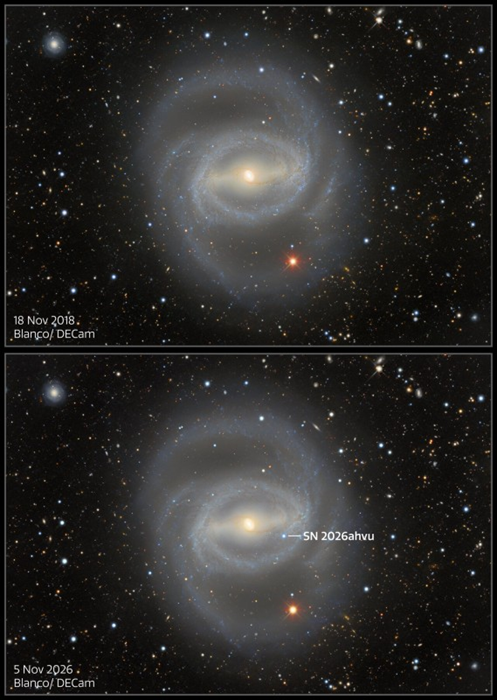 A comparison of spiral galaxy NGC 1433 before and after the detection of supernova SN 2026ahvu. The supernova appears as a very bright point of light to the right and slightly below the center of the galaxy. These images were captured by the U.S. Department of Energy-fabricated Dark Energy Camera (DECam), mounted on the U.S. National Science Foundation Víctor M. Blanco 4-meter Telescope at Cerro Tololo Inter-American Observatory (CTIO), a Program of NSF NOIRLab. DECam captured the before image as part of observations for the Dark Energy Survey (DES), a survey led by DOE's Fermi National Accelerator Laboratory, conducted from 2013–2019, to investigate the nature of dark energy. The after image was taken a few days after the Asteroid Terrestrial-impact Last Alert System (ATLAS) first detected SN 2026ahvu on 2 November 2026. The final composite also includes observations taken between 2013 and 2018. Caught early and still approaching its expected maximum brightness, SN 2026ahvu gives astronomers a valuable opportunity to study a stellar explosion as it unfolds. NSF NOIRLab is coordinating observations across the facilities it operates, working with its partners to maximize scientific return, and inviting other observatories to join the effort. Image Credit: Dark Energy Survey/DOE/FNAL/DECam/CTIO/NOIRLab/NSF/AURA Acknowledgment: PIs: G. Narayan & T. Murphey (University of Illinois at Urbana-Champaign) Image processing: M. Zamani & D. de Martin (NSF NOIRLab)
A star’s explosive demise has added a shiny new feature to NGC 1433, a barred spiral galaxy approximately 50 million light-years away in the southern constellation Horologium (the Pendulum Clock). New images of supernova SN 2026ahvu from the U.S. Department of Energy-fabricated Dark Energy Camera (DECam) and the Gemini South telescope capture the explosion against its galactic surroundings, recording an event that is changing in appearance from night to night.
DECam is mounted on the U.S. National Science Foundation Víctor M. Blanco 4-meter Telescope at Cerro Tololo Inter-American Observatory (CTIO) in Chile, a Program of NSF NOIRLab. Gemini South is one half of the International Gemini Observatory, an international collaboration led by the NSF, in partnership with Canada, Chile, Brazil, Argentina, and the Republic of Korea, and operated by NSF NOIRLab.
The Asteroid Terrestrial-impact Last Alert System (ATLAS) discovered the object on 2 November 2026. Initially designated AT 2026ahvu, it was subsequently confirmed through spectroscopy to be a young Type Ia supernova – an explosion of a white dwarf that has accreted matter from a close companion star – and received the designation SN 2026ahvu. At discovery, its apparent magnitude was approximately 17; within days, observations reported it at magnitude 13.5.
The supernova, visible to the right and slightly below the galaxy’s center, is expected to reach a maximum brightness of magnitude 10.5–12.1 between 18 and 23 November. Its discovery well before reaching peak brightness, combined with its relative proximity, gives astronomers the rare and valuable opportunity to witness the early development of the explosion and gather evidence that can quickly disappear as the expanding debris evolves. This is one of the nearest Type Ia supernova observed since SN 2011fe was discovered in the Pinwheel Galaxy (Messier 101) in 2011.
Type Ia supernovae arise from the thermonuclear destruction of white dwarfs, the dense remnants of stars like our Sun. Although astronomers use these explosions to measure cosmic distances, important questions remain about the stellar systems that produce them and precisely how they ignite. Observations during the earliest stages can help distinguish between possible explosion scenarios and search for signs of interaction with a companion star or surrounding material.
DECam also captured images of NGC 1433 before the explosion during observations for the Dark Energy Survey (DES), a survey led by DOE’s Fermi National Accelerator Laboratory, conducted from 2013–2019, to investigate the nature of dark energy. DECam’s images allow astronomers to compare the supernova’s environment pre- and post-explosion. Combined with the sharper Gemini imaging that provides a more in-depth view of the system, these observations demonstrate how combining NOIRLab facilities enables deeper investigation into rapidly changing phenomena in the night sky.
NOIRLab is coordinating follow-up observations with Blanco/DECam, Gemini, and the Southern Astrophysical Research (SOAR) Telescope on Cerro Pachón in Chile. Combining these facilities gives astronomers a more complete picture of the supernova. Repeated imaging tracks how its brightness and color evolve, while spectroscopy shows what the expanding material is made of and how fast it is moving. By following the explosion from its first days through its peak brightness and into its long fade, researchers can learn about the system before it exploded and the mechanism of the explosion. Together, these clues help astronomers refine Type Ia supernovae as a tool for measuring the expanding Universe.
Telescopes on the ground and in space are already turning their attention to SN 2026ahvu. NOIRLab invites other observatories to contribute complementary observations that would extend coverage across wavelengths and time zones. Coordinating these efforts can capture changes that any single facility might miss and help astronomers maximize what can be learned from this nearby explosion.
The event is also within reach of amateur astronomers. At its reported brightness, SN 2026ahvu can already be seen in small to moderately sized amateur telescopes under favorable conditions, particularly from southern locations where NGC 1433 rises high in the sky. To the eye, the supernova appears as a faint point of light, offering observers the chance to witness the changing glow of an exploding star in another galaxy.
The new DECam and Gemini images capture one moment in that unfolding story. Over the coming weeks, observations from professional and amateur astronomers will help trace its evolution, gathering clues to the physics of stellar explosions and the cosmic distance markers that help us measure our Universe.