For the first time, an international team of researchers from Germany, Thailand, India, China, and the United States has realized a three-component Hubbard system in the laboratory with tunable interactions. Using a quantum gas microscope, the researchers directly imaged individual atoms in the system. Reported in Science, the work provides an important experimental platform for future quantum simulations relevant to nuclear physics and materials science.
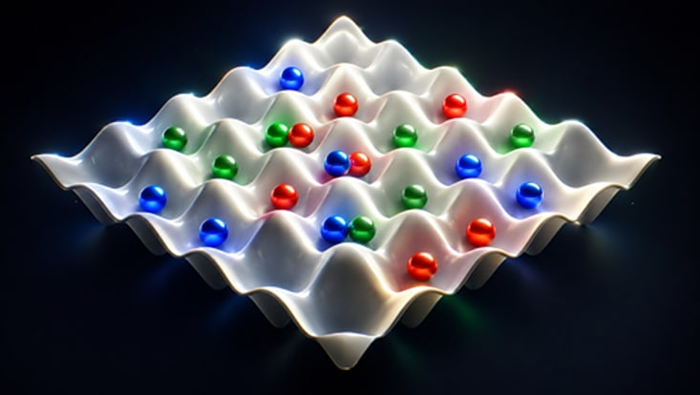 The illustration shows fermionic atoms of three flavors in an optical lattice. A quantum gas microscope can detect each atom individually with spatial resolution, allowing precise control of interactions. Image Credit: UHH/Schauss
Ultracold atoms are often used to create systems that mimic those in solid-state physics. In this scenario, the fermionic atoms serve as a substitute for electrons within a solid. This setup is distinctive because it implements a Hubbard model, one of the most important frameworks for describing fermion interactions on a lattice. This approach is considered particularly promising for gaining insights into high-temperature superconductivity.
The standard Hubbard model usually includes two spin states, spin-up and spin-down. Introducing a third component greatly expands the range of phenomena the system can explore, allowing researchers to study more complex quantum mechanical phases.
Ultracold atoms trapped in an optical lattice provide an ideal platform for quantum simulation. At the lowest energy level of the lattice, the atoms form a quantum system where they can tunnel between neighboring lattice sites, exchanging positions. Identical fermions cannot occupy the same site, but when distinguishable fermions come together on a single site, an interaction energy appears that depends on the applied magnetic field.
Strong Interactions Prevent Particles from ‘Flowing’ Freely
In the current study, the group led by Professor Peter Schauss, currently engaged in research at the University of Hamburg and within the Cluster of Excellence “CUI: Advanced Imaging of Matter,” has, for the first time, realized a three-component Hubbard model using ultracold atoms with adjustable interactions. The team also aimed to identify fundamental states and phases during the experiment.
It was particularly important to us to observe a so-called Mott state, in which the interactions suppress the double occupation of sites.
Peter Schauss, Professor, University of Hamburg
Strong interactions block particles from moving freely between lattice sites, producing an insulating behavior. Paradoxically, high-temperature superconductivity appears near these Mott states.
The team used a quantum gas microscope, which can image individual atoms with high spatial resolution. By preparing atoms in different internal states, they effectively created different fermion species, allowing them to implement three distinct components. While the setup is not a literal analog of electrons moving through a crystal lattice, it has a clear parallel in nuclear physics, where quarks come in three “colors.”
The Experimental Realization was Surprisingly Stable
It turned out that the experimental realization is surprisingly stable. Usually, one fears that three-body collisions could quickly destroy the system. Despite this potential danger, we were able to successfully carry out the measurements and observe a Mott insulator.
Peter Schauss, Professor, University of Hamburg
The researchers also observed many additional phases. Which phase appears depends on the interaction strength between the three atomic states. For instance, in the same system they found that ferromagnetic correlations can develop between one pair of states, while antiferromagnetic correlations emerge between another pair.
Furthermore, the researchers developed a technique to identify the number of triple-occupied lattice sites. The observed measurements were consistent with the numerical results computed by collaborators at Rice University. In the long run, the researchers intend to enhance the interactions in their model to enable the investigation of lattice models pertaining to quantum chromodynamics (QCD) within a laboratory setting.
Journal Reference:
Liu, L., et al. (2026) Quantum gas microscopy of three-flavor Hubbard systems. Science. DOI:10.1126/science.adv1247. https://www.science.org/doi/10.1126/science.adv1247.