Astrophysicists at the University of British Columbia (UBC) and the University of Sheffield suggest that one of cosmology’s greatest mysteries, dark energy, may actually be explained by the established laws of particle physics. The study was published in The Astrophysical Journal.
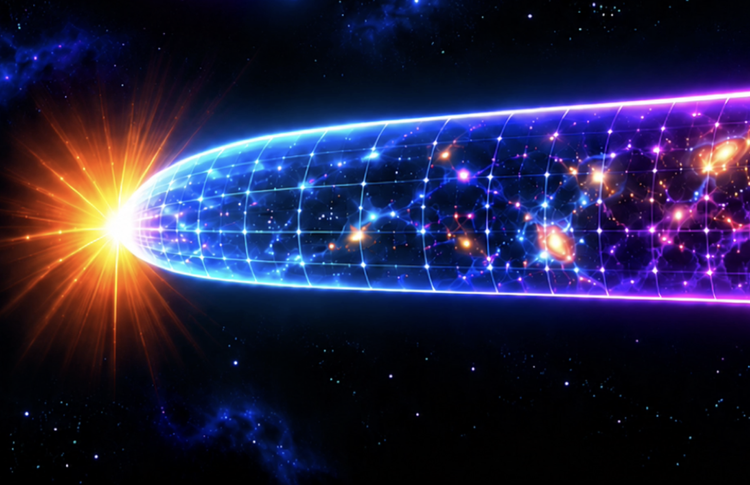 Researchers at the University of British Columbia and University of Sheffield are proposing dark energy could emerge from the Standard Model of particle physics. Rendition of the expansion of the Universe. Image Credit: B. Pfeiffer, with AI-assisted production.
For nearly thirty years, scientists have tried to understand how dark energy drives the accelerating expansion of the universe. Although it makes up roughly 70 percent of the cosmos's total energy budget, its physical nature and origin remain unknown. Most leading theories rely on hypothetical new particles or fields, none of which have ever been observed in experiments.
The UBC and Sheffield team proposes a surprising alternative: dark energy could stem from the exact same fundamental physics that holds atomic nuclei together. Rather than requiring exotic new physics, the answer may already be built into the Standard Model.
Dark energy could be explained by a fundamental framework called quantum chromodynamics (QCD). QCD is a well-established theory describing the strong nuclear force that binds quarks inside protons and neutrons.
Our theoretical framework suggests no new particles may be required at all. The characteristic energy scale predicted from the QCD vacuum and gravity comes out close to the observed dark-energy scale today without having to introduce an ad-hoc new field nor new parameter.
Ariel Zhitnitsky, Professor, Physics and Astronomy, UBC
UBC Professor Ludovic Van Waerbeke adds: “The most striking result is that the observed dark-energy scale emerges naturally from known physical constants, without the need for any additional fitting parameters.”
In quantum physics, empty space is never truly void; it is a dynamic environment filled with subatomic fields and quantum energy. Within QCD, this quantum vacuum possesses topological properties capable of influencing space across cosmic distances. The UBC researchers proposed that as the universe expands, this subatomic vacuum structure evolves over time, producing an energy shift strong enough to accelerate cosmic expansion on its own. Researchers at the University of Sheffield then tested this theoretical model against current astronomical observations.
The idea that the quantum vacuum as described by QCD could have the right properties to account for the accelerated expansion of the universe is very intriguing. It raises the possibility that dark energy could be connected to the established theory of the strong nuclear force, without introducing new fundamental fields. Testing models based on this idea against cosmological data is an essential step.
Dong Ha Lee, Study Lead Author and PhD Researcher, University of Sheffield
“Our analysis shows that such a model can reproduce the evolving dark energy behavior suggested by current observations. This motivates further theoretical work to better understand how the QCD vacuum responds to cosmic expansion and to develop predictions that can be tested with future observations,” notes Dong Ha Lee.
When tested against real astronomical observations, including light from distant exploding stars (supernovae) and relic radiation from the early universe, the model performed as accurately as standard cosmological frameworks while offering a plausible physical explanation for the origin of dark energy.
Building on these results, the researchers plan to sharpen their calculations and test the model with incoming data from next-generation space telescopes, which will reveal the universe's history in unprecedented detail over the coming years.
Journal Reference:
Zhitnitsky, A., et al. (2026) Evolving Dark Energy Is Vacuum Energy After All. The Astrophysical Journal. DOI:10.3847/1538-4357/aeb9cc. https://iopscience.iop.org/article/10.3847/1538-4357/aeb9cc.