Researchers at the Department of Energy’s Oak Ridge National Laboratory are working to improve how dark matter might one day be detected. By developing new quantum measurement and quantum optical sensing techniques, ORNL scientists are looking for ways to observe this unusual, unseen, yet seemingly pervasive material. Their study was published in Physical Review Research.
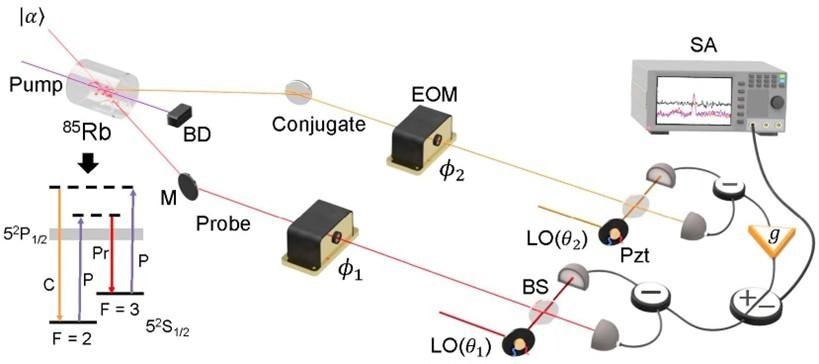 Scientists have utilized the unique properties of quantum states of light to implement distributed, quantum-enhanced sensing. Image Credit: ORNL, U.S. Dept. of Energy
ORNL is drawing on its deep expertise and technical capabilities to deliver safer, faster, and more reliable solutions at the quantum scale. This work reflects the lab’s broader commitment to supporting an innovative, quantum-enabled future while strengthening energy competitiveness and security.
With its heightened sensitivity, quantum sensing opens the door to detecting phenomena that were previously beyond reach, from uncovering new material properties to probing the fundamental building blocks of the universe.
Experimental and Theoretical Approaches Illuminate Invisible Particles
To that end, Claire Marvinney and Alberto Marino of ORNL's Quantum Sensing and Computing Group, together with other collaborators at ORNL and in Korea, successfully carried out a distributed sensing experiment. They used quantum noise reduction to quantify two optical phase shifts utilizing a two-mode, compressed light source in a nonlinear interferometer setup.
No time now? Download the PDF for later
Their theoretical extension from a two-mode to an M-mode (or an entangled, distributed sensing configuration that measures parameters among separated sensors, allowing precision to exceed classical limits) revealed an additional quantum measurement enhancement beyond that of squeezing alone.
Optomechanical sensors – think of them as little membranes or drums – move back and forth when you apply a force on them. The idea is that dark matter will interact with these membranes and make them move. By using light, particularly by shining a laser beam on it, we can detect the membrane’s motion. With quantum light, such as squeezed light that exhibits reduced noise properties, we can better detect that motion, enhancing the sensitivity of the measurement.
Alberto Marino, Group Leader, Quantum Sensing and Computing Group, Oak Ridge National Laboratory
Dark matter is thought to account for most of the universe’s matter, yet the particles that make it up remain unknown and largely theoretical. It cannot be observed with telescopes or other light-based instruments because it does not interact with electromagnetic radiation in any detectable way. Even so, scientists can infer its presence through its gravitational effects on visible matter, which reveal how it shapes galaxies and the broader structure of the universe.
Quantum Sensing Drives Particle Detection Innovation
The researchers employed two distributed sensors and two quantum resources to improve detection sensitivity: squeezing, which reduces quantum noise below the classical optical limit, and entanglement, which involves quantum connections between optical beams.
We wouldn’t be able to reach the sensitivity limits required to detect dark matter classically. We need a quantum advantage, so we’re using these two resources to improve our sensor, demonstrating proof-of-principle improvements.
Claire Marvinney, Research Scientist, Oak Ridge National Laboratory
The researchers' findings effectively show the use of squeezing and entanglement as resources for quantum improvement inside a distributed network of quantum sensors.
The distributed sensing scheme uses optomechanical systems to measure the average signal from multiple independent sensors, enabling quantum-enhanced detection of their collective motion. By relying on light to detect extremely small mechanical movements, the approach increases sensitivity to distributed signals that affect all of the sensors simultaneously.
The findings are expected to strengthen efforts in sensitive phase measurements, including ongoing direct-detection searches for dark matter. They also lay the groundwork for ultrasensitive measurement techniques through proof-of-principle experiments designed to simulate dark matter interactions.
With a two-mode, squeezed light source, the initial two modes are entangled. We can start with entanglement directly from the source and build from there, leveraging that source, so that’s the novel new approach that we’re using.
Claire Marvinney, Research Scientist, Oak Ridge National Laboratory
There may be many types of dark matter particles spanning a wide range of energy scales, and theoretical physicists do not always agree on how these particles may have formed after the Big Bang. As part of this effort, Marvinney and Marino are developing techniques to search for ultralight dark matter, one of two candidates identified as potentially detectable through a fifth-force interaction using an array of optomechanical sensors, as outlined in the 2022 Snowmass Windchime white paper. This particular candidate could be extraordinarily light, on the order of ten billionths of a trillionth of an electron’s mass.
Marino, discussing the high density of bosonic dark matter with ultralight mass, added, “Ultralight mass dark matter is like a wave, and if you have a lot of sensors, they will interact collectively with this dark matter wave and see the same signal, in the sense that they are all measuring the same signal, and the readout is an average measurement of all the sensors. When we have conditions like these, we’re looking at approaches where we can leverage quantum resources such as entanglement to make more accurate measurements.”
Adding Measurement Precision with Quantum Light
The quest for small particles necessitates precise tools and a great deal of patience. Interferometers are accurate measurement instruments that can detect changes in the interference of waves induced by the motion of one of the interferometer mirrors, allowing researchers to draw conclusions about the particles or fields that interact with the mirror.
Quantum-enhanced sensing systems based on squeezing and entanglement improve measurement precision, making them more potent than conventional measurement techniques. By demonstrating the benefits of squeezing as well as the additional benefit of entanglement in the sensor's probing light, scientists can improve the sensitivity of the joint measurement and detect previously unobservable faint signals for a better understanding of particle behavior and our physical world.
“The dark matter signal is expected to be so tiny that we need every advantage we can get. Not only do we want to take advantage of a giant array that’s all going to detect this, but we want to utilize the types of quantum noise reduction and entanglement that we can add to the detection, so we can reduce the noise and enhance our measurement,” Marvinney added.
Searching for dark matter is a bit like mapping the ocean floor into a grid while looking for a lost ship: each experiment can investigate only one small square at a time. Around the world, research teams are working on different sections of that same grid, gradually linking their findings as results come in. As more data is gathered, previously viable areas are ruled out, narrowing the search for either a missing vessel, or the elusive particles that may make up dark matter.
However, even finer dividing lines inside a single examined grid square can allow for the detection of even smaller objects, such as the broken-up bits of a lost vessel, that were previously too small to see. The researchers "zoomed in" on the examined grid square by enhancing the sensitivity of their systems utilizing quantum noise reduction via the nonlinear interferometer.
This meticulous, reductive procedure highlights even smaller details inside the narrowly defined quadrant of "ocean floor" that the team is scanning, allowing for the study of previously invisible features within this once-ruled-out region. Adding entanglement helps the researchers to increase their tests' signal-to-noise ratios, revealing weaker signals or, in the case of the missing ship, even smaller components that have broken away.
The two-mode squeezed state that we use in our experiments is comprised of two entangled optical beams. The entanglement, or quantum correlations, between them lead to squeezing, or reduced noise, when joint measurements are made. We can leverage the squeezing property to reduce the noise floor of the measurement – and make it more sensitive – by probing optomechanical sensors with the two-mode, squeezed states.
Alberto Marino, Group Leader, Quantum Sensing and Computing Group, Oak Ridge National Laboratory
Marino added, “For an array of sensors there are approaches that probe each sensor separately with independent quantum states of light to obtain a quantum enhancement via reduced noise. It is also possible to leverage the entanglement, or quantum correlations between multiple – in our case, optical beams – to perform a collective measurement of multiple sensors and obtain a larger enhancement.”
The finding of dark matter will undoubtedly have a significant impact, whether it discloses the presence of previously unknown particles, corrects our knowledge of gravity, or launches a new understanding of black hole processes. It is anticipated to solve puzzles ranging from astronomy and galaxies to the seemingly limitless particles that flow between them, revealing what drives their behavior, revising the current physics model, and rewriting our collective understanding of the universe.
“The very long-term goal is dark matter detection. What we’re doing now is developing the necessary techniques – proof-of-principle, fundamental experiments to set the foundation,” Marino stated.
Although this first "mapping the sea floor" method is laborious and time-consuming, sensing capabilities improve with each new measurement tool and technique, such as squeezing and entanglement, and search sensitivities rise in anticipation of a discovery that has significant ramifications for the study of physics.
“Dark matter will help explain not only how our universe was made, but also its components. It will help people understand fundamental physics and how additional particles and forces exist,” Marvinney noted.
Researchers from Yonsei University (Seoul), the Korea Institute of Science and Technology (Seoul), and the Korea Research Institute of Standards and Science (Daejeon) also contributed to this study.
Phase I of the Quantum Science Center at ORNL, the DOE Office of High Energy Physics' QuantISED program, and the Korean government grants all helped support the research. ORNL continues to support the quest for quantum innovation by advancing world-class scientific discovery to allow a quantum revolution that has the potential to revolutionize a wide variety of technologies important to American competitiveness. ORNL's 2025 celebration of the International Year of Quantum Science and Technology embodies these characteristics.
Download the PDF of this page
Sources:
Journal Reference:
Hong, S., et.al. (2026) Quantum-enhanced distributed phase sensing with a truncated SU(1,1) interferometer. Physical Review Research. DOI: 10.1103/PhysRevResearch.7.023231. https://journals.aps.org/prresearch/abstract/10.1103/PhysRevResearch.7.023231.
Oak Ridge National Laboratory