A striking image from NASA's Hubble Space Telescope shows the Egg Nebula’s dynamic light-shadow interaction, which is shaped by recently expelled stardust.
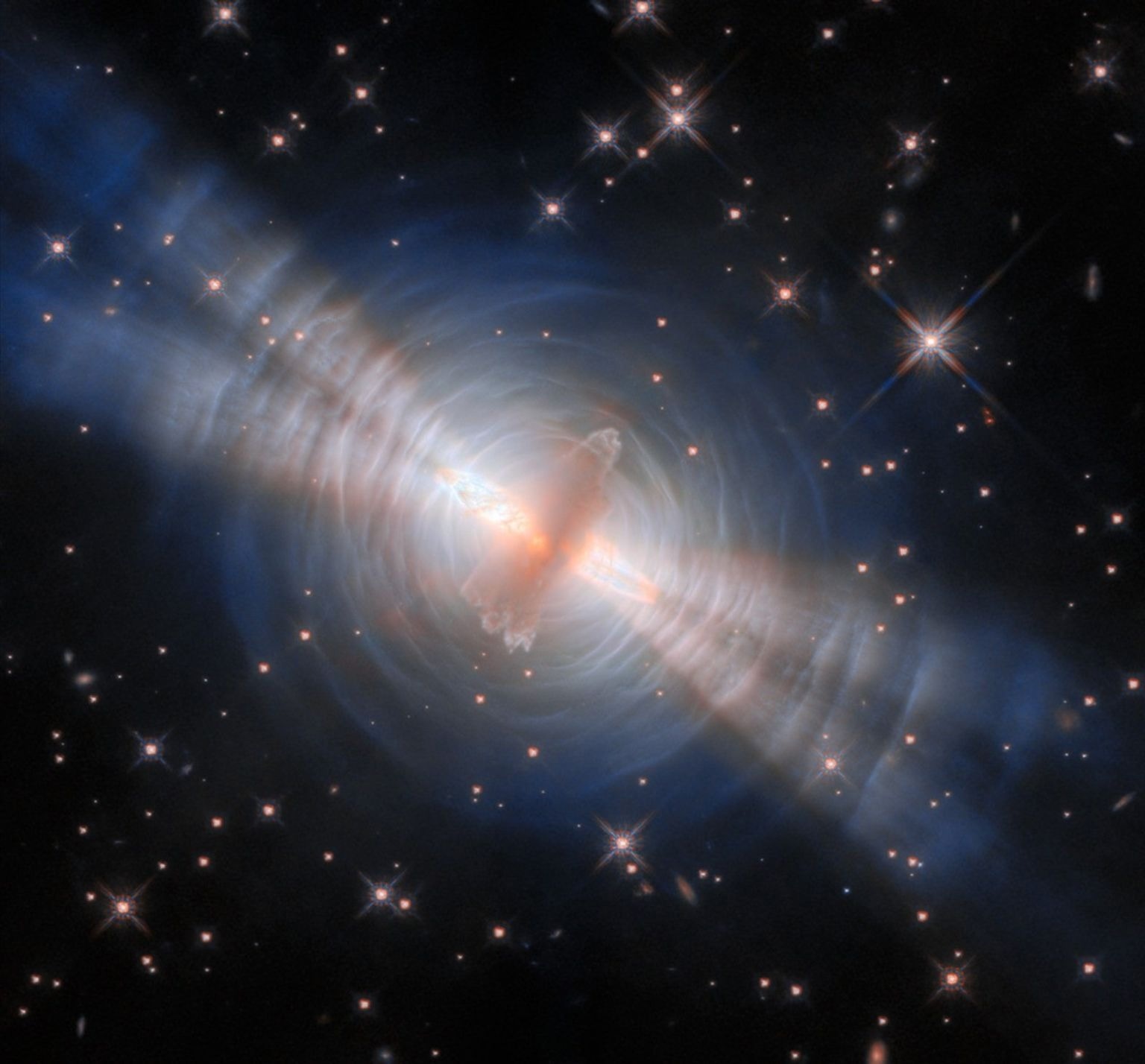 NASA’s Hubble Space Telescope reveals the clearest view yet of the Egg Nebula. This structure of gas and dust was created by a dying, Sun-like star. These newest observations were taken with Hubble’s Wide Field Camera 3. Image Credit: NASA, ESA, Bruce Balick (UWashington)
The Egg Nebula, located roughly 1,000 light-years away in the constellation Cygnus, features a central star concealed within a dense cloud of dust, like a yolk hidden inside a dark, opaque egg white. Its intricate structure, shaped by stellar winds and expanding shells of gas, remains largely invisible to most telescopes. Only Hubble’s exceptional resolution can uncover the fine details that hint at the processes behind this enigmatic formation.
The Egg Nebula holds the distinction of being the first pre-planetary nebula ever discovered, and it's also the youngest and closest of its kind. Pre-planetary nebulae represent a brief transitional phase in the life of a star similar to our Sun, occurring just before it evolves into a full-fledged planetary nebula. These structures form when a dying star sheds its outer layers, creating expanding shells of gas and dust. Despite the name, planetary nebulae have no connection to planets. The term is a historical misnomer dating back to early telescopic observations, when their round shapes reminded astronomers of distant planets.
The Egg Nebula offers a rare opportunity to test theories about the final stages of stellar evolution. At this early phase, light from the hidden central star escapes through a narrow polar opening, often called an "eye", in the surrounding dust, making the nebula appear to shimmer. This light reflects off a dusty disk that was expelled from the star’s surface just a few hundred years ago, providing a glimpse into the dynamic processes shaping the nebula in real time.
Twin beams from the fading star illuminate fast-moving polar lobes, which cut through a slower, older sequence of concentric arcs. Their forms and movements point to gravitational interactions with one or more unseen companion stars, all buried deep beneath the dense disk of stardust.
When stars exhaust their hydrogen and helium fuel, they begin to shed their outer layers. The exposed core heats up dramatically, emitting intense radiation that ionizes the surrounding gas and creates the glowing shells seen in planetary nebulae such as the Helix, Stingray, and Butterfly. The Egg Nebula, however, is still in the short-lived pre-planetary stage, a fleeting transition that lasts only a few thousand years. Its compact form and still-forming structure offer a rare opportunity to study the mass ejection process while the clues are still fresh and accessible, like a cosmic crime scene frozen in time.
Hubble's symmetrical patterns are too tidy to be caused by a powerful explosion, such as a supernova. Instead, the arcs, lobes, and central dust cloud were most likely caused by a coordinated series of poorly known sputtering events in the dying star's carbon-rich core. Aged stars like the one at the heart of the Egg Nebula play a vital role in the cosmic cycle. Through their final stages, they create and release heavy elements into space, material that later becomes the building blocks for new stars and planetary systems.
Hubble has already observed the Egg Nebula. An initial visible-light photograph from the telescope's WFPC2 (Wide Field and Planetary Camera 2) was supplemented in 1997 by a near-infrared NICMOS (Near Infrared Camera and Multi-Object Spectrometer) image, which provided a closer look at the nebula's brightness.
In 2003, Hubble’s ACS (Advanced Camera for Surveys) provided a fresh image of the Egg, revealing the entire expanse of the dust ripples around it. Another view from WFC3 (Wide Field Camera 3) in 2012 focused on the center dust cloud and spectacular gas outflows. This new image combines the data used to make the 2012 image with additional observations from the same program, providing the finest view yet of this exquisite cosmic egg.