A team of physicists at the University of Massachusetts Amherst recently hypothesized that the event that occurred in 2023, when a subatomic particle called a neutrino crashed into Earth with such high energy that it should have been impossible, occurs when a special type of black hole, known as a “quasi-extremal primordial black hole,” explodes. The results were reported in Physical Review Letters.
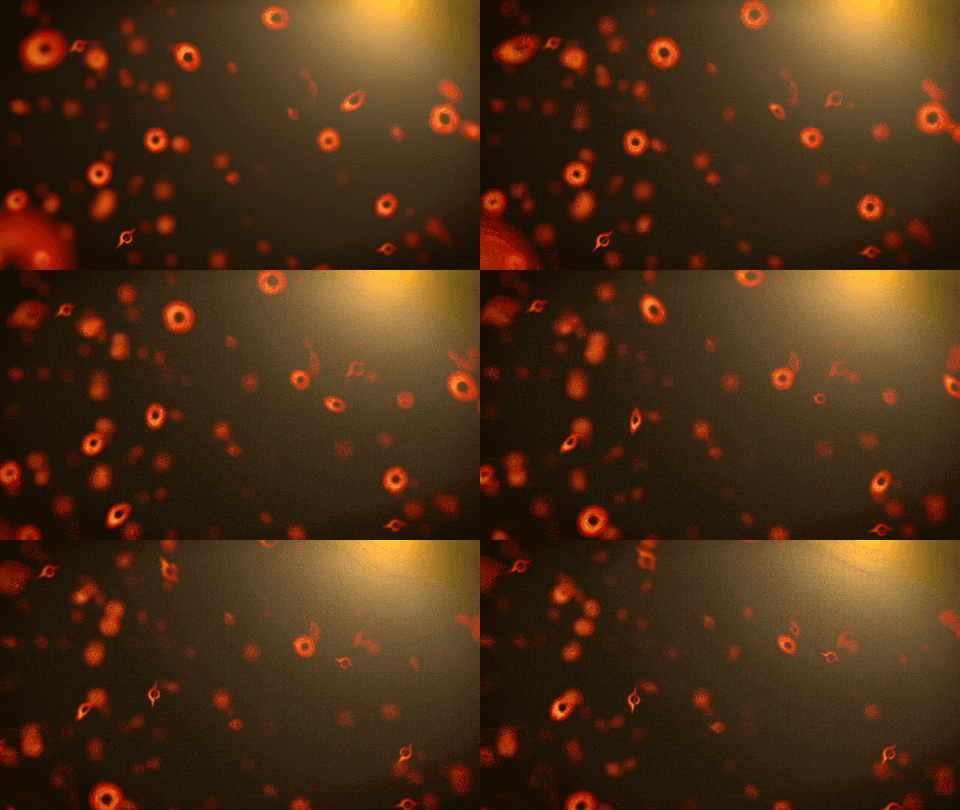 Did we just see a black hole explode? UMass Amherst’s physicists think so. This artist’s concept takes a fanciful approach to imagining small primordial black holes. Image Credit: NASA’s Goddard Space Flight Center
In fact, no known sources in the cosmos can generate such energy: 100,000 times greater than the highest-energy particle ever created by the Large Hadron Collider, the world's most powerful particle accelerator.
In the study, the team not only sheds light on the elusive neutrino but also explores how this elementary particle could reveal deeper insights into the fundamental structure of the universe.
The life cycle of a black hole is well understood: an old, large star runs out of fuel, implodes in a very strong supernova, and leaves behind a region of spacetime with such extreme gravity that nothing can escape from it, not even light.
However, as physicist Stephen Hawking suggested in 1970, a different kind of black hole, known as a primordial black hole (PBH), could have formed under the extreme conditions present shortly after the Big Bang, rather than from the collapse of a dying star. PBHs are considered “black” for the same reason as traditional black holes: their immense density makes it nearly impossible for anything, including light, to escape. That said, PBHs remain purely theoretical at this point, with no direct evidence confirming their existence.
PBHs may be far lighter than the black holes we have seen thus far, despite their density. Additionally, Hawking demonstrated that if PBHs heated up sufficiently, they could release particles gradually through what is now referred to as “Hawking radiation.”
The lighter a black hole is, the hotter it should be and the more particles it will emit. As PBHs evaporate, they become ever lighter, and so hotter, emitting even more radiation in a runaway process until explosion. It’s that Hawking radiation that our telescopes can detect.
Andrea Thamm, Study Co-Author and Assistant Professor, Physics, University of Massachusetts Amherst
If such an explosion were to be observed, it would provide researchers with a definitive catalog of all subatomic particles known to exist, including those that are already observed, such as electrons, quarks, and Higgs bosons, those that were only hypothesized, such as dark matter particles, and everything else that science has yet to discover.
The UMass Amherst team has already shown that these types of explosions happen surprisingly often (roughly once every decade) and that, with careful observation, today’s astronomical instruments are capable of detecting them.
Up to this point, however, the evidence remains purely theoretical.
Then, in 2023, an experiment known as the KM3NeT Collaboration detected that elusive neutrino, the very kind of evidence the UMass Amherst team had predicted was within reach.
However, there was a problem: a similar experiment, IceCube, which is also designed to detect high-energy cosmic neutrinos, not only missed the event entirely, but had never recorded anything approaching even a tenth of its intensity. If the universe is relatively packed with primordial black holes and they're erupting as frequently as suggested, shouldn’t we be seeing a steady stream of high-energy neutrinos? So what accounts for the gap between expectation and observation?
We think that PBHs with a ‘dark charge’ – what we call quasi-extremal PBHs – are the missing link. The dark charge is essentially a copy of the usual electric force as we know it, but which includes a very heavy, hypothesized version of the electron, which the team calls a “dark electron.
Joaquim Iguaz Juan, Study Co-Author and Postdoctoral Researcher, Physics, University of Massachusetts Amherst
“There are other, simpler models of PBHs out there; our dark-charge model is more complex, which means it may provide a more accurate model of reality. What’s so cool is to see that our model can explain this otherwise unexplainable phenomenon,” said Michael Baker, Study Co-Author and Assistant Professor, Physics, UMass Amherst.
“A PBH with a dark charge, has unique properties and behaves in ways that are different from other, simpler PBH models. We have shown that this can provide an explanation of all of the seemingly inconsistent experimental data,” added Thamm.
The researchers are certain that their dark-charge model PBHs can not only explain neutrinos, but also solve the puzzle of dark matter.
Observations of galaxies and the cosmic microwave background suggest that some kind of dark matter exists.
Michael Baker, Study Co-Author and Assistant Professor, University of Massachusetts Amherst
“If our hypothesized dark charge is true, then we believe there could be a significant population of PBHs, which would be consistent with other astrophysical observations, and account for all the missing dark matter in the universe,” added Iguaz Juan.
“Observing the high-energy neutrino was an incredible event. It gave us a new window on the universe. But we could now be on the cusp of experimentally verifying Hawking radiation, obtaining evidence for both primordial black holes and new particles beyond the Standard Model, and explaining the mystery of dark matter,” concluded Baker.
Sources:
Journal Reference:
Baker, M., J., et al. (2025) Explaining the PeV neutrino fluxes at KM3NeT and IceCube with quasiextremal primordial black holes. Physical Review Letters. DOI: 10.1103/r793-p7ct. https://journals.aps.org/prl/accepted/10.1103/r793-p7ct
University of Massachusetts Amherst