AZoQuantum spoke with Dr. Mažena Mackoit-Sinkeviciene to discuss how leading-edge research is bridging the gap between fundamental science and real-world applications. In this interview, she shares the motivations driving her work, the technical challenges her team is addressing, and how recent developments are expanding the field’s potential. Covering everything from the broader scientific landscape to the intricate details of current experiments, the conversation offers a clear and compelling snapshot of where the research stands today, and where it may go next.
Congratulations on the 2025 Baltic Women in Science Fellowship. In your view, which specific milestone or experimental breakthrough most convinced the jury of your impact in quantum technologies?
Thank you. This recognition is deeply appreciated. As a theoretical quantum physicist, my impact is not defined by a single isolated result, but by theoretical frameworks that enable and guide experiments over time. I believe the jury was most convinced by the lasting impact and translational relevance of my theoretical contributions across two distinct yet complementary quantum platforms, spanning solid-state quantum emitters and ultracold atomic systems.
A key milestone in my work on point defects in diamond and hexagonal boron nitride as quantum emitters. Together with collaborators, I developed a microscopic theoretical model identifying the carbon dimer defect as the origin of ultraviolet quantum emission in hBN. While purely theoretical at the time, this model was experimentally confirmed several years later, in 2025, by multiple international groups, including researchers at CNRS Université de Montpellier. This delayed experimental validation demonstrated that the theory was not only correct, but sufficiently predictive to guide complex experimental efforts in quantum communication materials and their practical integration into quantum photonic platforms.
Equally important was later work on nonclassical spin states in ultracold atomic gases, where we developed analytically tractable and experimentally realistic models for spin squeezing relevant to quantum-enhanced metrology and sensing. I think the jury recognized this combination of theory, experimental relevance, and cross-platform thinking, as well as my broader engagement with the quantum community through policy work, education, and European quantum initiatives. Taken together, these elements reflect an impact that goes beyond individual results and contributes to the long-term development of quantum technologies.

Image Credit: GarryKillian/Shutterstock.com
What other current or past work has made the biggest impact on you?
Moving from solid-state quantum emitters in diamond and hBN to ultracold atomic systems broadened my perspective on how coherence and noise limit quantum technologies. While these challenges are typically encountered at the level of individual defects in solid-state platforms, cold-atom systems provide a natural setting to study how engineered quantum correlations can mitigate their impact at the collective level.
This shift deepened my understanding of how coherence control, noise mitigation, and Hamiltonian engineering operate across very different physical platforms in quantum technologies. It also strengthened my appreciation for analytically tractable models that remain experimentally realistic.
What metrological limits are you currently pushing, and what novel strategies are you using to surpass them?
My work addresses the standard quantum limit in precision measurements, particularly in frequency metrology relevant to advanced timekeeping. This limit arises from quantum projection noise inherent to uncorrelated atomic ensembles. To surpass it, we develop spin-squeezing protocols based on engineered atom–light interactions in ultracold fermionic systems. A key novelty is the use of position-dependent laser phases and spin–orbit coupling to generate effective one-axis and two-axis twisting dynamics without requiring strong intrinsic interactions. These strategies are compatible with existing cold-atom platforms and offer realistic pathways toward enhanced precision in optical clocks and quantum sensors.
What new physics emerge when atoms interact with structured light compared with plane-wave illumination, and how are you probing those effects experimentally?
Structured light, particularly beams carrying orbital angular momentum and spatially varying polarization, enables new light–matter coupling channels. Unlike plane waves, such fields imprint their spatial phase and polarization structure directly onto atomic coherence. In our work, this manifests as phase-dependent dark states, orbital angular momentum exchange, and polarization-controlled transparency in atomic media.
These effects enable spatially resolved control of quantum states and open possibilities for high-dimensional quantum information encoding. By exploiting additional degrees of freedom, such as orbital angular momentum, frequency, and spatial modes, the approach goes beyond the conventional two-level qubit paradigm.
We probe these phenomena by analytically solving the Maxwell–Bloch equations for vector vortex beams interacting with multi-level atomic systems, providing quantitative predictions that can be directly tested experimentally.
Download the PDF of the interview
Could you walk us through a recent experiment that exemplifies your group’s approach to extracting weak signals from noisy backgrounds?
A good example is our recent work on generating spin squeezing in an atomic Fermi–Hubbard system using laser-induced coupling. In this experiment, the signal we aim to extract is very weak: a reduction of quantum noise below the shot-noise limit, which appears in spin fluctuations rather than in mean populations.
Our approach is to engineer the system so that this weak quantum signal is protected and structured. By operating in the Mott-insulating regime and applying position-dependent laser coupling, we generate controlled one- and two-axis squeezing dynamics. The squeezing is extracted through Ramsey-type measurements by scanning spin quadratures and identifying the minimum variance relative to a calibrated shot-noise reference.
What characterizes our approach is that we do not rely on amplification. Instead, we design the dynamics so that genuine many-body correlations have a predictable and robust signature, allowing them to be distinguished reliably from technical noise. This is important because surpassing the shot-noise limit enables higher measurement precision without increasing atom number, which is essential for next-generation atomic clocks and quantum sensors.
Where do you see the most promising application routes for your techniques (e.g., quantum sensing, navigation, time-keeping, or fundamental-constant tests), and what technical gaps must be closed to move from lab demos to deployable devices?
The most promising application routes for our techniques are quantum-enhanced time-keeping and quantum interferometry. Spin-squeezed states directly improve phase and frequency sensitivity, which is central to optical atomic clocks and interferometric measurements. Improved clock stability also has downstream implications for navigation and GPS-like systems, where precise time synchronization determines positioning accuracy.
Beyond clocks, these methods are highly relevant for precision interferometry and tests of fundamental physics. In a recent review paper with international collaborators, I summarized progress on large-scale atom interferometer prototypes and discussed future applications of squeezed-state atom interferometry for detecting ultralight dark matter and gravitational waves. This work highlights how reducing quantum noise through squeezing is becoming a key ingredient for next-generation interferometric sensors.
The main technical gaps toward deployable devices include extending coherence times, scalable and robust preparation of squeezed states, and integration into compact, stable platforms. Our work contributes by proposing experimentally feasible schemes compatible with existing cold-atom, clock, and interferometry architectures, helping to bridge the gap between laboratory demonstrations and real-world quantum sensors.
Which cross-disciplinary or cross-institutional partnerships have been most critical to your progress, and what capabilities did they unlock?
International collaborations with experimental groups in Europe, the United States, and Australia have been essential. These partnerships ensured that my theoretical work remained experimentally grounded and, in several cases, directly informed experimental design and interpretation. Equally important were interdisciplinary interactions bridging condensed matter physics, quantum optics, and atomic physics. These collaborations unlocked capabilities that would not be accessible within a single subfield.
How do you plan to leverage this award to accelerate your research agenda and broaden the Baltic community’s role in quantum science?
I plan to leverage this award to accelerate my research agenda while strengthening the international visibility of Baltic quantum science. On the scientific side, the award will support deeper integration of my work on quantum metrology and quantum emitters into European quantum research programs, enabling new collaborations and joint projects with leading groups.
Equally important, I see this award as a tool for community building. I aim to use it to connect early-career researchers from the Baltic region to European quantum initiatives. Beyond individual research results, one of the most impactful aspects of my career has been contributing to the development of the quantum ecosystem in Lithuania through work on the National Quantum Agenda, co-founding the Lithuanian Association of Quantum Technologies (Quantum Lithuania), and representing the country in the Quantum Flagship Community Network. These experiences reshaped my view of my role as a scientist. They made clear that long-term impact requires not only excellent research, but also education, coordination, and international integration. Going forward, I plan to use this award to strengthen regional leadership in quantum science and ensure that the Baltic community is not just a participant, but a visible and active contributor to the global quantum ecosystem.
About the Speaker
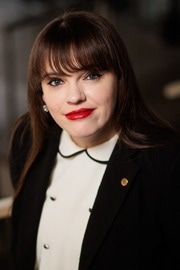
Dr Mažena Mackoit-Sinkeviciene is a researcher at the Institute of Theoretical Physics and Astronomy, Faculty of Physics, Vilnius University, working in the fields of quantum optics and quantum technologies. Her research focuses on quantum emission from point defects in solid-state platforms (including hBN and diamonds) and nonclassical spin states in ultracold atomic gases, topics directly linked to the development of quantum computers, optical atomic clocks, and quantum sensors. Her findings have already been applied in the work of international experimental collaborators. For her academic and scientific achievements, she has received several prestigious awards, including the Lindau Nobel Laureate Meeting Alumnus distinction, the Lithuanian Government Award, the Young Scientist Prize of the Lithuanian Academy of Sciences, the Dr Karol Mey Scholarship, and recognition from the European Physical Society (Young Minds section) and most recently the 2025 Baltic Women in Science Fellowship awarded by the Baltic National Academies of Sciences and UNESCO National Commissions. Dr Mackoit-Sinkeviciene is one of the co-authors of Lithuania’s National Quantum Guidelines, represents the country in the European Quantum Flagship network, serves as Vice President of the Lithuanian Physical Society, and is a board member of Quantum Lithuania.
Disclaimer: The views expressed here are those of the interviewee and do not necessarily represent the views of AZoM.com Limited (T/A) AZoNetwork, the owner and operator of this website. This disclaimer forms part of the Terms and Conditions of use of this website.