A team of researchers from the University of Chicago's Pritzker School of Molecular Engineering (UChicago PME) has used Quantum Machine Learning (QML) to identify cancer early. Their innovative approach was described in the journal Bioactive Materials.
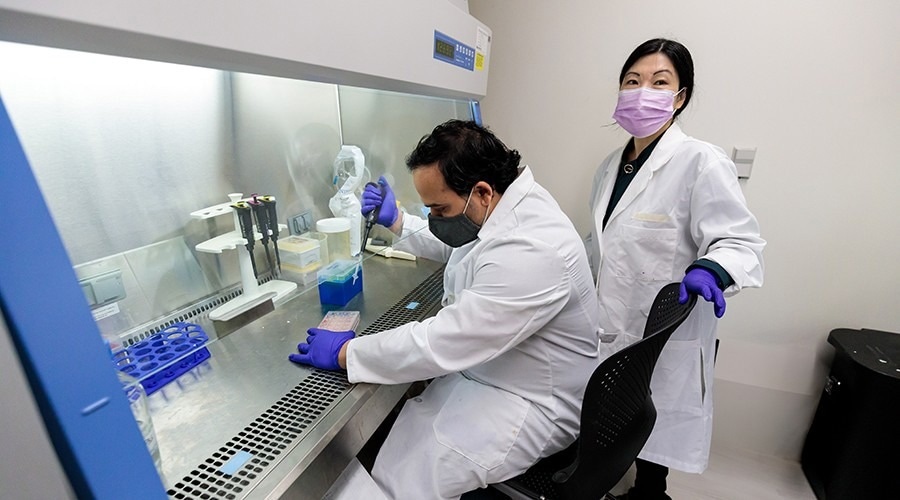 First author Abhimanyu Thakur (left) and Asst. Prof. Joyce Chen (right) of the University of Chicago Pritzker School of Molecular Engineering were part of a research team that outlined a new technique for cancer detection using Quantum Machine Learning. Image Credit: Jason Smith
A novel technology significantly outperforms traditional methods in distinguishing exosomes, microscopic particles released by cells, from cancer patients and those from healthy individuals, offering a promising advance in cancer detection.
This is the first application of the Quantum ML on exosomes’ as well as nanoparticles’ biomechanical characteristics. Nobody has done this so far. Traditionally, many different methods have been used to distinguish these particles, but those are time-consuming and tedious.
Abhimanyu Thakur, Study First Author, Ben May Department for Cancer Research, The University of Chicago
Thakur, who is currently affiliated with Harvard Medical School's Department of Neurosurgery, worked with renowned cancer specialist Joyce Chen, a UChicago PME and Ben May Center Assistant Professor. Chen described the findings as “the first piece of work” from her team, which combines quantum machine learning with cancer research.
In my lab, I always encourage the next-generation researchers to think about interdisciplinary approaches to do the research. The traditional way is not the only way to solve these problems. This combined methodology can often solve these big problems better.
Joyce Chen, Assistant Professor, Ben May Department for Cancer Research, The University of Chicago
Peers in the field claimed this is a better approach to identify cancer “long before symptoms appear or a lump shows up on a scan.”
By training a quantum-inspired algorithm to spot subtle electrical ‘fingerprints’ of nanoparticles and exosomes in a blood sample, the research team from UChicago shows a fast, label-free way to tell healthy cell vesicles from tumor-derived ones. That means a clinician could potentially detect cancer earlier, and monitor it more frequently, without the time, cost, or invasiveness of a traditional biopsy.
César de la Fuente, Presidential Associate Professor, University of Pennsylvania
AI for Health Care
Exosomes, which are tiny particles containing biological materials including proteins, lipids, and nucleic acids, are produced by all cells. However, according to Thakur, cancer cells emit them in “tremendous amounts.” Exosomes, like other extracellular vesicles, are unable to proliferate like cells, yet this abundance of biological information gives researchers a potent tool for diagnosing cancer.
They mimic their parent cells. That's how exosomes have become a very important platform for liquid biopsy. Because they mimic their originating cells, they can be used to predict what is going on in the originating cells.
Abhimanyu Thakur, Study First Author, Ben May Department for Cancer Research, The University of Chicago
According to Thakur, the “gold standard” for utilizing these exosomes and other nanoparticles to identify cancer is transmission electron microscopes, which are enormous devices that need a lot of lab space and may cost up to $1 million.
The group approached this issue in a creative way. The scientists examined the particles' electrokinetic characteristics rather than the laborious procedure of tagging, labeling, and differentiating which exosomes originated from cancerous cells and which from healthy ones.
The algorithms to identify these faint electrical signals were designed with assistance from co-author Asst. Prof. Jianpan Huang of the University of Hong Kong's Department of Diagnostic Radiology.
“Machine learning has been extensively applied across various fields in daily life and research. However, its application in the identification of nanoparticles and exosomes remains largely underexplored. This opportunity to work on a multidisciplinary project offers a promising avenue for us to collaborate by leveraging our respective expertise,” Huang added.
Next Steps
This novel process opens up a wide range of possible applications in biopharmaceutics, including pharmacokinetics (the study of what the body does to a drug) and pharmacodynamics (the study of what a drug does to the body), in addition to earlier, better cancer detection.
More data is needed to train and refine the machine learning algorithms in order to achieve this healthier future.
Huang further added, “It is important to note that the current demonstration was conducted using a single dataset. Future research involving datasets from multiple centers would be valuable to validate and strengthen these findings, as well as to further refine the methodology. Multi-center validation is essential for translating this technology into practical, real-world applications.”
Testing the procedure on various cancer types is part of this.
Chen concluded, “The hurdle is, biological systems are complex. We have to adapt our algorithm and software to the real systems. For example, this research studied colorectal cancer. If you apply it to lung cancer or bladder cancer, that might not work very well. We need to retrain the machine before we are to continue to see promising results.”
Sources:
Journal Reference:
Thakur, A., et.al. (2025) Quantum machine learning-based electrokinetic mining for the identification of nanoparticles and exosomes with minimal training data. Bioactive Materials. DOI: 10.1016/j.bioactmat.2025.03.023. https://www.sciencedirect.com/science/article/pii/S2452199X25001331
The University of Chicago Pritzker School of Molecular Engineering