Mauve, the world’s first commercial space science satellite, has successfully achieved ‘first light’, returning data to scientists about the universe for the first time.
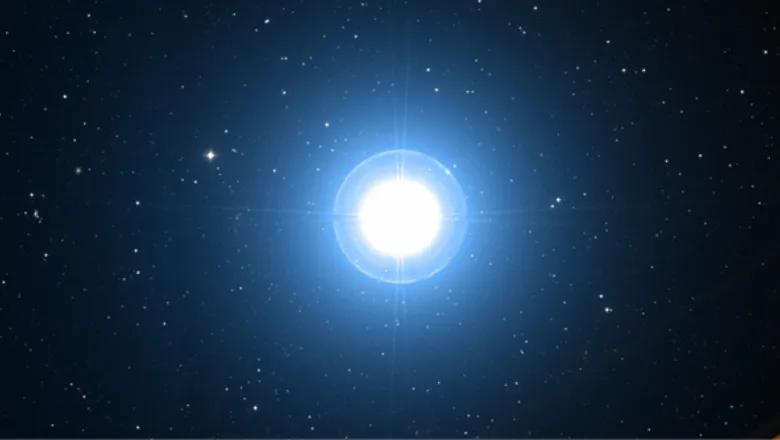 Image of Eta UMa generated using ESA Sky. Image Credit: ESA/DSS2 (Digitised Sky Survey)
Mauve, created by Blue Skies Space Ltd., a British space company co-founded by current King's faculty and alumni, will study stars in ultraviolet and visible light, allowing for a better understanding of their magnetic activity, stellar flares, and how they affect the habitability of nearby exoplanets.
The company believes that the craft would usher in a new era of exploration based on low-cost, rapidly built space telescopes that provide high-quality data about the universe directly to researchers.
The launch of Mauve has been a really emotional moment – seeing the project we worked hard for a number of years being sent to space! But as a scientist the real excitement comes when the data start flowing in: seeing the first spectrum from Mauve has suddenly made me realize that we’ll soon do science with the first privately funded space science mission ever!
Giovanna Tinetti, Vice Dean (Research), Professor, Faculty of Natural, Mathematical and Engineering Sciences, King’s College London
Giovanna Tinetti is the co-founder of Blue Skies Space.
Mauve used its 13 cm spectrophotometric telescope, engineered to analyze and collect data on the spectrum of light emitted by stars, to study Eta UMa, a star located 104 light-years away in the constellation Ursa Major, also known as the Great Bear.
Eta UMa, a blue-white star far hotter than the Sun, emits ultraviolet light, making it a perfect calibration target for an observatory collecting ultraviolet data such as Mauve.
Blue Skies Space was founded to provide access to space science data for scientists worldwide through a fleet of small, agile satellites. The first light from Mauve is a demonstration of this vision to serve the space science community.
Dr Marcell Tesseny, Chief Executive Officer and Co-Founder, Blue Skies Space
During its three-year mission, Mauve hopes to collect data on early-stage planetary evolution, test gravity theories through the examination of binary star systems, and chart how stars live and die, in addition to research priorities identified by researchers who participate in Mauve’s observational program.