Large-area Earth observation increasingly relies on optical systems that combine compact design, a wide field of view, and high optical performance.
A space camera optical system based on an off-axis four-mirror freeform design is one such solution, offering a 70° ultra-wide field of view from a 640 km orbital altitude.
This system is an ideal example of the capacity of freeform optics and advanced integration techniques to unlock new potential in spaceborne imaging.
Mission Objectives
This project required the development of a space camera system able to:
- Capture wide-area coverage in a single pass
- Maintain radiometric and geometric accuracy across the entire field
- Reliably function in Low Earth Orbit (LEO)
The system balances field of view and resolution to achieve optimal revisit time and surface coverage, making it ideally suited for environmental monitoring, agriculture, and other large-scale change-detection applications.
Optical Design Highlights
Ultra-Wide Field of View: 70 °
The system delivers an extremely wide 70 ° field of view. This capability is rarely achieved without considerable aberrations, but was made possible by an off-axis four-mirror optical configuration carefully optimized to correct for coma, distortion, and astigmatism across the entire field.
Orbit Altitude and Swath Width
The system achieves a ground swath width of 800 km at an altitude of 640 km. Its powerful capabilities enable coverage of large regions in a single pass, making it ideally suited for missions prioritizing rapid temporal coverage and large-area mapping.
Ground Resolution
The system’s 16-meter ground resolution would be considered moderate by current high-resolution standards, but this is sufficient for regional-scale analysis, including forest mapping, vegetation monitoring, and surface change detection.
Technical Challenges and Solutions
Off-Axis Freeform Optics
The design necessitates the precise fabrication of off-axis aspheric and freeform mirrors. These mirrors are inherently more difficult to produce than standard rotationally symmetric optics, with each mirror requiring tight surface figure tolerances to maintain image quality over the large field.
Solutions to these challenges included:
- Advanced CNC polishing and sub-aperture figuring approaches
- Using custom null optics for the interferometric testing of off-axis segments
- Freeform metrology is able to measure complex surface shapes
Precision Alignment and Integration
It is also important to note that off-axis systems are extremely sensitive to alignment errors. To mitigate this, the team implemented:
- Kinematic mounts and precision adjustment stages to enable simpler assembly
- Metrology-guided alignment procedures that leveraged laser trackers and optical benches
- Thermal compensation strategies designed to ensure in-orbit stability
Outcomes
The developed camera system was able to successfully demonstrate:
- Reliable in-orbit imaging performance
- Consistent wide-area data collection
- Long-term structural and optical stability
Its architecture continues to serve as a reference model for wide-swath Earth observation systems that prioritize speed and coverage over fine spatial resolution.
These types of off-axis freeform designs are key enablers for wide-field, high-performance space imaging. It is essential to have an extensive knowledge of freeform fabrication and integration to realize these systems, however.
The combination of a 70 ° field of view, a 640 km orbit, and 800 km swath width delivers strategic value for monitoring applications that require broad coverage and rapid revisit.
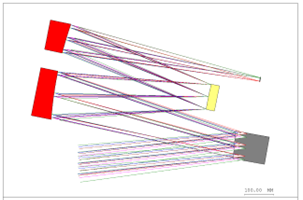
A design of a space camera optical system with a 70 ° field of view. Image Credit: Avantier Inc.
Looking Ahead
Demands on Earth observation continue to evolve, with these types of systems offering a scalable platform. Future improvements could potentially focus on:
- The integration of higher-resolution detectors
- The deployment of these systems as part of constellation-based architectures
- Expansion into hyperspectral or multispectral capabilities
Acknowledgments
Produced from materials originally authored by Avantier Inc.

This information has been sourced, reviewed, and adapted from materials provided by Avantier Inc.
For more information on this source, please visit Avantier Inc.