Optical quantum computing has the potential to revolutionize computation, tackling problems that continue to be intractable for even the most advanced classical supercomputers.
While this transformative technology essentially leverages the precise manipulation of light particles or photons, Avantier’s advanced custom optics are more than components; rather, they are fundamental building blocks designed to directly drive the success of next-generation quantum systems through enabling the control, detection, and integrity of quantum information.
This article looks at the fundamentals of optical quantum computing, highlighting why high-performance optics are key to unlocking its full potential.
Understanding Optical Quantum Computing
Optical quantum computing is regularly referred to as ‘photonic quantum computing’. This technology harnesses photons as qubits, which are the basic units of quantum information.
Various quantum computing platforms exist, but optical quantum computing differs from other quantum computing modalities in that it leverages the unique properties of light to perform complex calculations.
One prominent approach is Linear Optical Quantum Computing (LOQC). LOQC sees quantum information processed using fundamental optical elements such as:
- Beam splitters that create superpositions and entangle photons
- Phase shifters that enable the precise manipulation of photon phase
- Waveplates that control photon polarization
- High-efficiency photon detectors that are key to the effective measurement of quantum states and the enabling of probabilistic quantum gates
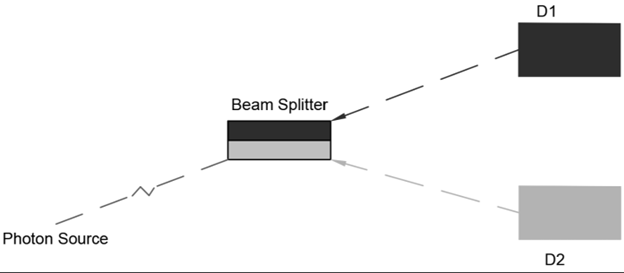
Single-photon input at beamsplitter; detectors measure transmission or reflection outcome. Image Credit: Avantier Inc.
Because this approach relies on light means, the quality and precision of each optical component can directly affect system performance, fidelity, and scalability.
Avantier’s custom optics are specifically engineered to ensure the ultra-low loss and high stability required for delicate quantum operations. These optics are helping to transform how quantum information is detected, processed, and ultimately, stored.
The Current Landscape of Optical Quantum Technologies
The field of optical quantum computing continues to advance rapidly, moving from theoretical concepts to increasingly complex experimental prototypes. Progress is undeniable, even though the field is still in its nascent stages and faces notable challenges in scalability, error correction, and maintaining qubit coherence.
Pioneering companies and research labs are already showcasing the potential of quantum solutions for use in specialized applications such as:
- Materials science, where quantum solutions are used to simulate complex molecular structures for new material development and drug discovery.
- Optimization problems, where quantum solutions are used to determine optimal solutions for finance, logistics, and resource allocation.
- Machine learning, where quantum solutions are key to accelerating a range of machine learning algorithms.
Classical computers currently dominate in terms of affordability and widespread application, but quantum operations’ inherent advantages signal a future where optical quantum computing plays a pivotal role. Today’s advances in precision optics are directly shaping this future.
Optics are also fundamental to the broader quantum ecosystem.
Photonic Integrated Circuits (PICs): The Miniature Quantum Labs
Like electronic integrated circuits, Photonic Integrated Circuits (PICs) orchestrate the flow of light on a chip, replacing electrons with photons. PICs are transformative in quantum computing, enabling the miniaturization and integration of complex optical circuits required for quantum operations.
PICs see regular use in medical diagnostics, biosensors, and ‘labs-on-a-chip.’ They are also essential for:
- Scalable qubit architectures that integrate multiple quantum components on a single chip, resulting in reduced size and complexity
- Improved stability, thanks to robust platforms designed for precise photon manipulation
- Reduced loss, including minimal signal degradation over short distances on the chip
Avantier specializes in custom optical solutions designed to either complement or integrate into PIC designs. These solutions offer the precise light control required in highly sensitive quantum systems.
Quantum Communications: Unbreakable Security and Future Networks
Optics are also central to quantum communication, a field set to transform secure data transfer.
Quantum Key Distribution (QKD)
QKD leverages the principles of quantum mechanics, using individual photons as qubits to transmit cryptographic keys. QKD’s power stems from quantum superposition, whereby a qubit may exist as 0, 1, or both simultaneously, and quantum entanglement, whereby two qubits are linked, irrespective of distance.
Should an eavesdropper attempt to measure or intercept these photons, their quantum state would be instantly altered, alerting the communicating parties. This ensures a level of demonstrable security that is fundamentally impossible via classical encryption methods.
Quantum Teleportation
Quantum teleportation involves the transfer of a quantum state from one location to another without the need to physically move the particle itself. This is not matter teleportation in its theoretical sense, but it continues to be key to future quantum networks due to its potential to distribute entanglement over long distances.
It is possible to relay this information via single photons, photon modes, or even single atoms.
There are challenges associated with the practical deployment of large-scale quantum networks, including scalability, noise reduction, and the need for robust error correction.
Avantier’s custom optics are engineered to meet these demanding requirements, with ultra-low-loss optical fibers, high-precision beam-steering components, and specialized detectors, directly facilitating the development of resilient, high-fidelity quantum communication infrastructure.
A further key use of optics in optical quantum computing involves the powering of quantum communications networks.
There are already examples of quantum light networks on a limited scale, and it is expected that these networks will rapidly expand in the coming years. Large-scale quantum networks are in development, with engineers currently working to address issues around noise reduction, scalability, and automated error corrections.
High Numerical Aperture (NA) Objective Lenses in Quantum Systems
High NA objective lenses also play a critical role in other quantum computing modalities, most notably those involving trapped-ion and atomic systems. These specialized lenses are essential in a range of applications.
Precision Qubit Addressing
Precise focusing is vital for implementing quantum gates and state preparation, and it is necessary to achieve extremely tight focus to individually address and manipulate single atoms or ions with laser beams.
Efficient Photon Collection
Maximizing the collection efficiency of photons emitted from single atoms or ions is key to enabling high-fidelity state readout, quantum networking, and entanglement generation. A higher NA enables the collection of a larger cone of light, leading to considerably enhanced signal-to-noise ratios.
High-Resolution Imaging
High-resolution in situ imaging of individual atoms or ions within optical traps or lattices enables the study of quantum effects at the single-particle level and allows researchers to verify experimental setups.
Optical Trapping and Cooling
Many quantum experiments require the creation and maintenance of tightly confined optical traps, or ‘tweezers’, that can isolate and cool atoms or ions to ultra-cold temperatures.
There are unique challenges associated with the design and manufacture of high-NA objectives for quantum applications, including the need for wavelength-specific optimization, low aberrations, and compatibility with cryogenic or ultra-high-vacuum environments.
Avantier: A Trusted Partner in Quantum Optics
Avantier understands the close link between the future of computing and communication and developments in photonics and quantum mechanics. As a leader in custom optical solutions, the company is uniquely positioned to offer precision optics able to meet the rigorous demands of optical quantum computing and a range of other quantum technologies.
Avantier’s commitment to innovation and quality is reflected in its range of experience, expertise, and services.
Unrivaled Expertise
Avantier’s designers and optical engineers boast in-depth knowledge around the design and manufacture of micro-optics and complex objective lenses, thriving on the challenges posed by this groundbreaking technology. This expertise is key to the careful manipulation and collection of photons in quantum systems.
Advanced Manufacturing Capabilities
Avantier leverages state-of-the-art manufacturing processes and equipment to produce components that boast exceptional precision and consistency. This includes advanced polishing techniques for demanding surfaces, thin-film coating for specific quantum wavelengths, specialized assembly for high NA objectives, and the manufacture of cryogenic/vacuum-compatible optics where required.
Precision Metrology
Avantier’s rigorous in-house metrology ensures that complex high NA objectives and other optical components consistently meet the most stringent specifications for wavefront quality, high transmission, low scattering, and thermal stability. These characteristics are vital for maintaining qubit coherence and fidelity across different quantum platforms.
Customization and Collaboration
Avantier excels at rapid prototyping and developing custom solutions. The company’s team works closely with developers and researchers to translate cutting-edge theoretical designs into reliable, high-performance optical hardware tailored to its customers’ quantum experimental setups.
The company stands behind every optic produced in its facilities and is confident that these optics are empowering the next generation of quantum breakthroughs.
Acknowledgments
Produced from materials originally authored by Avantier Inc.

This information has been sourced, reviewed, and adapted from materials provided by Avantier Inc.
For more information on this source, please visit Avantier Inc.