Synergy between the primary optics and sensor in precision imaging defines the entire system’s operational boundaries. A significant amount of optical potential can be lost to the ‘crop factor’ when adapting high-performance full-frame optics to specialized sensors, for example, APS-C, M4/3, or industrial formats.
This article looks at the use of a Precision Telecompressor to overcome this limitation. Rather than simple mechanical adaptation, this advanced optical relay is designed for the total optimization of the optical path, overcoming physical limitations and improving both resolution density and signal integrity by intelligently compressing the image field.
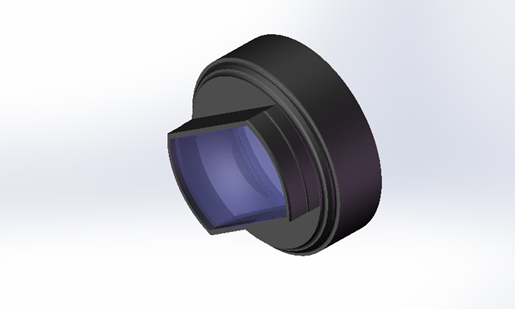
Design and Production of Decoupling Lens 3D Simulation by Avantier. Image Credit: Avantier Inc.
The Core Concept: System-Level Performance Optimization
The Precision Telecompressor functions as a critical interface, managing light energy between the primary lens and the imaging surface to achieve two key technical objectives.
Image Field Realignment and MTF Optimization
The telecompressor restores the primary lens’s native field of view by optically compensating for the sensor’s crop factor. This process works by strategically mapping high-performance MTF (Modulation Transfer Function) characteristics from the center of the primary optics to the smaller, high-density sensor, generally improving center-to-edge sharpness compared to native small-format lenses.
Concentration of Luminous Flux (SNR Enhancement)
The telecompressor leverages the law of conservation of energy to concentrate the total light energy from a large-diameter image circle into a smaller area. This physically increases photon density per unit area.
For example, a 0.71x telecompression factor delivers an effective aperture gain of approximately one stop. This means that the system is able to operate at lower ISO values or higher shutter speeds, considerably enhancing the Signal-to-Noise Ratio (SNR) in low-illumination settings.
Optical Engineering: The Mechanics of Telecompression
A Precision Telecompressor’s performance is dependent on a complex multi-element optical assembly designed for active path management.
Optical Path Compression Logic
The unit receives the light cone from the primary lens and refracts this into a steeper, higher-density cone. By functioning as a high-refractive-power compressor, the unit ensures that peripheral rays meet the sensor surface at optimal incident angles, maintaining telecentricity where required while minimizing vignetting.
Collaborative Aberration Correction
A collaborative optimization strategy is required to ensure that system integration does not degrade image quality. This includes:
- The use of specialist optical materials, including the integration of Ultra-Low Dispersion (ED) glass able to suppress chromatic aberration in high-contrast transitions.
- Aspherical element implementation, designed to ensure a flat, distortion-free image plane through the precision correction of spherical aberration and field curvature.
- Micron-level centering, including critical alignment of the optical axis to minimize off-axis astigmatism and coma. This approach ensures uniform resolution across the entire frame.
Industry-Specific Optimization Solutions
Avantier offers a range of verifiable solutions designed to meet the technical needs of different professional sectors.
Deep Space and Astronomical Observation
These applications require maximum photon collection efficiency and minimal tracking errors.
The Precision Telecompressor can increase the optical system’s speed, reducing the focal ratio and allowing for considerably shorter exposure times. This mitigates the impact of atmospheric noise and mechanical tracking deviations.
Geospatial Surveying and Remote Sensing
These applications require a careful balance between wide-angle coverage and high-resolution data retention, often in settings with sub-optimal lighting.
The telecompressor can be used to restore the native wide-angle perspective under these circumstances, maximizing spatial information per capture. This increased flux helps to ensure data continuity during dawn or dusk operations.
Ecological Research and Dynamic Monitoring
These applications require capturing high-velocity targets in densely canopied or shadowed environments.
By reducing the effective focal length and increasing the f-number, the telecompressor enables higher shutter speeds required to ‘freeze’ motion without introducing digital gain noise.
Specialized Medical and Industrial Imaging
The applications require that color fidelity and resolution be maintained across an array of non-standard sensor formats.
This is achieved by providing seamless format conversion for endoscopic or industrial inspection systems while maintaining the MTF signature and optical characteristics of the original lens.
Conclusion
The Precision Telecompressor is a mature engineering solution, ideal for organizations looking to achieve maximum ROI while leveraging existing optical assets.
Avantier delivers enabling solutions that transform standard equipment into high-performance analytical tools by addressing the technical bottlenecks associated with sensor-lens mismatches.
Acknowledgments
Produced from materials originally authored by Avantier Inc.

This information has been sourced, reviewed, and adapted from materials provided by Avantier Inc.
For more information on this source, please visit Avantier Inc.