In a recent study published in Nature Communications, Qimiao Si at Rice University outlined a technique that may improve the knowledge of quantum entanglement in quantum materials and make it easier to apply quantum entanglement in macroscopic systems. According to his theory, this can be accomplished by combining quantum materials with quantum light.
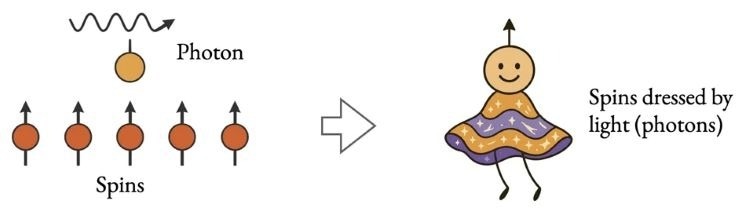 The photon and matter (here, labeled spins) are separate. On the right side, the matter (spins) and photons have become entangled. Image Credit: Rice University.
Particles that are entangled with one another are said to be in a state of quantum entanglement. Even though they are not physically near to one another, the characteristics of one particle affect the other in this entangled state.
Researchers can store and process quantum information using this phenomenon, which has frequently been seen in small quantum systems with few particles. Qimiao Si, a professor, is interested in comprehending and utilizing quantum entanglement in macroscopic systems with enormous particle counts.
“In this theory, by placing matter in a small mirrored cavity and pushing it towards what is called the quantum critical point, we can then introduce photons and induce quantum entanglement in the photon-matter hybrid,” said Si, the Harry C. and Olga K. Wiess Professor of Physics and Astronomy and director of the Extreme Quantum Materials Alliance.
These cavity photon–matter hybrids have long been difficult to realize. Theoretical studies have suggested that hybridization requires exceptionally strong light–matter interactions, making such systems challenging to engineer. However, this new theory indicates that placing the material near its quantum critical point could lower the threshold required to enter the hybrid entangled state.
You can think of the quantum critical point as the point in which a material can ‘choose’ between two different quantum phases. The material is in one phase. Only by reaching the quantum critical point can it transition into the second phase.
Yiming Wang, Graduate Student and Co-First Author, Rice University
According to this new idea, scientists could use nonthermal techniques to increase the entanglement of light and matter by forcing matter to be close to a quantum critical point. The material is pushed toward the quantum critical point using nonthermal techniques like pressure or substituting one chemical component for another.
The barrier for strong quantum entanglement decreases as the material approaches its quantum critical point. It should be much simpler to entangle the two if light is delivered into the mirrored cavity when the material is close to its quantum critical point.
Once the light and matter become entangled, their individual properties reflect each other. If the material enters the quantum critical point when entangled to light and transitions to the second phase, the light will transition as well.
Shouvik Sur, Co-First Author and Former Postdoctoral Fellow, Rice University
By leveraging existing light-based and material platforms, experimental physicists could use this approach not only to generate light–matter entanglement but also to explore the behavior of these entangled states across different phases of matter. In addition, the framework provides researchers with a practical pathway for harnessing quantum entanglement in next-generation quantum technologies.
Si's team found last year that the quantum critical materials known as weird metals exhibit both enhanced and existing quantum entanglement. If researchers could figure out how to extract it, that quantum entanglement may be a valuable resource for quantum technologies.
According to this novel hypothesis, light can be removed from the cavity once photons and matter have become entangled, hence enabling the extraction of quantum entanglement. The development of cutting-edge technologies like quantum sensing might be made possible by such a system.
Ultimately, this uncovers a pathway of using quantum light to retrieve matter’s quantum entanglement. This could lay the groundwork for extracting the resources of quantum entanglement and realizing new functionality out of quantum materials.
Qimiao Si, Director, Extreme Quantum Materials Alliance
The research was supported by the Robert A. Welch Foundation (C-1411), the Vannevar Bush Faculty Fellowship (ONR-VB N00014-23-1-2870), the Air Force Office of Scientific Research (FA9550-21-1-0356), and the U.S. Department of Energy Office of Science's Basic Energy Sciences program (DE-SC0026179).
Journal Reference:
Sur, S., et al. (2026) Amplified response of cavity-coupled quantum-critical systems. Nature Communications. DOI: 10.1038/s41467-026-73112-1. https://www.nature.com/articles/s41467-026-73112-1.