Superconducting qubits, used in quantum computers, are highly vulnerable to outside interference. These components must be cooled to millikelvin (mk) temperatures to preserve their quantum state and avoid decoherence, the loss of quantum information.
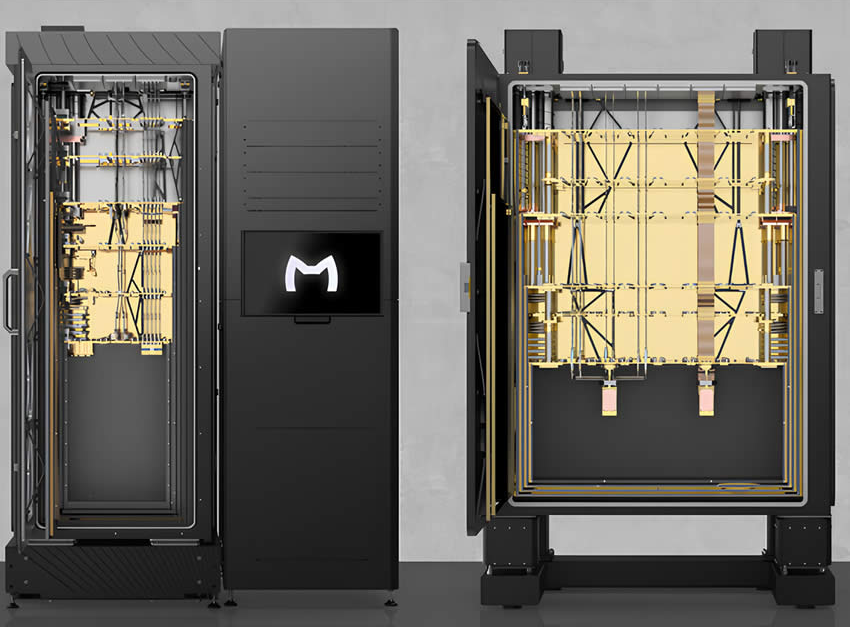
Image Credit: Minus K Technology
Dilution refrigerators are the most widely used technology for reaching these extremely low temperatures. Such devices are essential for quantum computing because they chill superconducting qubits to almost absolute zero (0 Kelvin or -273.15 °C).
These refrigerators achieve extreme temperatures by using a helium-3 and helium-4 blend that undergoes phase separation at very low temperatures, absorbing heat and chilling the system to the required level.
By providing a stable, low-temperature environment, dilution refrigerators enable quantum computers to perform complex computations without being disrupted by thermal noise.
Vibration Decoupling
Even though they provide the required cooling, dilution refrigerators can introduce vibrations due to internal components such as compressors, pumps, and pulse tubes.
External environmental sources can also produce vibrations, including building HVAC systems, operating elevators, opening and closing doors, foot traffic near the machinery, and exterior construction and street traffic.
Such vibrations can disrupt the fragile quantum states of qubits, resulting in errors and diminished computational precision. Consequently, a vibration decoupling system designed for stability serves as an essential requirement for dilution refrigerators to achieve the successful creation and implementation of quantum computers.
Multiple techniques are implemented alongside dilution refrigerators to isolate vibrations. These approaches encompass:
- Flexible bellows that redirect vibrations away from the structure of the refrigerator.
- Cryogenic spring pendulums are designed to segregate the vibrations of the pulse tube.
- Braided copper straps utilized for thermalization.
- Vibration isolation platforms that employ technologies such as active piezoelectric vibration cancellation to decrease floor vibrations that might transfer to the refrigerator.
Low-frequency vibrations near the pulse tube excitation frequency remain a particular concern for quantum researchers. The previously mentioned vibration isolation remedies do not sufficiently eliminate frequencies as low as 0.5 Hz in the vertical and horizontal directions.
Reaching vibration decoupling at this specific level is viewed as an ideal performance goal for quantum computing inside dilution refrigeration. Only one vibration isolation platform possesses the capability to deliver vibration decoupling down to 0.5 Hz, and that is Negative-Stiffness vibration isolation.
Negative-Stiffness Vibration Isolation
Launched during the mid-1990s by Minus K Technology, negative-stiffness vibration isolation has gained widespread acceptance for applications that are highly sensitive to vibration, primarily due to its capacity to successfully isolate lower frequencies in both horizontal and vertical orientations.
The isolators produced by the company are used by over 300 government laboratories and universities across 53 nations.
Negative-stiffness isolators are unique because they operate entirely in a passive mechanical state. They require neither compressed air nor electricity. They also contain no chambers, pumps, or motors and require zero maintenance, as there are no parts that will degrade.
“Vertical-motion isolation is provided by a stiff spring that supports a weight load, combined with a Negative-Stiffness mechanism,” said Erik Runge, Vice President of Engineering at Minus K.
“The net vertical stiffness is made very low without affecting the static load-supporting capability of the spring. Beam-columns connected in series with the vertical-motion isolator provide horizontal-motion isolation. A beam-column behaves as a spring combined with a negative-stiffness mechanism. The result is a compact passive isolator capable of very low vertical and horizontal natural frequencies and high internal structural frequencies.”
These negative-stiffness isolators reach a high degree of isolation in multiple directions, offering the flexibility to customize resonant frequencies down to 0.5 Hz horizontally and vertically (although certain versions operate at 1.5 Hz horizontally)*.
Once calibrated to 0.5 Hz, these isolators attain roughly 93 percent isolation efficiency at 2 Hz, 99 percent efficiency at 5 Hz, and 99.7 percent efficiency at 10 Hz.
(*It should be noted that for an isolation setup possessing a 0.5 Hz natural frequency, the isolation process commences at 0.7 Hz and gets better as the vibration frequency increases. The natural frequency is generally utilized to characterize the performance of the system.)
One early adopter of negative-stiffness platforms designed for vibration decoupling on quantum computing dilution refrigerators is Maybell Quantum Industries (Maybell).
Maybell and Negative-Stiffness Vibration Decoupling
Based in Denver, Maybell is a quantum infrastructure company that has cemented its position as a global leader in quantum infrastructure innovation and performance. The dilution refrigeration cryogenic platforms from the company supply outstanding usability and reliability for entrepreneurs and researchers alike.
“Vibration on modern dilution refrigerators is mostly driven by two different sources,” said Kyle Thompson PhD, Founder and CTO with Maybell. “One of them is external low Hz vibrations. The other is the pulse tube refrigerator which pre-cools the cryostat. High pressure helium flows through the pulse tube at about one Hz (150 psi) creates low Hz vibrations. Both have the potential to be very detrimental to the qubits.”
“It was critical for us to find vibration isolation that could decouple at these low frequencies from environmental and pulse tube noise,” added Thompson. “In particular, we were concerned about vibration transfer at frequencies close to one Hz.”
“It was difficult to find vibration isolation that had a transfer function of one Hz,” continued Thompson. “The only one we found capable of isolating below one Hz was Negative-Stiffness vibration isolation developed by Minus K Technology. Their isolators have a 0.5 resonant frequency.”
“Minus K’s Negative-Stiffness isolators can get a much lower transfer of energy at lower frequencies than we can get any other way,” explained Thompson. “That is why we are using them. We currently have Negative-Stiffness isolators integrated into our The Big Fridge model dilution refrigerator.”
Featuring a base temperature under 10 millikelvin, room for over 10,000 Flexline traces, and a sample volume exceeding 130 L, The Big Fridge supplies the performance and scale required for rigorous quantum research.
Following decades of constructing and operating dilution refrigerators, the engineers at Maybell comprehend precisely how these devices malfunction. They designed The Big Fridge to eradicate the primary reasons behind failure, maintenance, and downtime.
No Scroll Pumps: Maybell substituted failure-prone, maintenance-heavy circulation scroll pumps with micro roots blowers inside The Big Fridge, which furnish decades of operation without the need for maintenance.
Zero Acid-Flux Solder: The components of The Big Fridge dilution unit endure longer by omitting acid flux, which produces corrosion, along with solder that deteriorates following prolonged cryogenic usage.
Minimal Rubber: Each inch of rubber in standard dilution units represents a guaranteed leak rate at present and a probable point of failure in the future. Within The Big Fridge, Maybell swapped out the dozens of KF flanges utilized in competing systems for metal-to-metal flanges and welded joints. (KF – Klein Flansch – flanges are employed during vacuum applications inside dilution refrigerators).
Infinite Lifecycle Helium Traps: Users do not need to top off LN2 ever again. Cycling helium traps that clean themselves ensure The Big Fridge remains cold permanently.
“The Minus K isolators are what is separating our dilution refrigerator from internal and external vibrations and performing exceptionally well.”
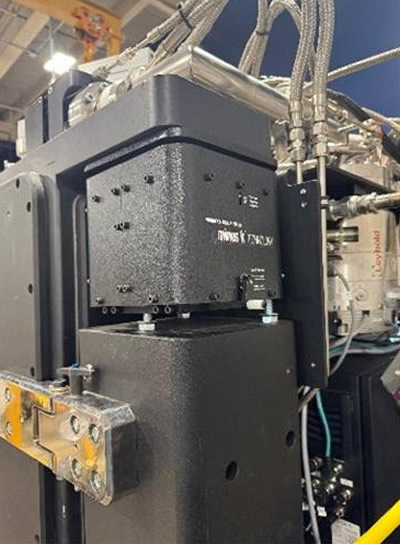
One of the Minus K vibration isolators installed on The Big Fridge. Image Credit: Maybell Quantum Industries
Future Focus
“Quantum computers right now are very much still in technical development,” added Thompson. “But the market is growing very fast and in five years it will be considerably bigger. Whether or not it will be at utility scale by then – performing commercial and industrial work that classical computers cannot – is yet to be seen.
“Maybell’s industrial identity and engineering requirements are focused on designing systems for commercial and industrial applications,” explained Thompson. “We are closely looking at where quantum computing is going, and design our systems for that future, rather than a specific scientific application.”
This information has been sourced, reviewed, and adapted from materials provided by Minus K Technology.
For more information on this source, please visit Minus K Technology.