The European Space Agency’s Euclid Space Telescope detected 31 of the most ancient quasars ever discovered. Two of these massive and bright galaxy cores, fueled by massive black holes, are the oldest quasars ever discovered in cosmic history. They sparkled with the light of a trillion Suns when the Universe was 670 million years old, or about 5% of its present age. The findings were published in Astronomy & Astrophysics.
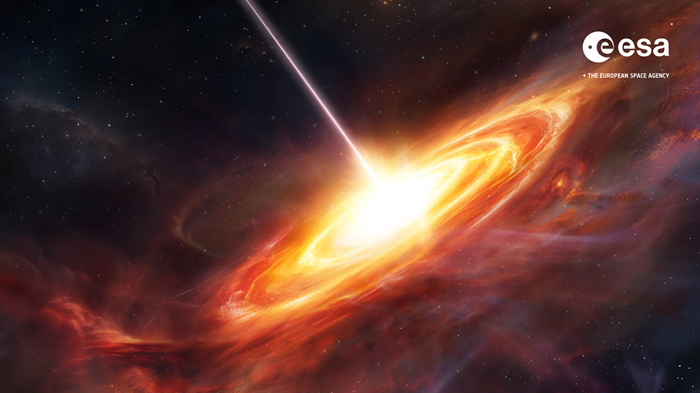 The focus of this artist impression is a fiery red-orange disc of spiraling material. The material swirls inwards towards a bright white-yellow center, from which a thin beam-like jet of material emerges to the left, directed to the top-center of the frame. Image Credit: ESA
Quasars are a brief period in a galaxy’s existence when tremendous volumes of material spiral toward its center black hole, unleashing immense amounts of energy. During this phase, the galaxy’s core glows brighter than anything else in the universe, frequently outshining the rest of its host galaxy by hundreds to thousands of times.
The quest for the Universe's first quasars has been ongoing for decades. These objects explain what happened in the early universe, including the formation of the first supermassive black holes and galaxies. However, quasars from this period are difficult to locate. They are rare because few galaxies have had enough time to expand, and their initial light is weak and easily mistaken for that of stars that are closer to Earth.
Euclid, which was launched in 2023, has now identified an extraordinary 31 new quasars in the early Universe, stretching back to a time when the universe was barely 5% of its present age.
These early quasars date back to the Universe's infancy. By finding and studying them, we can better understand how these enormous systems formed and grew so quickly – one of the greatest mysteries in astrophysics.
Daming Yang, Study Lead Author and PhD Student, Leiden University
Beneath the Tip of the Iceberg
The earliest known quasars represented only the tip of the iceberg. Until recently, the number of quasars identified in the early Universe was too small to support robust population-level studies. Euclid’s latest discovery changes that by detecting not only the most luminous outliers but also a much more representative sample of the ancient quasar population.
Euclid is a true game-changer. Before, we could only find a handful of the very brightest ancient quasars, but Euclid lets us search far more efficiently across huge areas of sky to capture much fainter light. It’s a unique tool for quasar hunting.
Daming Yang, Study Lead Author and PhD Student, Leiden University
Astronomers have discovered twelve new quasars with redshifts of 7 or greater, corresponding to the Universe's first 770 million years. Redshift measures how much the wavelength of light has been stretched by the expansion of the Universe, allowing astronomers to estimate both an object's distance and the epoch at which it is observed.
The two most distant quasars in the sample, EUCL J172902.75+641018.1 and EUCL J125308.55+705432.3, have redshifts of 7.77 and 7.69, respectively, making them the highest-redshift quasars identified to date. Their light has traveled for more than 13 billion years, meaning they are observed as they existed within the first 670 million years after the Big Bang.
This finding more than doubles the number of quasars we know of that are so ancient.
Antonio La Marca, Research Fellow, European Space Agency
Astronomers spent more than a decade discovering the first ten or so quasars with a redshift of 7 or higher; however, Euclid detected more in a single year.
“The Euclid team has taken a true ‘census’ of quasars at the dawn of the Universe for the first time. It’s a big step towards understanding these fascinating objects on a more fundamental level,” La Marca added.
A Milestone in Cosmic History
Silvia Belladitta and colleagues conducted a more detailed follow-up study of Daming and colleagues' second-most distant quasar. Their observations revealed that the quasar resides in a dust-rich, gas-rich galaxy undergoing intense star formation, providing a rare glimpse of what the host galaxy of a rapidly growing supermassive black hole may have looked like in the early Universe.
The quasars date back to a fascinating time in cosmic history known as the ‘epoch of reionization', when everything transitioned from cold and dark (the ‘dark ages’) to hot and ‘ionized’ (split apart by intense light). This transitional period was pivotal, laying the groundwork for what is seen today.
“Ancient quasars are rare discoveries. They're interesting in themselves, but also time machines that enable us to explore the early Universe and understand how the first generation of galaxies came to be,” stated ESA Euclid Project Scientist Valeria Pettorino.
“Euclid’s capabilities are unrivalled. The telescope combines a large area, depth, sharp imaging, and unique space-based infrared vision in a way that lets us pick out rare, extremely distant objects far more efficiently than before,” Pettorino stated.
Pettorino further added, “And it’s not just the telescope: the data processing is only possible thanks to thousands of Euclid Consortium scientists and engineers working together to deliver scientific discoveries, sifting through enormous datasets to identify rare, distant quasars that we can study further using telescopes on the ground.”
The 31 quasars identified here were discovered using data from the Euclid Wide Survey, which will span more than one-third of the sky once complete. Euclid will reveal the mysteries of the dark Universe; the telescope will investigate its composition, history, development, and large-scale structure while viewing billions of galaxies and discovering countless quasars.
Euclid discovers the most ancient quasars in the Universe. Video Credit: ESA/Euclid/Euclid Consortium/NASA, video production by Antoine Basset (CNES)
Journal Reference:
Yang, D., et.al. (2026) Euclid: Discovery of 31 new quasars at 6.6 < z < 7.8. Astronomy & Astrophysics. DOI: 10.1051/0004-6361/202658883. https://www.aanda.org/10.1051/0004-6361/202658883.