Using an advanced galaxy simulation, a Leibniz Institute for Astrophysics Potsdam (AIP)-led research team gained new insights into the mechanisms driving galactic core evolution throughout the cosmos and the history of the Milky Way's formation, connecting theoretical models with observational data. The study was published in Astronomy & Astrophysics.
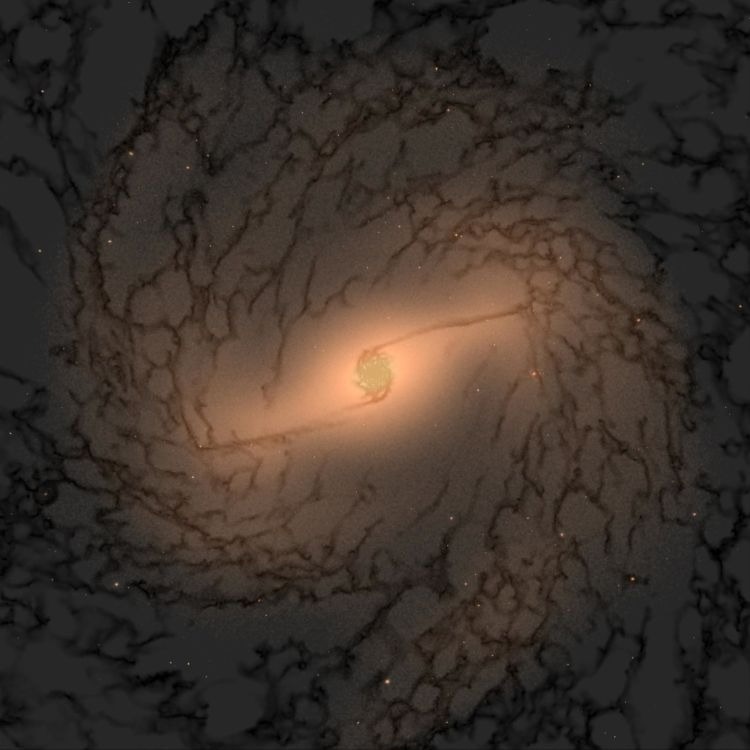 High-resolution hydrodynamical simulation from the SMUGGLE-Ring project: a stellar bar forms in a Milky-Way-like galaxy and channels gas inward along bar-driven inflow lanes. This gas feeds the central region, where a compact nuclear star cluster and a surrounding nuclear stellar disk grow together over time. Image Credit: AIP/S. Kwak
The investigation reveals that nuclear star clusters and nuclear stellar discs within galactic cores do not function as isolated systems. Instead, they operate as interconnected structures that grow concurrently, nourished by gas transported inward through the galaxy’s stellar bar and further shaped by the mergers of high-mass star clusters.
For the first time, this simulation explicitly demonstrates a developmental connection linking the emergence of nuclear star clusters to nuclear stellar discs.
Understanding how galactic centers form and evolve remains one of astrophysics’ most compelling challenges. The recent study focuses on uncovering the physical mechanisms responsible for producing two prominent structures surrounding the central black holes of most galaxies: nuclear star clusters and nuclear stellar discs.
Only within the past decade have these galactic components been detected inside the Milky Way and external systems. From an observational standpoint, the two structures were regarded as outcomes of distinct creation pathways, with surveys indicating no obvious relationship between their respective masses and dimensions. Nonetheless, their origin mechanisms remained unexplained, and realistic simulations were previously absent.
This puzzle is now addressed by an innovative galaxy simulation originating from the SMUGGLE-Ring project, providing a novel outlook while uniting theoretical models with empirical data.
In a study accepted as a Letter to the Editor in Astronomy & Astrophysics, AIP researcher Dr. SungWon Kwak, along with co-authors, show, for the first time, that a fully self-consistent, high-resolution hydrodynamical model of a Milky Way-type barred galaxy can spontaneously generate both a nuclear star cluster and a nuclear stellar disc, tracking their development across billions of years.
The simulation highlights that the stellar bar of the galaxy serves a pivotal function throughout this evolutionary process.
Our simulation achieves this by showing how the galactic bar acts like a cosmic conveyor belt, channeling gas inward to feed both structures simultaneously from the exact same reservoir.
SungWon Kwak, Researcher, Leibniz Institute for Astrophysics Potsdam
As gas gathers within the core region, stellar feedback from dying stars produces shockwaves that continually initiate fresh waves of star formation. Across a span of several billion years, hundreds of millions of solar masses of stars accumulate inside these central structures.
A major benefit of the simulation lies in enabling scientists to track mechanisms impossible to observe directly in actual galaxies. Astronomical observations supply merely a single present-day image of a galaxy.
In contrast, the simulation tracks galactic development across four billion years, letting researchers view the emergence of the stellar bar, chart the inward transport of gas, observe star formation spikes, and track the outward expansion of the nuclear stellar disk from the core across time.
Furthermore, these findings clarify why observational studies have faced difficulty in uncovering an obvious relationship between nuclear star clusters and nuclear stellar disks.
The apparent disconnection does not mean that the stars themselves differ fundamentally in age, chemical composition, or motion.
Dr. Cristina Chiappini, Study Co-Author and Scientist, Leibniz Institute for Astrophysics Potsdam
Rather, the simulation demonstrates that the structural relationship between the two features evolves naturally over time. During extended periods of continuous growth, the relative masses and dimensions of the cluster and disc gradually diverge. Consequently, nuclear star clusters and nuclear stellar discs observed in galaxies at different stages of evolution can appear strikingly dissimilar, despite sharing the same underlying growth mechanism.
Incorporating realistic dark matter dynamics within the simulation proves essential to establishing this discovery.
Previous studies rely on fixed background potentials for the galactic bar and dark matter halo, but the realistic dynamical treatment between stars and the dark matter halo using live particles in our model allows us to form a realistic bar that evolves in time and then naturally forms nuclear structures. Furthermore, our model also exhibits a 'dark gap' around the bar region, which is found in many observations and is known as evidence of the interaction between stars and dark matter by the rotation of the stellar bar.
Dr. Ivan Minchev, Study Co-Author, Leibniz Institute for Astrophysics Potsdam
The scenario proves even more compelling, as the simulation depicts a remarkably massive star cluster, containing approximately 30 million solar masses, spiraling into the galactic core and merging into the nuclear star cluster. Remarkably, modern observational data has identified similarly massive star clusters situated within the bar of NGC 1365, with several projected to spiral inward toward its center and coalesce with the galaxy's central nuclear star cluster.
Such merger occurrences can rapidly alter both the mass and scale of the nuclear star cluster over brief timeframes. This introduces further complexity and interest to the co-evolutionary history of galactic cores, given that a supermassive black hole resides within the nuclear star cluster in these galaxies.
As a result, these merger events may leave signatures on the mass of the supermassive black hole, potentially broadening our understanding of the connections among galactic structures and helping astronomers interpret future observations.