The lunar exosphere is bounded by the emptiness of space and the Moon’s surface. This environment is primarily composed of neutral atoms and molecules, and is so thin that the atoms present rarely collide.
This atmosphere is generated by the interaction of radiation from the sun, radioactive decay, and meteoritic bombardment, balanced by losses into space and recycling back to the surface.
Lunar material is ejected into the exosphere at low energies due to sputtering by solar H+ and He++. A fraction of this material is comprised of ionized species.
Sputtered secondary ions can be easily observed by spacecraft-based ion mass spectrometers. These ions feature direct information on the planetary surface composition.
Measurements from the LADEE, WIND, AMPTE, and SELENE moon missions have successfully identified photo-ionized neutrals and secondary ions in the exosphere, including: H2+, He+, O+, C+, Na+, Al+, Si+, K+, Ar+, CO+, Ca+, and Fe+.
Experimental
Secondary ion mass spectra (Figure 1) were acquired during 4 keV He+ irradiation of lunar soils returned by the Apollo missions. This enabled and improved understanding of the relationship between solar-wind-derived secondary ions and the lunar surface composition. It was also key to guiding the design of spacecraft-based mass spectrometers.
Lunar analogs were achieved using < 1 mm grains of two mature soil samples: Mare 10084 and Highland 62231. A Corning glass lunar-simulant was also used, alongside the silicate mineral olivine.
X-ray photoelectron spectroscopy (XPS) was used to measure sample surface compositions, while SIMS spectra were acquired using a Hiden Analytical EQS.
Positive SIMS spectra were measured at ejected-ion energies ranging from 2 to 36 eV during this study. Instrument transmission is expected to be roughly constant as a function of energy at this range.
Extraction lens voltages were optimized for ions of mass 27 (Al+) prior to spectra collection. The sample surface was charge-neutralized during SIMS data collection using low-energy (≤ 4 eV) electrons because the lunar soils became significantly charged under ion bombardment.
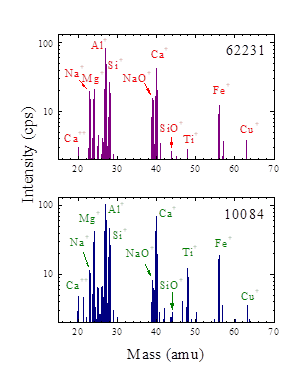
Figure 1. Secondary ion mass spectra of mature, lunar mare soil 10084 and highland soil 62231 for 10 eV ions ejected from the surface by 4 keV He+. Cu+ is an impurity and not intrinsic to the sample. Image Credit: Hiden Analytical
Results
It was observed that sputtered secondary ion intensities do not correspond one-to-one to the surface composition. These intensities, however, depend on factors such as the atom's ionization potential, the primary ion type, and the local composition of the solid matrix.
It is important to take care when determining yields from calibration standards with known compositions that closely match the target of interest.
The study presented here determined species-dependent relative yield factors to correlate secondary-ion count rates with the atomic surface composition. It was then possible to use these correction factors along with Monte Carlo simulations of solar wind bombardment to better predict the sputtered ion spectra for planetary satellites, asteroids, and other airless bodies.
SIMS spectra were also found to change with fluence, reaching equilibrium only after ∼4 x 10¹⁷ He+ cm-2 (approximately 9000 years on the lunar surface).
The collected spectra highlight that ion irradiation preferentially removes weakly bound species such as oxygen (O) and sodium (Na), enriching the surface with more refractory materials, including aluminum (Al), magnesium (Mg), calcium (Ca), iron (Fe), and titanium (Ti).
Secondary-ion energy spectra were also acquired for selected masses (Figure 2). The distributions were all found to rise rapidly and peak below 15 eV before dropping off slowly with energy, as is typical of insulating surfaces.
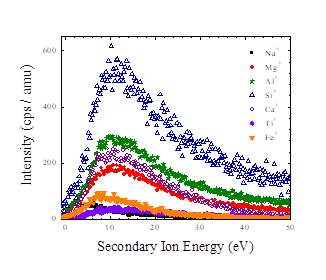
Figure 2. Energy spectra of secondary ions ejected from mature lunar mare soil 10084 by 4 keV He+. Image Credit: Hiden Analytical
Conclusion
The study presented here shows that it is possible to measure appreciable numbers of secondary ions ejected by solar wind-type ions from lunar soils within minutes in the laboratory.
These measurements can support ongoing and future moon exploration by helping infer the surface composition of other airless planetary bodies exposed to the magnetosphere, the solar wind, or ionospheric ions.
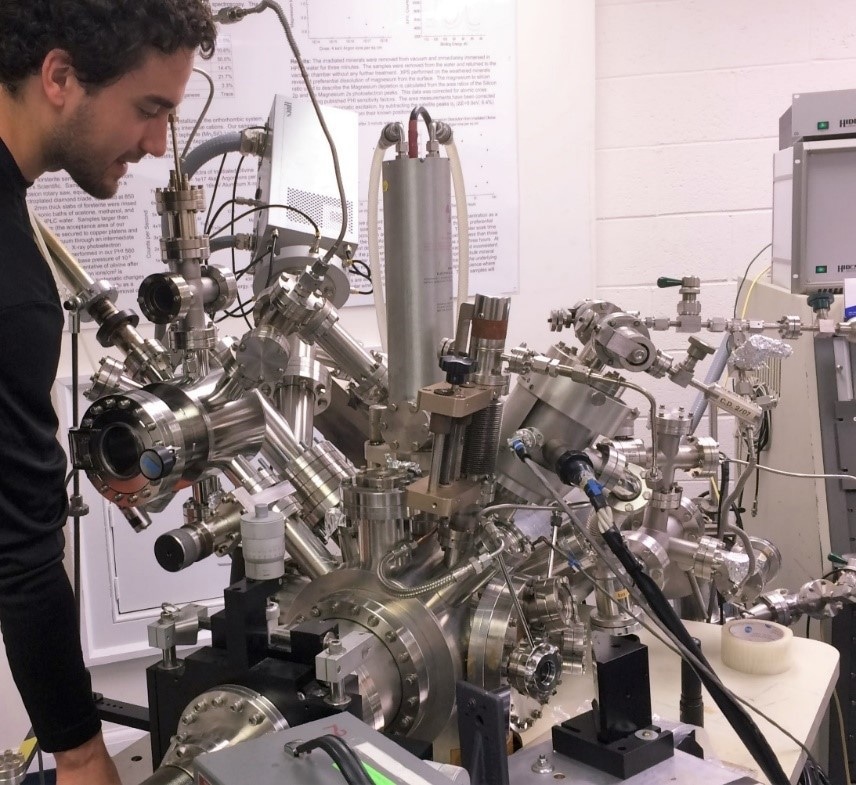
Figure 3. Experimental setup with Hiden Analytical EQS secondary ion mass spectrometer on a modified PHI 560 XPS/SAM system. Image Credit: Hiden Analytical
References and Further Reading
- Dukes, C.A. and Baragiola, R.A. (2015). The lunar surface-exosphere connection: Measurement of secondary-ions from Apollo soils. Icarus, 255, pp.51–57. https://www.sciencedirect.com/science/article/abs/pii/S0019103514006617?via%3Dihub.
- Hilchenbach, M., et al. (1993). Observation of energetic lunar pick-up ions near earth. Advances in Space Research, 13(10), pp.321–324. https://www.sciencedirect.com/science/article/abs/pii/027311779390086Q.
- Schaible, M.J., et al. (2017). Solar Wind Sputtering Rates of Small Bodies and Ion Mass Spectrometry Detection of Secondary Ions. Journal of Geophysical Research Planets, 122(10), pp.1968–1983. https://agupubs.onlinelibrary.wiley.com/doi/full/10.1002/2017je005359.
- Halekas, J.S., et al. (2015). Detections of lunar exospheric ions by the LADEE neutral mass spectrometer. Geophysical Research Letters, 42(13), pp.5162–5169. https://agupubs.onlinelibrary.wiley.com/doi/full/10.1002/2015GL064746.
- Stern, S.A. (1999). The lunar atmosphere: History, status, current problems, and context. Reviews of Geophysics, 37(4), pp.453–491. https://agupubs.onlinelibrary.wiley.com/doi/abs/10.1029/1999RG900005.
- Yokota, S. et al. (2009). First direct detection of ions originating from the Moon by MAP-PACE IMA onboard SELENE (KAGUYA). Geophysical Research Letters, 36(11). https://agupubs.onlinelibrary.wiley.com/doi/full/10.1029/2009GL038185.
- Yokota, S. et al. (2014). Structure of the ionized lunar sodium and potassium exosphere: Dawn-dusk asymmetry. Journal of Geophysical Research Planets, 119(4), pp. 798–809. https://agupubs.onlinelibrary.wiley.com/doi/full/10.1002/2013JE004529.

This information has been sourced, reviewed, and adapted from materials provided by Hiden Analytical.
For more information on this source, please visit Hiden Analytical.