Astronomers from the University of Warwick have uncovered the cosmic digestive system of a black hole, revealing that even when these black holes seem dim, they are not merely endless voids. The study was published in the Monthly Notices of the Royal Astronomical Society.
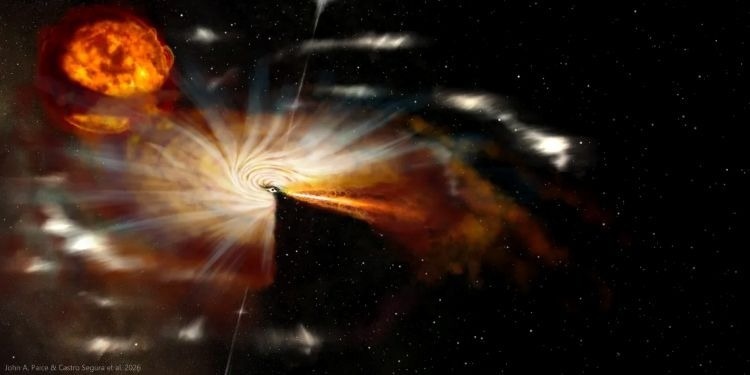 Artist impression of SwiftJ1727 with donor jet clouds. Image Credit: John A. Paice & Noel Castro Segura et al, ‘SwiftJ1727 - Final - No Overlay – DonorJetClouds’, (2026)
Black holes are frequently depicted as insatiable cosmic entities that devour everything in their vicinity. However, recent observations of a significant black hole eruption, spearheaded by Warwick Postdoctoral Fellow Dr. Noel Castro Segura, indicate that the truth is considerably more complex.
Utilizing the European Southern Observatory’s Very Large Telescope (VLT), astronomers have monitored the newly identified black hole system, Swift J1727.8−1613, during a remarkable eruption in 2023.
The astronomers discovered that while the black hole was consuming gas from a neighboring star, it was also expelling some of that material back into space in the form of jets and winds.
Importantly, these substantial material outflows occur when black holes are exceptionally faint, operating at activity levels far lower than previously thought. This suggests that black holes may behave less like endless voids and more like powerful cosmic digestive systems.
People often imagine black holes simply swallowing everything around them. What we're seeing is a much more complex process. Matter falls in, the system processes it, and a surprising amount is expelled again.
Dr. Noel Castro Segura, Study Lead Author and Postdoctoral Fellow, University of Warwick
The research presents one of the most comprehensive optical records of a black hole outburst to date, enabling scientists to observe the evolution of the system over time instead of depending on a limited number of observations. Instead of capturing a black hole consuming a star in a single image, the data gathered reflects various state changes throughout the event.
Swift J1727.8−1613 was identified when it suddenly emerged in 2023 as one of the brightest X-ray sources in the sky. This system consists of a black hole drawing gas from a companion star, forming a rotating disc of superheated material around it. The 2023 outburst gave astronomers a rare opportunity to observe this feeding process in real time, as such events have seldom been captured in such remarkable detail.
One of the most fascinating discoveries of the study was that, as the black hole emitted a powerful jet, the disc supplying it also experienced considerable changes. This provides a rare insight into the relationship between matter falling into a black hole and matter being expelled back into the cosmos.
Perhaps the most unexpected finding emerged after the black hole's feeding frenzy had largely subsided. Even after Swift J1727's activity had fallen to just one-hundredth of its peak level, researchers found evidence that dense gas was still being ejected from the system.
This discovery implies that black holes may persist in driving significant outflows long after the most intense activity has ceased. In fact, the volume of material being expelled could be comparable to the amount ultimately consumed by the black hole itself.
If black holes can continue shedding material even after their largest outbursts, it means they may be much less efficient eaters than we previously assumed. A significant fraction of the meal may never reach the black hole at all, changing our understanding of how binary stars in galaxies evolve.
Dr. Noel Castro Segura, Study Lead Author and Postdoctoral Fellow, University of Warwick
The findings add to a growing body of evidence suggesting that black holes are more than mere cosmic consumers. Instead, they appear to function as dynamic systems that both absorb and redistribute matter, drawing in material, processing it, and expelling a significant portion back into space through powerful jets and winds.
We usually gravitate towards the dramatic fireworks when a black hole outburst begins, but our observations show that the finale can be just as intense. Even as the system’s X-ray emission dropped to a fraction of its peak, it still had enough power to generate a massive expulsion of gas.
Kyle Solomons, Doctoral Researcher, University of Cape Town
During a single outburst of Swift J1727.8−1613, astronomers observed the entire cycle unfold, offering one of the most distinct insights into how black holes consume matter, respond, and affect the environment.
Journal Reference:
Castro Segura, N., et al. (2026) Optical outburst evolution of the transient black hole X-ray binary Swift J1727.8−1613: disc response to jet ejections and late-outburst emergence of powerful disc winds. Monthly Notices of the Royal Astronomical Society. DOI:10.1093/mnras/stag1175. https://academic.oup.com/mnras/article/550/4/stag1175/8743827