The University of Michigan is sponsoring a $9 million project sponsored by the US Office of Naval Research to explore ways to form entangled networks of quantum sensors.
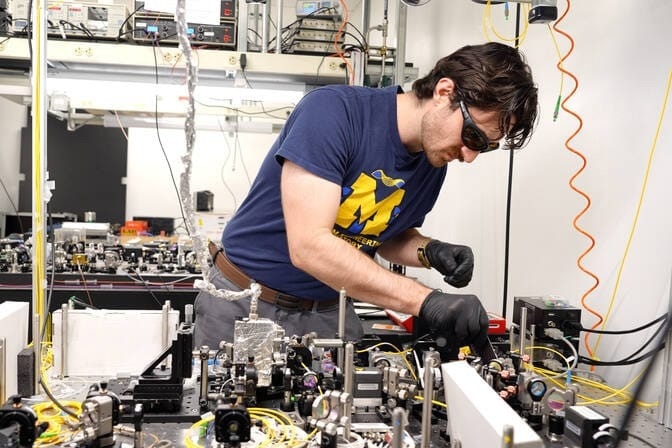 William Ward, a PhD student in applied physics, is building an entanglement-enhanced communication network with quantum-light sources and receivers in the Quantum Engineering Lab. The new MURI aims to explore the limits of classical sensor networks and attempt to surpass them with quantum networking. Image Credit: Jero Lopera, Electrical and Computer Engineering, University of Michigan.
Quantum sensors significantly enhance sensitivity and accuracy, and even greater precision becomes possible when quantum entanglement is used to link them together.
Entanglement holds strong promise for high-precision networking because it links particles through their quantum states, regardless of the distance between them. When one particle is measured, it immediately reveals information about its entangled counterpart.
Over the past few years, we discovered that entanglement can allow you to improve the performance of a sensor network in terms of the resolution – so you can actually detect finer details and take measurements faster than a conventional sensor network, with more sensitivity or higher signal-to-noise ratio.
Zheshen Zhang, Project Leader and Associate Professor, Electrical and Computer Engineering, University of Michigan
Zhang added, “We want to put these technologies in the broader context of designing the next generation of quantum technologies – using quantum computing and networking resources to boost the performance of such devices.”
If successful, they could achieve substantial improvements in measurement sensitivity, scaling with the square of the number of sensors rather than with the square root. The five-year Multidisciplinary University Research Initiative aims to exploit entanglement. It brings together scientists from U-M, Princeton University, the University of Chicago, the University of Maryland, the University of Arizona, and the University of Southern California.
Quantum sensors are already connected via conventional networking methods such as fiber-optic connections. One of the main concerns the team wants to address is how much more accuracy can be gained using entangled networking. What they uncover might enhance atomic clocks, self-guided navigation without GPS, and the detection of magnetic fields and radiofrequency radiation.
The researchers must also develop methods for maintaining entanglement over time, preventing noise in the system from destroying the links between entangled atoms or gadgets, which could be a first step towards a future quantum internet.
They propose to evaluate their techniques using two testbed quantum devices. The first is an array of Rydberg atoms,in which an electron has absorbed so much excess energy that its orbit extends far from the nucleus. These atoms are particularly well suited for sensing applications because their loosely bound, highly extended electron is extremely sensitive to both electric and magnetic fields.
Quantum entanglement can increase the sensitivity even further. Rydberg atoms occupy so much space that two adjacent atoms cannot be in the Rydberg state at the same time. However, if two such atoms are struck by a laser pulse simultaneously, they can enter a quantum superposition in which only one atom is excited to the Rydberg state, yet the system exists in a shared state where it is fundamentally indeterminate which atom it is. In this state, both atoms effectively operate as sensors, responding collectively and almost instantaneously to any signal detected by either one.
The team is starting with a 25-qubit array, which is effectively a pair of atoms, but plans to extend to several hundred. Jeff Thompson, Princeton's associate professor of electrical and computing engineering, leads this testbed.
The other testbed is built on a membrane that vibrates in reaction to light waves, just like eardrums do in response to sound waves. Zhang from the University of Michigan will lead the team in upgrading a single sensor to a four-sensor system. The research will also cool the sensors to just a fraction above absolute zero (0.1 Kelvin), a temperature so low that quantum fluctuations, rather than thermal energy, become the dominant source of noise in the system. These sensors will be linked together via entangled light.
Using these testbeds, the team plans to create quantum networking solutions, such as error suppression and correction.
Discrete and Continuous-Variable Distributed Entangled Quantum Sensing: Foundation, Building Blocks, and Testbeds is the title of the project. Liang Jiang (University of Chicago), Quntao Zhang (University of Southern California), Alexey Gorshkov (University of Maryland), Saikat Guha (University of Maryland), Peter Seiler (University of Michigan), and Dalziel Wilson (University of Arizona) are other co-PIs.