Recent observations from NASA's James Webb Space Telescope, illustrated alongside a new image from NASA's Hubble Space Telescope, challenge previous assumptions by indicating that a significant portion of the hot, dusty material is, in fact, contributing to the central black hole. The methodology employed to collect this data also holds promise for examining the outflow and accretion processes of other nearby black holes. The study, featuring the clearest image of a black hole's environment ever captured by Webb, was published in the journal Nature.
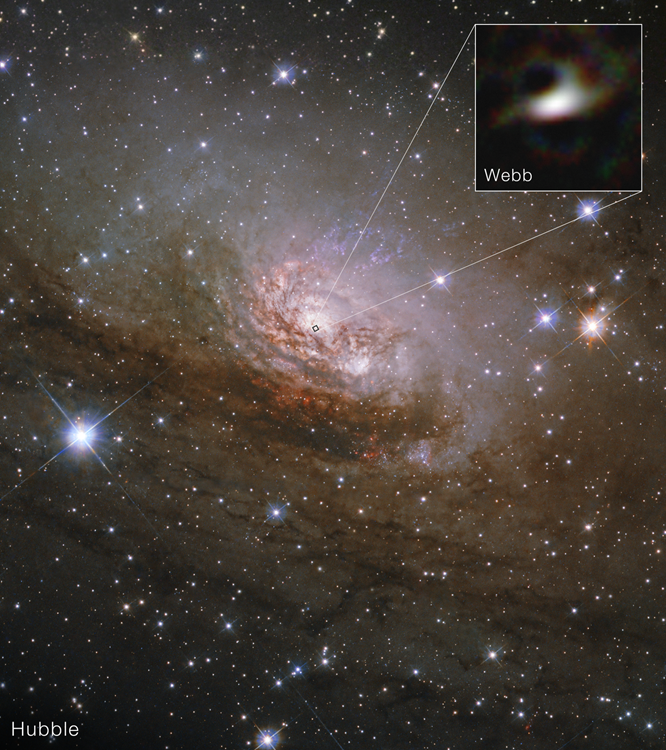 This image from NASA’s Hubble Space Telescope shows the Circinus galaxy. A close-up of its core from NASA’s James Webb Space Telescope shows the inner face of the hole of the donut-shaped disk of gas disk glowing in infrared light. The outer ring appears as dark spots. Image Credit: NASA, ESA, CSA, Enrique Lopez-Rodriguez (University of South Carolina), Deepashri Thatte (STScI); Image Processing: Alyssa Pagan (STScI); Acknowledgment: NSF's NOIRLab, CTIO
The Circinus Galaxy, located approximately 13 million light-years from Earth, harbors an active supermassive black hole that plays a significant role in its development. It was previously believed that the primary source of infrared light emanating from the area nearest to the black hole consisted of outflows, which are streams of superheated material that are expelled outward.
Outflow Question
Supermassive black holes, such as those found in Circinus, maintain their activity by consuming the matter that surrounds them.
The infalling gas and dust accumulate into a toroidal structure, commonly referred to as a torus, encircling the black hole. As these supermassive black holes draw in matter from the inner walls of the torus, they create an accretion disk, which resembles a whirlpool of water swirling around a drain. This disk experiences an increase in temperature due to friction, ultimately reaching a point where it emits light.
The brightness of this luminous matter can become so intense that it complicates the task of resolving details within the center of the galaxy using ground-based telescopes. This challenge is exacerbated by the bright starlight that obscures visibility within Circinus. Additionally, the torus's extreme density means that the inner region of the infalling material, which is heated by the black hole, remains hidden from our observation. For many years, astronomers have grappled with these challenges, continuously designing and refining models of Circinus based on the data they have been able to collect.
In order to study the supermassive black hole, despite being unable to resolve it, they had to obtain the total intensity of the inner region of the galaxy over a large wavelength range and then feed that data into models.
Enrique Lopez-Rodriguez, Study Lead Author, University of South Carolina
Early models were built to match the spectra from specific regions, such as emissions from the torus or from outflows, each identified by distinct light wavelengths. However, because the region couldn't be fully resolved, these models led to uncertainties across different parts of the spectrum. For example, some telescopes detected an excess of infrared light but lacked the resolution to pinpoint exactly where it was coming from .
“Since the ‘90s, it has not been possible to explain excess infrared emissions that come from hot dust at the cores of active galaxies, meaning the models only take into account either the torus or the outflows, but cannot explain that excess,” said Lopez-Rodriguez.
The models suggested that a substantial share of the emissions, and by extension, mass, near the center came from outflows. To test this idea, astronomers needed two key capabilities: first, the ability to filter out starlight that had previously interfered with deeper analysis; and second, the means to distinguish the infrared emissions of the torus from those produced by the outflows. The Webb telescope, with its advanced sensitivity and technology, proved essential in meeting both requirements and significantly advancing our understanding.
Webb’s Innovative Technique
Webb required the Aperture Masking Interferometer tool integrated with its NIRISS (Near-Infrared Imager and Slitless Spectrograph) instrument to investigate the core of Circinus.
On Earth, interferometers typically manifest as arrays of telescopes: mirrors or antennas that collaborate as if they were a singular telescope. An interferometer achieves this by collecting and merging the light from the target source, resulting in the electromagnetic waves constituting light to "interfere" with one another (thus, the term "interfere-ometer") and producing interference patterns. Astronomers can analyze these patterns to reconstruct the dimensions, shapes, and characteristics of distant objects with significantly enhanced detail compared to non-interferometric methods.
The Aperture Masking Interferometer enables Webb to function as a collection of smaller telescopes operating in unison as an interferometer, independently generating these interference patterns. It accomplishes this by employing a specialized aperture composed of seven small, hexagonal openings, which, similar to photography, regulates the quantity and direction of light that enters the telescope's detectors.
These holes in the mask are transformed into small collectors of light that guide the light toward the detector of the camera and create an interference pattern.
Joel Sanchez-Bermudez, Study Co-Author, National University of Mexico
Armed with new data, the research team successfully constructed an image based on the interference patterns from the central region. They used data from earlier observations to confirm that the data obtained from Webb was devoid of any artifacts. Consequently, this led to the first extragalactic observation made by an infrared interferometer in space.
“By using an advanced imaging mode of the camera, we can effectively double its resolution over a smaller area of the sky. This allows us to see images twice as sharp. Instead of Webb’s 6.5-meter diameter, it’s like we are observing this region with a 13-meter space telescope,” said Sanchez-Bermudez.
The data indicated that, in contrast to the models suggesting that the infrared excess originates from the outflows, approximately 87 % of the infrared emissions from hot dust in Circinus are derived from regions nearest to the black hole, whereas less than 1 % of the emissions are attributed to hot dusty outflows. The remaining 12 % is sourced from more distant areas that could not be distinguished previously.
It is the first time a high-contrast mode of Webb has been used to look at an extragalactic source. We hope our work inspires other astronomers to use the Aperture Masking Interferometer mode to study faint, but relatively small, dusty structures in the vicinity of any bright object.
Julien Girard, Study Co-Author and Senior Research Scientist, Space Telescope Science Institute
Universe of Black Holes
Although the enigma surrounding the excessive emissions from Circinus has been resolved, the universe contains billions of black holes. The team observes that those with varying luminosities may affect the source of the majority of emissions, determining whether they originate from a black hole's torus or their outflows.
“The intrinsic brightness of Circinus’ accretion disk is very moderate. So, it makes sense that the emissions are dominated by the torus. But maybe, for brighter black holes, the emissions are dominated by the outflow,” said Lopez-Rodriguez.
The astronomers have developed a validated method to explore any black holes of interest, provided they are sufficiently luminous for the Aperture Masking Interferometer to function effectively. Examining further targets will be crucial for compiling a database of emission data to determine whether the findings from Circinus were exceptional or indicative of a broader trend.
“We need a statistical sample of black holes, perhaps a dozen or two dozen, to understand how mass in their accretion disks and their outflows relate to their power,” said Lopez-Rodriguez.
Journal Reference:
Lopez-Rodriguez, E., et al. (2026) JWST interferometric imaging reveals the dusty torus obscuring the supermassive black hole of Circinus galaxy. Nature Communications. DOI: 10.1038/s41467-025-66010-5. https://www.nature.com/articles/s41467-025-66010-5