Most galaxies in the universe glow brilliantly over cosmic time and space. However, a unique type of galaxies remains virtually invisible: low-surface-brightness galaxies dominated by dark matter and containing only a sparse scattering of faint stars. One such enigmatic object, known as CDG-2, may be one of the most dark matter-dominated galaxies ever identified. The Astrophysical Journal Letters published the scientific study detailing this discovery.
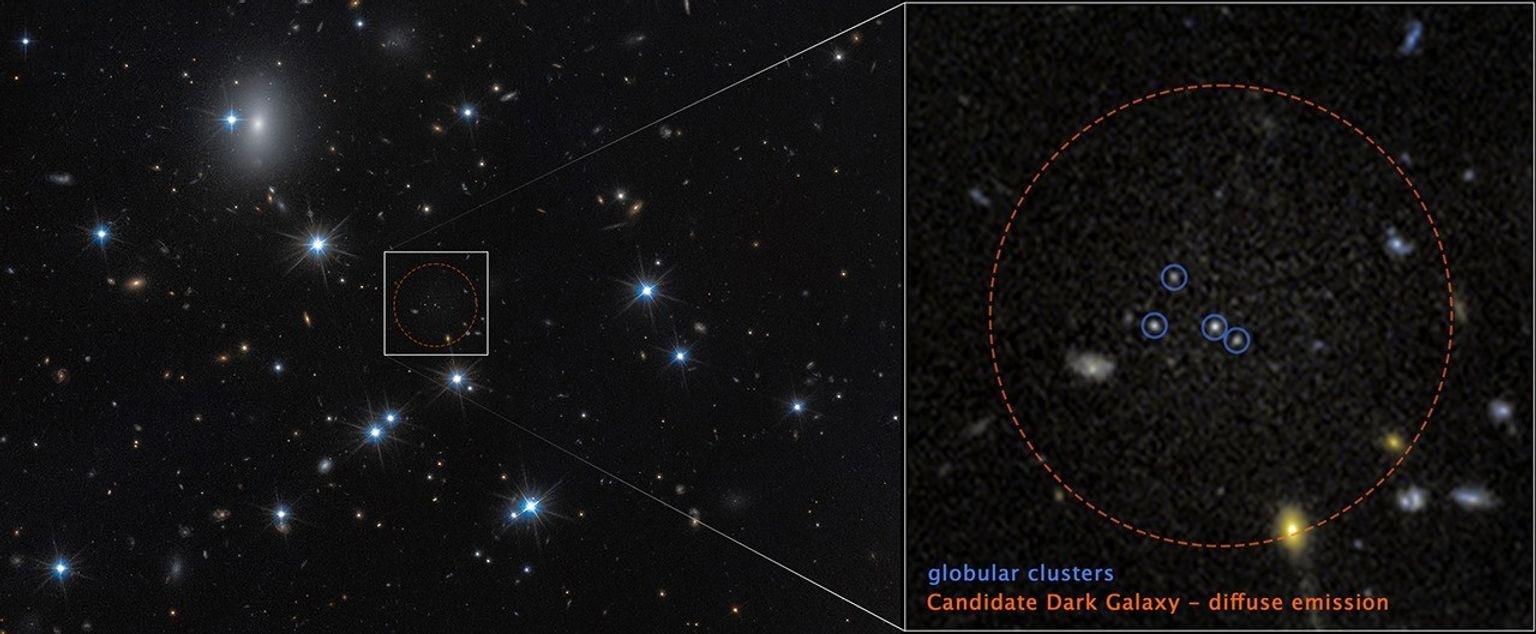 The low-surface-brightness galaxy CDG-2, within the dashed red circle at right, is dominated by dark matter and contains only a sparse scattering of stars. The full image from NASA’s Hubble Space Telescope is on the left. Image Credit: NASA, ESA, Dayi Li (UToronto); Image Processing: Joseph DePasquale (STScI)
Detecting such faint galaxies is incredibly complex. David Li of the University of Toronto, Canada, and his team used advanced statistical techniques to identify ten previously confirmed low-surface-brightness galaxies and two additional dark galaxy candidates by looking for tight groupings of globular clusters, which are compact, spherical star groups that orbit normal galaxies. These clusters may indicate the presence of a faint, hidden star population.
Astronomers used three observatories: NASA's Hubble Space Telescope, ESA's Euclid space observatory, and the Subaru Telescope in Hawaii, which is ground-based. Hubble's high-resolution imagery discovered a tight gathering of four globular clusters in the Perseus galaxy cluster, which is 300 million light-years away. Follow-up investigations utilizing Hubble, Euclid, and Subaru data found faint, diffuse light around the star clusters, indicating the presence of an underlying galaxy.
This is the first galaxy detected solely through its globular cluster population. Under conservative assumptions, the four clusters represent the entire globular cluster population of CDG-2.
David Li, Postdoctoral Fellow, University of Toronto
According to preliminary investigation, CDG-2 has the brightness of around 6 million Sun-like stars, with globular clusters accounting for 16 % of its apparent material. Surprisingly, 99 % of its mass appears to be dark matter. Much of the typical matter required for star formation, namely hydrogen gas, was likely stripped away by gravitational interactions with neighboring galaxies in the Perseus cluster.
Globular clusters have high stellar density and are gravitationally linked. This makes the clusters more resistant to gravitational tidal disturbances, allowing them to serve as reliable tracers of faint, diffuse galaxies.
As sky surveys increase with missions such as Euclid, NASA's upcoming Nancy Grace Roman Space Telescope, and the Vera C. Rubin Observatory, astronomers are increasingly relying on machine learning and statistical approaches to go through massive datasets.
"Dark Galaxy" Identified by Hubble
NASA's Goddard Space Flight Center; Lead Producer: Paul Morris. Video Credit: NASA
Sources:
Journal Reference:
Li, D., et.al. (2026) Candidate Dark Galaxy-2: Validation and Analysis of an Almost Dark Galaxy in the Perseus Cluster. The Astrophysical Journal Letters. DOI: 10.3847/2041-8213/adddab. https://iopscience.iop.org/article/10.3847/2041-8213/adddab/meta.
NASA