Researchers at RIKEN have demonstrated experimentally that a microwave photonic circuit device known as a Josephson traveling-wave parametric amplifier (JTWPA) can achieve the low-noise, high-gain characteristics required for high-performance quantum computing. The development of 100-qubit superconducting quantum computer systems could be accelerated by this breakthrough. The findings were published in Physical Review Applied.
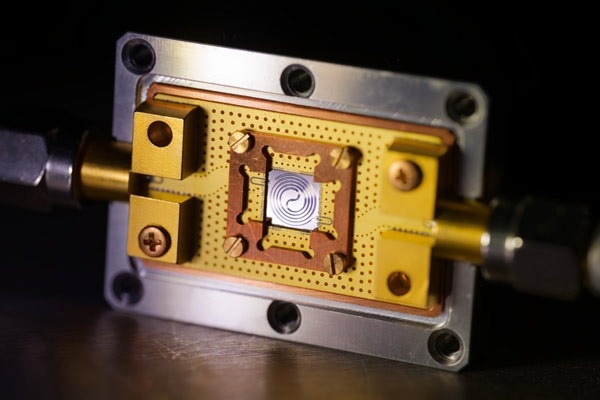 A long, spiral-wound waveguide with a fine-tapered, fishbone-like structure can amplify photon signals from quantum computing qubits with very low noise. Image Credit: 2026 RIKEN Center for Quantum Computing
Quantum computers are remarkable scientific and engineering achievements that combine highly sophisticated quantum physics with cutting-edge fabrication techniques to physically control light near the limits of quantum dynamics.
While the real power of quantum computing lies in its fundamental building blocks (quantum bits, or qubits), their calculations only become valuable once they can be accurately read. That’s where a significant challenge emerges. The very act of measuring a qubit’s state can introduce noise and interference, potentially distorting or obscuring the data it holds .
The readout operation must satisfy a demanding set of requirements. It needs to be fast and deliver an exceptionally high signal-to-noise ratio, allowing the qubit to be measured in a single shot. At the same time, it must operate with only a few quanta of energy, a quantum being the energy carried by a single microwave photon, to avoid disturbing the system.
Ideally, the readout system should also be capable of scanning across multiple frequencies, enabling several qubits to be measured through the same circuit.
So far, amplifiers based on an array of Josephson junctions fulfill all of these qualities except for noise, which is what we focused on in this study.
Sandbo Chang, Scientific Researcher, RIKEN
Chang, Yasunobu Nakamura, also of RQC, and others have overcome a long-standing noise problem with JTWPAs. This advancement has the potential to enhance this widely used approach for qubit signal processing.
When a readout signal is amplified, it necessarily introduces noise. According to quantum mechanics, every phase-preserving amplifier with high gain must generate at least half a quantum of noise. The best previous noise level obtained by a Josephson traveling-wave parametric amplifier was frequently one photon or more, limiting the technology’s applicability.
This is mostly because previous approaches use lossy dielectric material in their design.
Sandbo Chang, Scientific Researcher, RIKEN
By eliminating the use of lossy dielectric material and instead designing a spiraled fishbone-like tapered waveguide structure, the team was able to reduce noise to 0.68 quanta, which is only 0.18 quanta over the quantum limit. They showed this by doing simulations and developing an experimental device.
Our goal was also to keep the fabrication recipe as accessible as possible. The hope is that most labs that can already fabricate superconducting qubits will already have the techniques and equipment they need to reproduce our results.
Yasunobu Nakamura, Director, RIKEN Center for Quantum Computing
Download the PDF of this article
Sources:
Journal Reference:
Chang, C. W. S., et.al. (2026) Josephson traveling-wave parametric amplifier based on a low-intrinsic-loss lumped-element coplanar waveguide. Physical Review Applied. DOI: 10.1103/qhl6-cz2z. https://journals.aps.org/prapplied/abstract/10.1103/qhl6-cz2z.
RIKEN