Researchers at Osaka Metropolitan University have successfully developed a novel type of Kondo necklace utilizing a meticulously designed organic–inorganic hybrid material that consists of organic radicals and nickel ions. This accomplishment was facilitated by RaX-D, a sophisticated molecular design framework that allows for precise manipulation of the molecular arrangement within the crystal and the associated magnetic interactions. The study was published in Communications Materials.
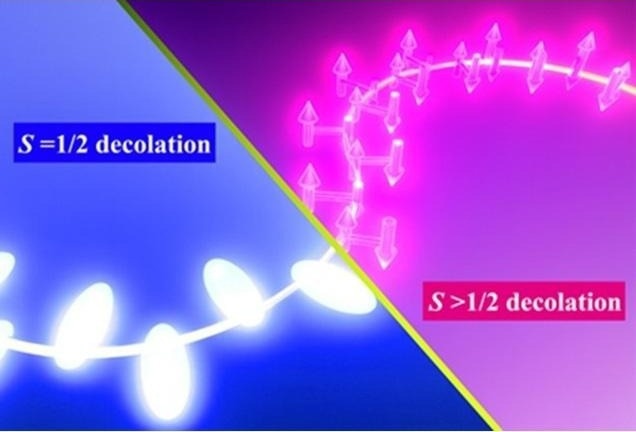 Quantum spin size determines whether the Kondo effect suppresses or preserves magnetism. The size of the spin crucially affects how the system behaves. At spin-1/2, fully quantum spins pair up and cancel each other, so no magnetism appears. At spin > 1/2, larger spins can’t fully cancel, leaving leftover spins that can interact and create magnetic order. Image Credit: Osaka Metropolitan University
Collective behavior represents a remarkable phenomenon in condensed-matter physics. When quantum spins engage with one another as a cohesive system, they generate distinctive effects that are not observable in isolated particles. Understanding how quantum spins interact to produce this behavior is a central challenge in modern condensed-matter physics.
Among these phenomena, the Kondo effect (the interaction between localized spins and conduction electrons) holds a pivotal position in numerous quantum phenomena.
However, in actual materials, the existence of additional charges and orbital degrees of freedom complicates the task of isolating the fundamental quantum mechanism that underlies the Kondo effect. In these materials, electrons possess not only spin but also the ability to move and occupy various orbitals. When these additional behaviors intertwine, it becomes challenging to concentrate solely on the spin interactions that are responsible for the Kondo effect.
Download the PDF of this article
The Kondo necklace model, introduced in 1977 by Sebastian Doniach, streamlines the Kondo lattice by concentrating exclusively on spin degrees of freedom. This model has been viewed as a promising conceptual framework for investigating new quantum states; nevertheless, its experimental implementation has posed a significant challenge for almost fifty years.
A crucial question is whether the Kondo effect and the resulting behavior fundamentally vary with the size of the localized spin. Gaining insight into this characteristic would hold universal significance in the field of quantum material research.
The research team under the leadership of Associate Professor Hironori Yamaguchi from the Graduate School of Science at Osaka Metropolitan University was involved in the study.
Expanding upon their previous achievement of a spin-1/2 Kondo necklace, the researchers illustrated that the characteristics of the Kondo effect undergo a significant qualitative change when the localized spin (decollated spin) is increased from 1/2 to 1. Thermodynamic measurements indicated a distinct phase transition to a magnetically ordered state.
Through quantum analysis, the team elucidated that the Kondo coupling facilitates an effective magnetic interaction between spin-1 moments, thus stabilizing long-range magnetic order.
This finding challenges the conventional perspective that the Kondo effect mainly suppresses magnetism by binding free spins into singlets, which is a maximally entangled state with a total spin of zero. Conversely, the study indicates that when the localized spin exceeds 1/2, the same Kondo interaction operates in the opposite manner, fostering magnetic order.
By juxtaposing the spin-1/2 and spin-1 realizations in a pristine spin-only environment, the researchers uncovered a novel quantum boundary: the Kondo effect invariably generates local singlets for spin-1/2 moments, while it stabilizes magnetic order for spin-1 and higher.
This revelation offers the first direct experimental proof that the role of the Kondo effect is fundamentally contingent upon the size of the spin.
The discovery of a quantum principle dependent on spin size in the Kondo effect opens up a whole new area of research in quantum materials. The ability to switch quantum states between nonmagnetic and magnetic regimes by controlling the spin size represents a powerful design strategy for next-generation quantum materials.
Hironori Yamaguchi, Study Lead and Associate Professor, Graduate School of Science, Osaka Metropolitan University
Uncovering that the Kondo effect functions in fundamentally distinct manners based on spin size provides a novel viewpoint on our comprehension of quantum matter and lays a new conceptual foundation for the design of spin-based quantum devices.
Regulating whether a Kondo lattice transitions to a magnetic or non-magnetic state is of significant importance for future quantum technologies, as it presents a method to manage critical behaviors such as entanglement, magnetic noise, and quantum critical phenomena.
The researchers are optimistic that their discoveries will facilitate the innovation of new quantum materials and may eventually aid in the advancement of emerging quantum technologies, including quantum information systems and quantum computing.
This study received partial funding from JST PRESTO. A portion of this work was conducted under the interuniversity cooperative research program associated with the joint-research initiative of ISSP at the University of Tokyo.
Sources:
Journal Reference:
Yamaguchi, H., et al. (2026) Emergence of Kondo-assisted Néel order in a Kondo necklace model. Communications Materials. DOI: 10.1038/s43246-025-01027-3. https://www.nature.com/articles/s43246-025-01027-3
Osaka Metropolitan University