Dark matter is thought to account for most of the matter in the Universe, yet its true nature remains one of modern physics’ greatest mysteries. Now, an international team led by researchers at the University of Bonn has re-examined observations from the James Webb Space Telescope and found that the data may be consistent with an alternative explanation that does not require dark matter at all. Published in Physical Review D, the study suggests that if dark matter does exist, its abundance may be significantly lower than current models predict.
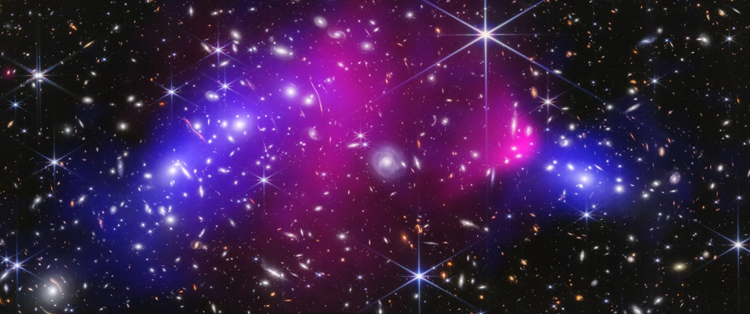 Image from the James Webb Space Telescope of the inner region of the Bullet Cluster. Pink shows the hot gas; the distribution of dark matter is shown in blue. According to the new study, neutron stars and black holes would explain the gravitational lensing effect. Image Credit: NASA, ESA, CSA, STScI, CXC; Science: James Jee (Yonsei University, UC Davis), Sangjun Cha (Yonsei University), Kyle Finner (Caltech/IPAC).
The Bullet Cluster has traditionally been regarded as evidence supporting the existence of dark matter.
Approximately 4 billion years ago, a significant collision occurred in space. Two galaxy clusters, each comprising hundreds of galaxies, collided at speeds exceeding 2,500 kilometers per second. These galaxy clusters host billions of stars, yet the majority of their visible matter is composed of interstellar gas.
As the two gas clouds traversed one another, they experienced considerable deceleration due to frictional forces and were also heated to high temperatures. X-ray telescopes reveal the hot clouds as two diffuse patches that are relatively close to each other when viewed from Earth.
A Cosmic Test of Dark Matter
During the collision, the galaxies in the two clusters passed through one another largely unhindered because the distances between individual stars are immense. In contrast, the interstellar gas within the clusters collided and slowed, becoming separated from the galaxies. As a result, the two galaxy clusters now lie on either side of the gas clouds, forming a structure known as the Bullet Cluster.
The Bullet Cluster is considered one of the strongest pieces of evidence for dark matter. Images of the system reveal that more distant galaxies appear distorted into crescent-like shapes due to gravitational lensing, an effect predicted by Albert Einstein in which massive objects bend light.
Surprisingly, the strongest lensing signal does not originate from the bright gas clouds, where most of the visible matter resides. Instead, it is concentrated around the galaxy clusters themselves, despite their relatively low visible mass. This discrepancy suggests that a substantial amount of additional, invisible matter is present in the system, providing a compelling case for the existence of dark matter.
This observation has so far been considered evidence of the existence of dark matter.
Dr. Pavel Kroupa, Professor, Helmholtz Institute of Radiation and Nuclear Physics, University of Bonn
This is because dark matter is thought to exert gravitational influence without interacting with normal matter in other ways. As a result, it passes through collisions unaffected, staying aligned with the galaxies rather than the gas.
Alternative Theory can also Explain the Observations
Although dark matter is widely accepted as the leading explanation for a range of astrophysical observations, it has never been detected directly. More than four decades ago, physicist Mordehai Milgrom proposed an alternative framework known as Modified Newtonian Dynamics (MOND), which seeks to explain these observations without invoking dark matter. The theory has remained outside the mainstream, however, largely because it was thought to be unable to account for key observations of the Bullet Cluster, long regarded as one of the strongest pieces of evidence for dark matter.
However, we show in our study that, on the contrary, the Bullet Cluster is actually particularly consistent with the MOND scenario.
Dong Zhang, Professor, Helmholtz Institute of Radiation and Nuclear Physics, University of Bonn
Zhang, a colleague of Kroupa, carried out a large proportion of the calculations.
New observations from the James Webb Space Telescope have enabled researchers to estimate the number of stars in both galaxy clusters with greater precision. The team also incorporated evidence showing that the Bullet Cluster contains significant quantities of heavy elements, including iron and oxygen. Because these elements are forged in the cores of massive stars and dispersed during stellar explosions, their abundance provides important clues about the cluster’s stellar population and evolutionary history.
“If massive stars eventually burn up, they become neutron stars or black holes. Like dark matter, both are invisible and can only be detected by the huge gravitational forces that they exert,” explained Zhang.
Only Half as Much Dark Matter – or None at All?
Co-author Dr. Indranil Banik from the University of Portsmouth demonstrated that the gravitational lensing effect observed can be accounted for by the newly determined quantity of visible stars, neutron stars, and black holes.
The remnants of massive stars take on the role of dark matter to a certain extent in the MOND scenario. Even in the standard model, which assumes the existence of dark matter, its postulated quantity would have to be significantly reduced – by around half.
Dr. Pavel Kroupa, Professor, Helmholtz Institute of Radiation and Nuclear Physics, University of Bonn
The physics professor from Bonn believes that the present research significantly enhances the plausibility of the MOND scenario.
Sponsorship
The study included the Universities of Bonn, Portsmouth (UK), Yonsei (Seoul), Prague (Czech Republic), Wuppertal, and Nanjing (China), as well as visiting researchers from the Institute for Advanced Studies in Basic Sciences (IASBS) located in Zanjan (Iran) and the Institute for Research in Fundamental Sciences (IPM) based in Tehran (Iran).
Funding for this study was provided by the China Scholarship Council, a Royal Society University Research Fellowship, the Alexander von Humboldt Foundation, the Czech Grant Agency, the German Academic Exchange Service (DAAD), and the German Research Foundation (DFG).
Download the PDF of this page here
Journal Reference:
Dong, Z., et al. (2026) Baryonic mass budgets in the central regions of the Bullet Cluster and their consistency with strong lensing in MOND. Physical Review D. DOI: 10.1103/6zrp-q7c4. https://journals.aps.org/prd/accepted/10.1103/6zrp-q7c4.