Astrophysicists from Nanjing University and the University of Bonn have shown that the mass of newly formed stars inside a star cluster is actually controlled by a specific process of self-regulation rather than being random. The journal Research in Astronomy and Astrophysics published the study.
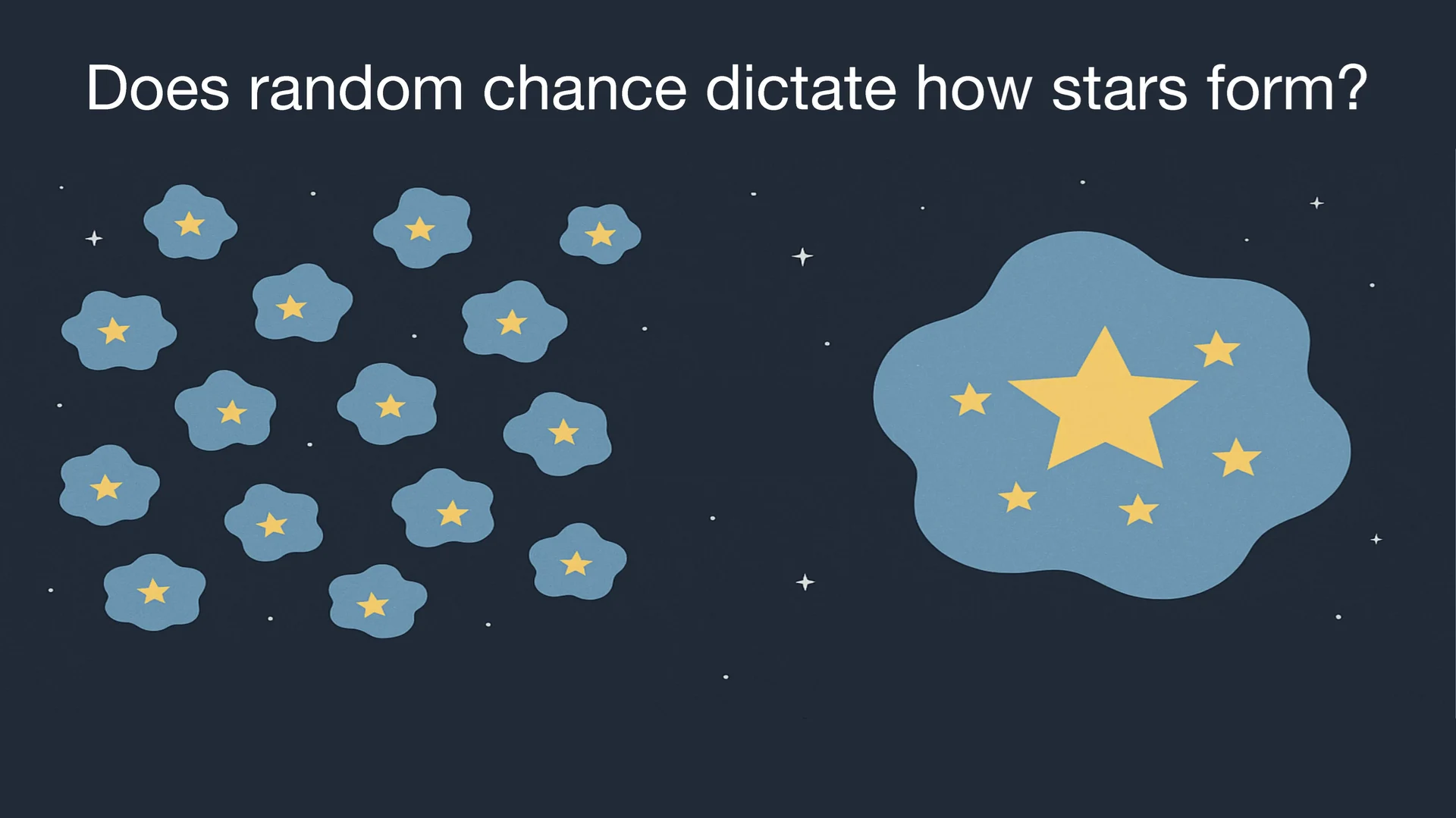 A large number of small molecular clouds (left) cannot form the same population of stars as one very large cloud (right). This has a significant influence on the evolution of galaxies. Image Credit: © Eda Gjergo
When a galaxy welcomes new stars, they normally form in star clusters within massive gas clouds. Some of the stars in these clusters are small, cool, and dim, while others have ten times the mass and a hundred thousand times the brilliance of the Sun, but they also have a shorter lifespan. The luminosity of a galaxy is significantly impacted by these variations in initial mass.
“The total mass of a dwarf galaxy is relatively low, so it won’t produce any extremely massive stars that’d be brighter than our Sun,” explains Professor Pavel Kroupa from the Helmholtz Institute for Radiation and Nuclear Physics at the University of Bonn, who is also a member of its Transdisciplinary Research Area (TRA) “Matter”.
By contrast, very massive elliptical galaxies, which formed almost 10 billion stars in just 10 million years during the early stage of the Universe, generate millions of these ultra-bright stars.
Pavel Kroupa, Professor, Helmholtz Institute for Radiation and Nuclear Physics, University of Bonn
Every single star in a cluster has a random mass. Kroupa and his then-doctoral student, Carsten Weidner, tested this premise in 2006. They found that the mass of the star cluster determines the mass of the most massive star.
In order to compute the distribution of stars in a young population, Kroupa developed a concept known as optimum sampling using the pair's discovery.
When stars are formed from a gas cloud, their masses aren’t decided at random but follow a precise order that leaves no room for statistical fluctuations. This can only happen if the star-formation process is extremely self-regulating.
Pavel Kroupa, Professor, Helmholtz Institute for Radiation and Nuclear Physics, University of Bonn
However, physicists were unable to explain this self-regulation until recently. The study's primary author, Dr. Eda Gjergo of Nanjing University in China, has now developed a method that uses Shannon entropy, also called information entropy, to explain how a star cluster forms in accordance with a particularly effective principle.
As Dr. Eda Gjergo details: “Out of all the possible mass distribution scenarios, what actually plays out is the one that’s the most natural for large scales and the least dependent on microscopic details.”
The work is opening up a new way of formulating theories about star populations. We now only need to have a number, namely the mass of the star population, in order to know what kinds of stars and how many of them will form from a gas cloud. This is enabling us to make highly efficient calculations about the evolution of galaxies, because we no longer have to perform thousands of calculations for a single one, saving much of supercomputing time and thus energy as well.
Pavel Kroupa, Professor, Helmholtz Institute for Radiation and Nuclear Physics, University of Bonn
Consequently, numerous calculations pertaining to the evolution of galaxies will have to be redone: “Contrary to what the previous theory suggested, small dwarf galaxies do not form any massive stars, and this has a fundamental impact on the theory of the matter cycle in the Universe,” Kroupa adds.
According to Nanjing University co-author Professor Zhiyu Zhang, "these findings will lead to observation projects in order to study the non-random formation of stars in greater detail."
The National Natural Science Foundation of China, the Program for Innovative Talents, Entrepreneur, the DAAD–Eastern European Exchange Program between Bonn and Prague, and the Czech Science Foundation provided funding for the study, which involved Nanjing University, the University of Bonn, and Charles University Prague.
Journal Reference:
Gjergo, E., et al. (2026) The Initial Mass Function as the Equilibrium State of a Variational Process: Why the IMF Cannot be Sampled Stochastically. Research in Astronomy and Astrophysics. DOI: 10.1088/1674-4527/ae4600. https://iopscience.iop.org/article/10.1088/1674-4527/ae4600.