Quantum computing promises unprecedented speed and efficiency for complex simulations and optimization as qubits scale. However, a newly highlighted obstacle threatens this progress. According to research from the Helmholtz-Zentrum Dresden-Rossendorf (HZDR) in the New Journal of Physics, the quantum Zeno effect can cause computational processes to completely "freeze" under extreme conditions as qubit counts increase.
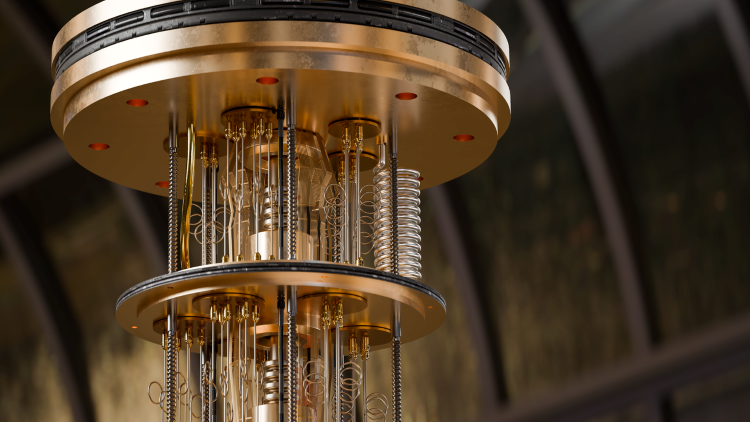 A quantum computer's cooling system keeps its quantum chips at temperatures close to absolute zero. Only under these conditions can the chips exhibit the quantum properties that make quantum computing possible (artistic impression). Image Credit: B. Schröder/HZDR
Quantum computing promises to solve complex problems faster and more energy-efficiently than today's most advanced supercomputers, with applications ranging from molecular simulation to logistics optimization. As the number of qubits, the fundamental processing units of quantum computers, continues to grow, this goal is becoming increasingly achievable.
The quantum Zeno effect is a previously overlooked obstacle to a certain class of quantum computers.
Dr. Gernot Schaller, Lead of Quantum Technologies, Institute of Theoretical Physics, Helmholtz-Zentrum Dresden-Rossendorf
Adiabatic quantum computers operate differently. Their qubits remain in the ground state, the lowest-energy state, throughout the computation. To solve a problem, the system's energy landscape is gradually modified at a sufficiently slow rate for the qubits to continuously adapt and remain in the evolving ground state. Once this process is complete, the final ground state directly encodes the solution.
Adiabatic algorithms are considered robust and can be executed by quantum computers largely independently of the hardware that is used.
Ralf Schützhold, Professor and Institute Director, Helmholtz-Zentrum Dresden-Rossendorf
Consequently, it does not matter whether qubits are produced via solid-state superconductors or single ions held in electromagnetic traps. Both variants are currently utilized for evaluating adiabatic algorithms, which offer elegant and straightforward programming.
When Disturbances Become an Issue
“However, a quantum computer can only function properly if its qubits are not disturbed too much,” Schützhold underlines.
Safeguarding the system by shielding it against electromagnetic radiation and cooling it to near-absolute-zero temperatures (–273.15 °C) helps insulate the qubits from interference.
Only under these conditions can they assume every possible state between zero and one, a behavior termed superposition. Furthermore, their quantum-mechanical link, known as entanglement, remains exceptionally vulnerable to outside interference. The combined dynamic of superposition and entanglement alone enables the rapid resolution of intricate challenges.
But despite all these measures, environmental impacts on the qubits can never be fully eliminated.
Ralf Schützhold, Professor and Institute Director, Helmholtz-Zentrum Dresden-Rossendorf
Based on the theoretical framework developed by Schützhold's group, adiabatic quantum computers become increasingly vulnerable to interference as they scale in size and qubit capacity. This occurs because an increased count of interconnected qubits reduces the energy landscape shifts they must track.
“This is where the quantum Zeno effect kicks in,” remarks Schaller. Consequently, even minute environmental factors can alter the quantum states of the qubits. “Each disturbance acts like an unwanted measurement, slowing down the system’s evolution,” Schaller notes. “In the worst case, a calculation could even freeze completely.”
To clarify the concept, a comparison can be drawn to baking: a cake requires undisturbed oven time to rise properly. Frequently unlatching the oven door to monitor progress disrupts baking, causing the cake to remain flat.
The quantum Zeno effect operates in a similar way. Each interaction disturbs the natural evolution of the quantum state. When such disturbances occur too frequently, the system cannot reach the intended final state. In extreme cases, the computation effectively comes to a halt .
Engineers building quantum computers can implement strategies to mitigate the quantum Zeno effect, such as improving thermal and electromagnetic radiation insulation. Within the cake analogy, this corresponds to securing the oven door with a lock.
Schützhold additionally suggests active intervention strategies: “Using the spin-echo method, we can apply coherent pulses to reduce the coupling of qubits to their environment.” In the baking context, the oven would quickly increase temperature briefly to offset each instance of opening the door. “Our study shows that we can only develop powerful quantum computers when we factor in environmental impacts from the very beginning,” Schützhold concludes.
Journal Reference:
Ahmadiniaz, N., et al. (2026) Quantum Zeno effect versus adiabatic quantum computing and quantum annealing. New Journal of Physics. DOI:10.1088/1367-2630/ae6e68. https://iopscience.iop.org/article/10.1088/1367-2630/ae6e68.