When a gravitational wave passes through the Earth, the LIGO, Virgo and KAGRA detectors are ready to detect it, but their sensitivity depends on many factors and it is possible that one of them may not be operating at full capacity at that moment. In moments like these, it is essential to be able to process the data collected by that detector to improve its quality, and the network of detectors now has a new efficient tool to do so: Astro Calibration.
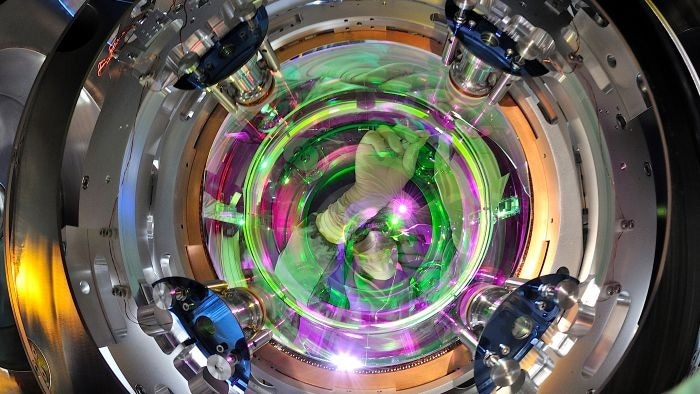 Image Credit: European Gravitational Observatory
Gravitational waves distort space, stretching and compressing it as they pass through. This effect on the detector arms is around 10-19 m, far smaller than the diameter of a proton! To be sensitive to such tiny changes, the detectors must be carefully calibrated in real time, using feedback control circuits and a precise procedure that models how the detector changes as the waves pass through it, whilst also taking into account the effects generated by the control circuits themselves. If the calibration is not optimal, the ‘reading’ of the signal and therefore the interpretation of the cosmic phenomenon that generated it are compromised.
However, if the gravitational signal detected is sufficiently strong – that is, when it clearly outweighs the background noise – comparing the signal to predictions from general relativity (together with comparison of the signals observed in other detectors), can be used to recalibrate the data from a ‘mis-tuned’ detector retrospectively.
Theoretical models are, in fact, like musical scores that suggest the shape of the signal (i.e. which notes the signal plays); together with data from well-‘tuned’ detectors, they allow us to clean the data from the poorly calibrated detector of spurious effects, thereby recording it correctly. The process is similar to how music-production software such as auto-tune can correct a singer’s errant pitch to meet the intended note in a melody.
“Gravitational waves are ripples in spacetime that stretch and squeeze space. They are tiny by the time that they reach the Earth, millions of years after the events that first created them - said Christopher Berry, researcher of the University of Glasgow’s Institute for Gravitational Research - “They are not something which we can hear, but our detectors can output the signals as waveforms that we can increase in pitch to listen to, with each signal producing their own distinctive chirp. Those chirps encode a wealth of information we can analyse to learn about their sources - their masses, spins, distance, and location.
Specifically in the case of the merger of two black holes, the astrophysical calibration technique works because the characteristic ‘chirp’ of the signal is described with extreme precision by Einstein’s theory of general relativity.”
In an article accepted in Physical Review Letters researchers from the LIGO–Virgo–KAGRA (LVK) Collaboration demonstrate how this technique has been applied to two particularly intense and interesting signals, GW240925 and GW25020, where, as always, the signal name indicates the date of the detections, which were detected in September 2024 and February 2025 respectively. At the time both these signals arrived, the LIGO Hanford detector (in Washington, USA) was not in optimal condition, making the interpretation of its data particularly difficult.
By comparing the predicted signals with the observed ones, the researchers were able to draw precise conclusions about how the LIGO Hanford detector distorted the data collected simultaneously by the LIGO Livingston detector in Louisiana and the Virgo detector in Italy. For GW240925, this method confirmed the known calibration errors measured on-site. For GW250207, however, it was essential to resort to astro calibration as no reliable on-site calibration measurements were available.
Using the corrected calibration for the LIGO Hanford detector, LVK researchers have discovered that GW240925 was generated by black holes with masses 9 and 7 times that of the Sun at a distance of approximately 350 megaparsecs from Earth, whilst GW250207 was generated by two black holes with masses 35 and 30 times that of the Sun at a distance of approximately 200 megaparsecs from Earth. Without taking calibration uncertainties into proper account, these estimates could have been biased towards an incorrect value.
Elisa Maggio, a researcher from the Italian Institute for Nuclear Physics and former postdoc and Marie Curie Fellow at the Max Planck Institute for Gravitational Physics (Albert Einstein Institute) in Potsdam said: "These discoveries demonstrate that, over a decade of work since the first detection, we have developed a comprehensive understanding of the entire analysis pipeline, from the signals themselves to the detector behavior. In the rare instance that something goes wrong with one detector, we now have robust methods to leverage data from the other detectors to give us the best-quality results. This information is crucial to recognize false deviations from general relativity arising from the unmodeled detector’s behavior."
Benoît Revenu from the Nantes Subatech laboratory said: “It is remarkable that these immense cosmic events can not only be measured by our instruments, but can also be used to verify our measurements. The fact that we have successfully utilized astrophysical calibration demonstrates the maturity of gravitational wave detectors’ capabilities and how we are moving from the era of initial discoveries to the era of precision gravitational wave astronomy. Moreover, the catalogue of gravitational wave detections is growing ever more rapidly, and in a few weeks’ time we will publish a new chapter, with new observations that further deepen and expand our understanding of the Universe and its most violent phenomena.”