A team at the University of Arizona's Steward Observatory, led by Weizhe Liu and Xiaohui Fan, reported in Nature that they have discovered an unprecedented number of extraordinarily powerful and fast galactic "winds" streaming from quasars just one billion years after the Big Bang (the universe is currently 13.8 billion years old).
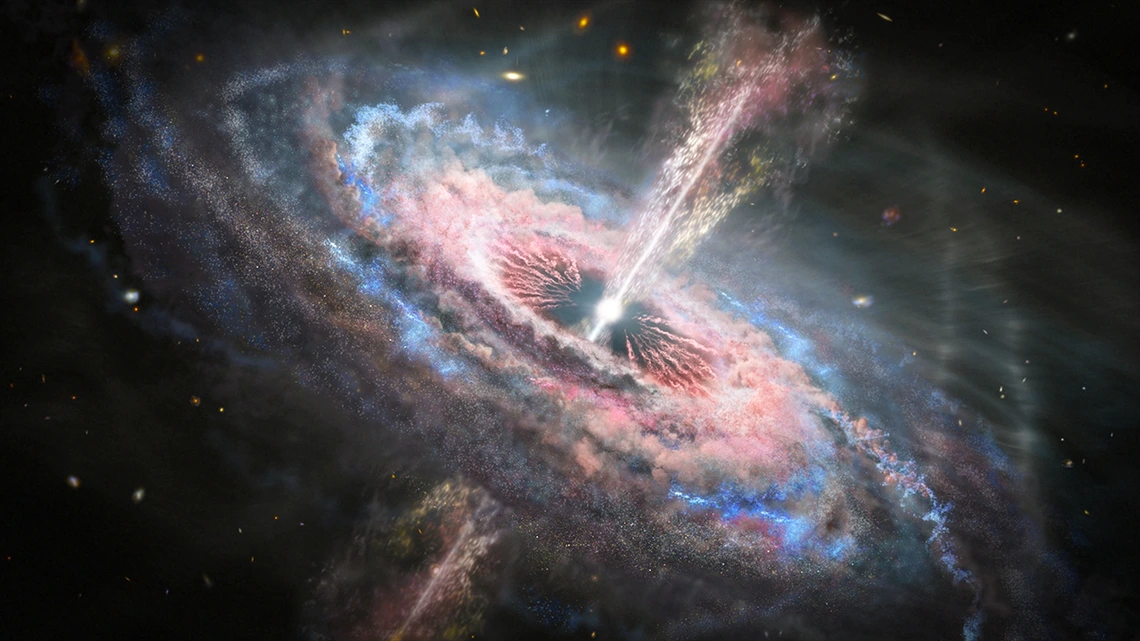 This artist's concept depicts a distant galaxy with an active quasar at its center. The "quasar winds" are propelling hundreds of solar masses of material outward into the galaxy disk each year. This affects the entire galaxy as the material snowplows into surrounding gas and dust. Image Credit: NASA, ESA, and J. Olmsted (STScI)
Astronomers have discovered that most, if not all, galaxies contain supermassive black holes at their centers. As observatories have become more powerful, scientists have been able to look farther back in time, bringing the observable edge of the universe closer to the Big Bang. It has become increasingly clear that black holes play an essential role in the formation and evolution of galaxies, but exactly how and why remains one of the biggest unanswered questions in cosmology and astrophysics. Many researchers have spent countless nights trying to understand the connection.
Massive amounts of energy are released as the supermassive black hole at the center of a quasar galaxy devours matter. Quasars are thought to be the most energetic objects in the cosmos, and they frequently outshine all other light sources in their host galaxy.
Another cosmological mystery may be solved by the study: astronomers discovered an unexpectedly large number of young galaxies that stopped forming stars early on at very high "redshifts", the furthest reaches of space and time, in this case, within about two billion years after the Big Bang.
"Many of those galaxies looked 'old' in the sense that they had stopped forming stars long before it would be expected," said Liu, the paper's first author and a JASPER postdoctoral scholar at Steward Observatory.
How could they have formed so early and become so massive when they quit star formation so early? That surprising discovery challenged our current paradigm of galaxy evolution, and that was one of the main motivations behind our paper.
Weizhe Liu, JASPER Postdoctoral Scholar, Steward Observatory, University of Arizona
The likely culprit behind this process is known as “quenching.” According to cosmological simulations, quasars can destroy a galaxy’s gas supply through their intense energetic activity, effectively shutting down the star-formation process. However, because so few quasars of the appropriate age had been observed, astronomers lacked definitive evidence, until today.
JWST Observations
The U of A-led team searched the high-redshift universe for quasars using the James Webb Space Telescope and discovered 27 of them from a billion years after the Big Bang. According to Liu, six of them were distinguished by extraordinarily fast galaxy-scale winds that reached speeds of up to 5,000 miles per second, which is incredibly fast even for a quasar.
According to the survey, quasars with exceptionally rapid outflows were at least four times more frequent at higher redshifts than at lower ones, and their average kinetic energy outflow rate was almost 100 times higher than that of quasars at lower redshifts.
"In other words, quasars with extreme outflows were much more common in the early universe and became scarcer over time, which is surprising," said Fan, a Regents Professor and associate head of the Department of Astronomy who is the paper's second author.
According to the team, these “super quasars” may help explain the large number of galaxies that stopped forming stars in the early universe. Fan explained that while some quasars produce prominent particle jets that typically shoot outward in opposite directions, scientists have long understood that these jets are not responsible for expelling gas from a galaxy.
Those jets move at speeds close to the speed of light. They essentially just punch a narrow hole into the galaxy. In contrast, the outflows we are talking about here are more like stellar wind, and we think they could be driven in many directions by radiation pressure from the quasar's extreme bright light.
Xiaohui Fan, Regents Professor and Associate Head, Department of Astronomy, University of Arizona
Additionally, the scientists calculated that the severe outflow quasars seem to have a very limited lifespan, going quiet after roughly 100 million years and leaving behind a quiescent galaxy. They calculate that a galaxy with an intense outflow quasar at its center would lose thousands of solar masses of gas annually.
"That is a very high rate of mass loss," Liu said. "Apply that over the course of at least a million years, and you will see you can remove a lot of gas from an entire galaxy over a relatively short period of time."
The Space Between Galaxies
Liu and his colleagues think that because these outflows are so swift, they may be able to leave the galaxy and potentially enter the intergalactic medium, which is the region between galaxies.
In other words, these quasars could affect not only their host galaxies, but beyond, with their effects felt possibly hundreds of thousands of light-years away.
Weizhe Liu, JASPER Postdoctoral Scholar, Steward Observatory, University of Arizona
According to Fan, the observations of severe outflows offer a crucial connection between supermassive black holes and galaxies.
"These winds are a direct result of the black hole growing by accreting mass, and later, and when the black hole stops growing, the winds subside as well," he added. "So, we're seeing the direct interactions between the black holes and the galaxies in which they reside, during at early time of the universe."
The results also provide a potential explanation for how galaxies can stop forming stars at such an early stage of the universe. Compared to their more developed, spiral cousins today, early galaxies were probably more compact, "gassier," and "clumpier." According to Liu, this has significant ramifications for how a galaxy interacts with its supermassive black hole.
"It is much easier for a quasar to interact with the gas around it if the gas is denser and distributed all around it rather than confined to a thin disk," Liu noted.
The structure composition of the galaxies would have made it even simpler for a quasar to remove more gas from its galaxy more quickly and efficiently, especially when combined with the higher outflow rates from an exceptionally fast-accreting quasar.
"In short, the impact of the black holes on their host galaxies through this process would have been more effective than in an older, more evolved galaxy in the later universe," he added.
Journal Reference:
Liu, W., et al. (2026) Extreme galaxy-scale outflows are frequent among luminous early quasars. Nature. DOI: 10.1038/s41586-026-10477-9. https://www.nature.com/articles/s41586-026-10477-9.