According to research published in the journal Monthly Notices of the Royal Astronomical Society (MNRAS) by astrophysicists at the University of Lancashire, planets develop more easily around double stars than single stars.
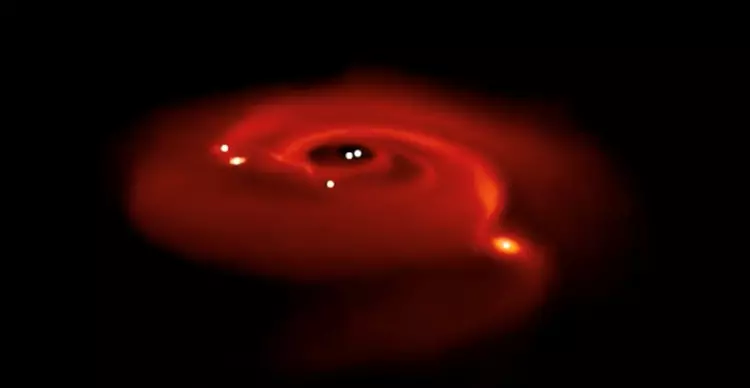 Computer simulation of planets forming in a disc around a binary star. Image Credit: University of Lancashire
Although binary stars are common throughout the galaxy, astronomers long believed that circumbinary planets (worlds that orbit two stars) would be harder to form because of the competing gravitational pull between the two suns.
The new study, however, raises the possibility that the opposite may be true.
The scientists modeled the development of gas disks around young binary stars using cutting-edge computer simulations. According to the calculations, the inner parts of these discs form a “forbidden zone” where planets cannot form due to intense gravitational forces. Beyond this region, however, the disk breaks apart due to its own gravity, creating several young planets, turning it into a stage for the development of massive planets.
Close to a binary star it’s simply too violent for planets to form. But move farther out and the disc becomes an ideal environment for planet formation.
Dr. Matthew Teasdale, PhD Student, University of Lancashire
The scientists discovered that discs surrounding binaries can produce more planets through fragmentation than discs around single stars, and a greater proportion of these objects end up as gas giant planets larger than Jupiter. Some planets can also be ejected from their systems, allowing them to wander freely across interstellar space.
Binary stars were once seen as hostile environments for planet formation. What we’re finding is that they can actually be extremely productive. Once you get past the danger zone, planets can form quickly and in large numbers.
Dr. Dimitris Stamatellos, Project Supervisor and Reader, Jeremiah Horrocks Institute, University of Lancashire
The findings suggest that circumbinary planets are more common than previously thought, and that gravitational instability, where massive discs fragment under their own gravity, may play a key role in how these planets form.
With over 50 circumbinary exoplanets already identified, including many with large orbits, the findings help explain how these worlds develop and survive. They also provide new opportunities for future observations with facilities like ALMA, the James Webb Space Telescope, and the planned Extremely Large Telescope (ELT).
While planets may struggle to survive near their twin Suns, further out these systems transform into dynamic planet-forming environments, suggesting that real-life Tatooines may be far less rare than we once imagined.
Dr. Dimitris Stamatellos, Reader, Jeremiah Horrocks Institute, University of Lancashire
Journal Reference:
Teasdale, M. and Stamatellos, D. (2026) The formation of circumbinary planets through disc fragmentation. Monthly Notices of the Royal Astronomical Society. DOI: 10.1093/mnras/stag476. https://academic.oup.com/mnras/article/548/3/stag476/8661676.