Astronomers using the James Webb Space Telescope found a surprising non-rotating galaxy from the early universe, challenging existing galaxy formation theories. The study was published in Nature Astronomy.
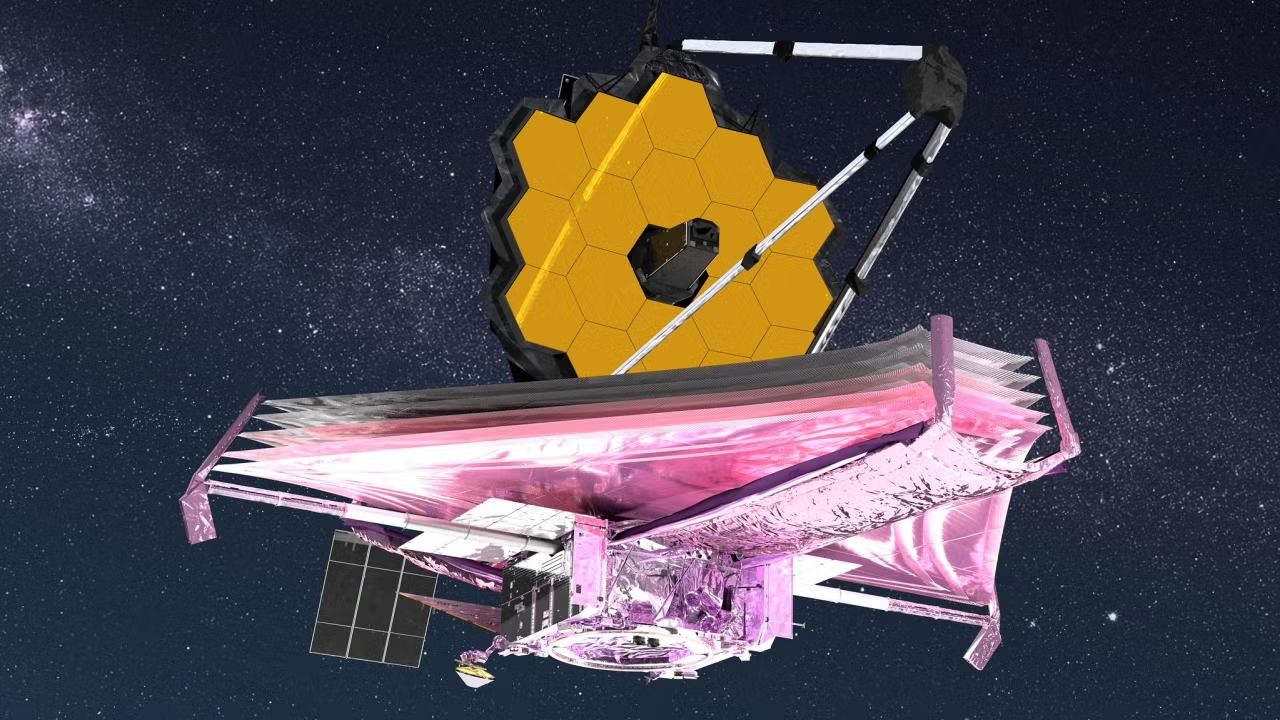 Using instruments on the James Webb Space Telescope, astronomers can measure the movement of mass inside galaxies less than two billion years after the Big Bang. To their surprise, astronomers discovered a galaxy that is not rotating as would be expected at that age of the Universe. Artist conception of the JWST in space. Image Credit: GSFC/CIL/Adriana Manrique Gutierrez by NASA.
This phenomenon is typically observed only in large, well-evolved galaxies that are relatively nearby in space and time, said Ben Forrest, a research scientist in the Department of Physics and Astronomy at the University of California, Davis.
This one in particular did not show any evidence of rotation, which was surprising and very interesting.
Ben Forrest, Research Scientist, Department of Physics and Astronomy, University of California, Davis
Current ideas suggest that angular momentum from inflowing gas and gravity caused the first galaxies to spin as they formed.
Certain galaxies, particularly those in galaxy clusters, repeatedly fused with one another over billions of years, adding to or partially canceling each other's spins. Because of this, some galaxies that are nearest to Earth (and thus relatively new) may exhibit a lot of random star movement but minimal overall rotation.
It is unexpected that galaxy XMM-VID1-2075 had reached this state when the cosmos was less than 2 billion years old, because this process should take a very long period.
This galaxy was originally seen by Forrest and colleagues using the W.M. Keck Observatory in Hawaii as part of the MAGAZ3NE (Massive Ancient Galaxies at z>3 NEar-Infrared) survey.
Previous MAGAZ3NE observations had confirmed this was one of the most massive galaxies in the early universe, with already several times as many stars as our Milky Way, and also confirmed that it was no longer forming new stars, making it a compelling target for follow-up observations.
Ben Forrest, Research Scientist, Department of Physics and Astronomy, University of California, Davis
Pushing the Frontiers
The scientists examined XMM-VID1-2075 and two other galaxies of comparable age in greater detail using the James Webb Space Telescope. The relative mobility of the stuff within them might be measured.
“This type of work has been done a lot with nearby galaxies because they're closer and larger and so you can do these kinds of studies from the ground, but it's very difficult to do with high redshift galaxies because they appear a lot smaller in the sky,” Forrest said. “(James Webb Space Telescope) is really pushing the frontier for these kinds of studies.”
According to Forrest, of the three galaxies they examined, one is obviously rotating, one is "kind of messy," and one has a lot of random motion but no rotation.
That’s consistent with some of the most massive galaxies in the local universe, but it was a bit surprising to find it so early on.
Ben Forrest, Research Scientist, Department of Physics and Astronomy, University of California, Davis
In fewer than two billion years, how did this galaxy become a "slow rotator?" One idea is that it was caused by a single collision between two galaxies that were rotating essentially in opposing directions rather than by several mergers. The team's observations corroborate that theory.
“For this particular galaxy, we see a large excess of light off to the side. And so that's suggestive of some other object which has come in and is interacting with the system and potentially changing its dynamics,” Forrest said.
In the early universe, astronomers are still searching for such things. They can test galaxy formation ideas by contrasting their observations with simulations.
“There are some simulations that predict that there will be a very small number of these non-rotating galaxies very early in the universe, but they expect them to be quite rare. And so this is one way in which we can test these simulations and really figure out how common they are, and that can then give us information about whether our theories of this evolution are correct,” Forrest said.
Additional co-authors include Brian C. Lemaux (UC Davis and Gemini Observatory, Hawai'i); Adam Muzzin and Adit H. Edward (York University, Toronto); Danilo Marchesini, Richard Pan, and Nehir Ozden (Tufts University); Jacqueline Antwi-Danso (University of Toronto); Wenjun Chang (UC Riverside); M. C. Cooper and Stephanie M. Urbano Stawinski (UC Irvine); Percy Gomez (W. M. Keck Observatory, Kamuela, Hawai'i).
Lucas Kimmig and Rhea-Silvia Remus (Ludwig-Maximilians-Universität München, Germany); Ian McConachie (University of Wisconsin–Madison); Allison Noble (Arizona State University); and Gillian Wilson and M. E. Wisz (UC Merced) also contributed to the study.
NASA, the Space Telescope Science Institute, and the National Science Foundation all provided funding for the project.
Journal Reference:
Forrest, B., et al. (2026). A massive and evolved slow-rotating galaxy in the early Universe. Nature Astronomy. DOI: 10.1038/s41550-026-02855-0. https://www.nature.com/articles/s41550-026-02855-0.