Kerr optical frequency combs are compact light sources used in many applications, including precision measurements to high-speed communications. However, accurately simulating how they operate remains challenging as device designs become more complex. In a recent study, researchers from the USA developed a simulation framework that directly solves Maxwell’s equations, reproducing known comb dynamics while capturing subtle effects beyond the reach of conventional modeling approaches.
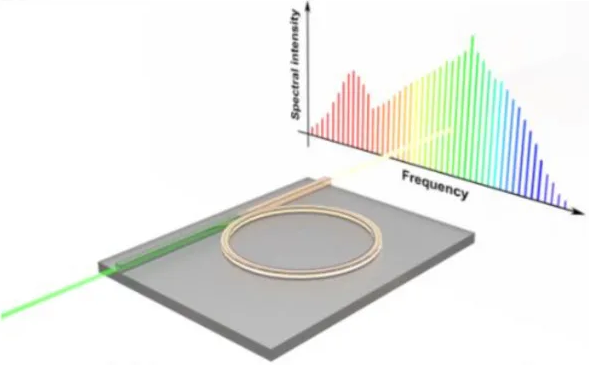 A pulsed laser excites a microresonator to generate evenly spaced optical frequencies used in applications such as spectroscopy, astronomy, and telecommunications. Image Credit: IEEE Photonics Society
Optical frequency combs generate many evenly spaced light frequencies for applications such as optical clocks, precision spectroscopy, and high-speed communications. They are produced in compact Kerr microresonators, but accurately simulating these devices becomes difficult as their designs grow more complex.
To address this issue, a research team led by Professor Zongfu Yu from the University of Wisconsin-Madison, USA, developed a new simulation framework for Kerr comb generation. Their study, published in the IEEE Journal of Selected Topics in Quantum Electronics on 29 January 2026, uses a computational approach that directly solves Maxwell’s equations–the fundamental equations describing electromagnetic waves.
Through simulations spanning over a billion grid points and millions of time steps, the researchers captured the full spatial and temporal evolution of light inside the resonator. They successfully reproduced the known stages of Kerr comb formation while also revealing subtle effects that conventional models cannot naturally capture, including detailed spatial field evolution and slight frequency mismatches between comb lines. “The promising accuracy of our simulations underscores the potential of full-wave modeling as a design tool for next-generation microresonator comb sources,” says Prof. Yu.
Unlike existing approaches, the new framework directly handles the geometry and material properties of a device without requiring additional modeling assumptions. This could make it easier to design sophisticated photonic components and better understand the processes involved in comb generation.
Beyond improving simulations, the framework also offers new insights into the physical processes that drive comb formation, making it a valuable tool for investigating next-generation integrated photonic devices. “We believe our results will be of interest for the further development of compact, integrated frequency comb devices and for advancing our understanding of nonlinear optical dynamics in microresonators,” concludes Prof. Yu.