Researchers at Waterloo have developed a novel approach to understanding how the universe originated, which could reshape current knowledge of the Big Bang and the earliest stages of cosmic history. Their findings, published in Physical Review Letters, indicate that the universe’s rapid initial expansion may have emerged naturally from a more fundamental and comprehensive theory of quantum gravity.
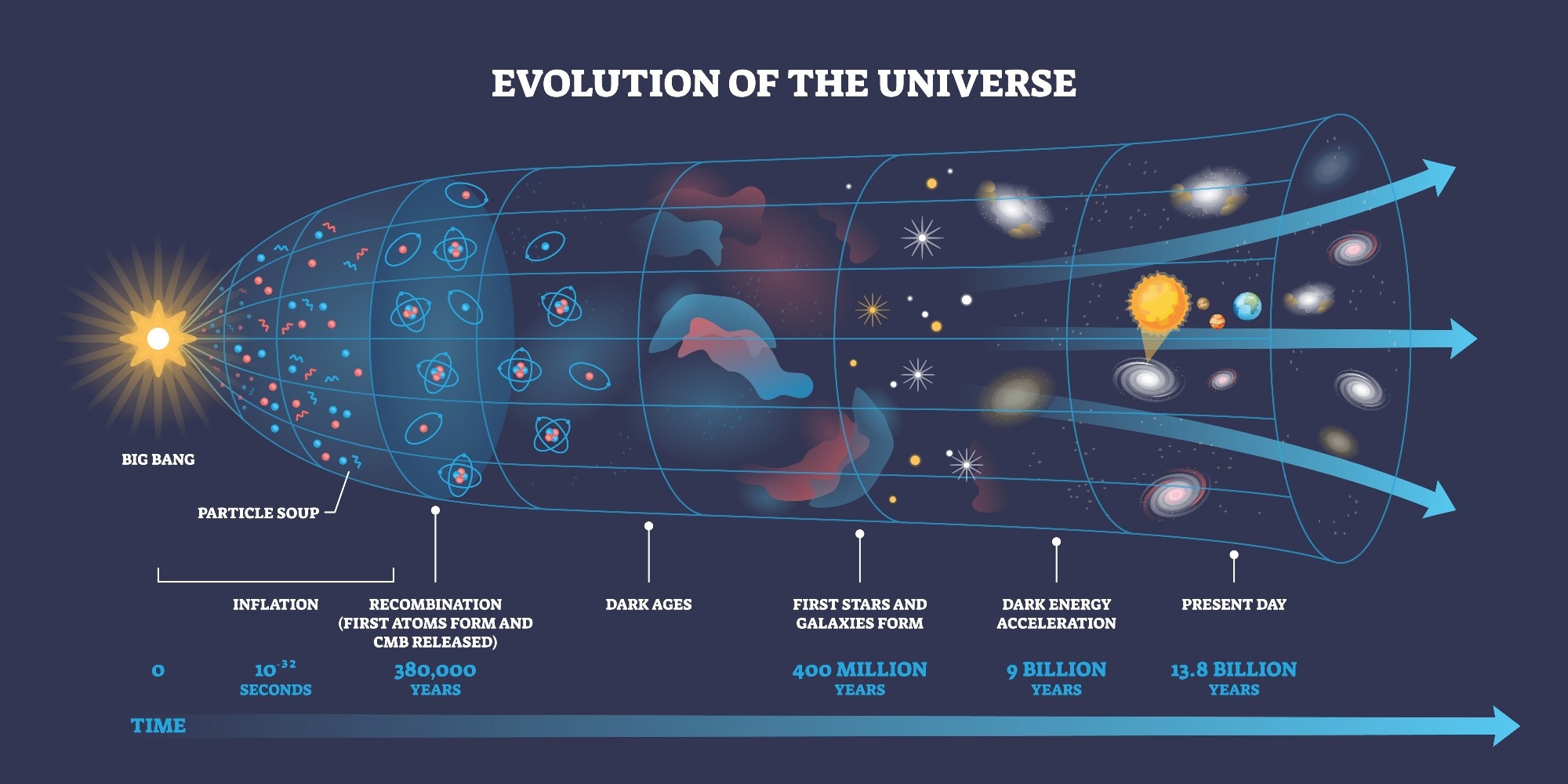
Image Credit: VectorMine/Shutterstock.com
Dr. Niayesh Afshordi, professor of physics and astronomy at the University of Waterloo and Perimeter Institute (PI), guided the research team that investigated a new approach to unifying gravity with quantum physics.
While general relativity has remained successful for over a century, it fails under the extreme conditions present at the origin of the universe. To address this issue, the team employed Quadratic Quantum Gravity, which remains mathematically consistent even at very high energies similar to those present during the Big Bang.
Most current explanations for the Big Bang depend on Einstein’s theory of gravity, along with additional elements introduced ad hoc. This new framework provides a more integrated picture that links the universe’s earliest moments to the well-established cosmological observations seen today.
The research group determined that the Big Bang’s rapid initial expansion can arise naturally from this straightforward, self-consistent theory of Quantum Gravity, without requiring any added components. This early phase of expansion, commonly known as inflation, is a key concept in modern cosmology because it explains why the universe appears as it does today.
The model also predicts a minimum level of primordial gravitational waves, which are small ripples in spacetime generated in the earliest moments after the Big Bang. These signals could be detected in upcoming experiments, providing a rare opportunity to test theories about the universe’s quantum origins.
This work shows that the universe’s explosive early growth can come directly from a deeper theory of gravity itself. Instead of adding new pieces to Einstein’s theory, we found that the rapid expansion emerges naturally once gravity is treated in a way that remains consistent at extremely high energies.
Dr. Niayesh Afshordi, Professor, Physics and Astronomy, University of Waterloo
The scientists were surprised by how experimentally verifiable their theory proved to be.
Even though this model deals with incredibly high energies, it leads to clear predictions that today’s experiments can actually look for. That direct link between quantum gravity and real data is rare and exciting.
Dr. Niayesh Afshordi, Professor, Physics and Astronomy, University of Waterloo
The timing of this work is important. Cosmology is entering a new era of precision, in which new instruments can measure the universe with unprecedented accuracy. Upcoming galaxy surveys, cosmic microwave background experiments, and gravitational wave detectors are becoming sensitive enough to test ideas that were once purely theoretical. At the same time, scientists are identifying limitations in the simplest models of early universe expansion, increasing the need for new approaches rooted in fundamental physics.
Ruolin Liu, a PhD student at the University of Waterloo and Perimeter Institute for Theoretical Physics, and Jerome Quintin, a lecturer at École de technologie supérieure and former postdoctoral scholar at Waterloo and PI, also contributed to this research.
The team intends to refine their predictions for upcoming experiments to examine how their framework relates to particle physics and other questions about the early universe. Their long-term objective is to reinforce the connection between quantum gravity and observational cosmology.
Sources:
Journal Reference:
Liu, R., et al. (2026) Ultraviolet Completion of the Big Bang in Quadratic Gravity. Physical Review Letters. DOI: 10.1103/6gtx-j455. https://journals.aps.org/prl/abstract/10.1103/6gtx-j455.
University of Waterloo